China-origin marble-look ceramic tile is listed at US$ 4.00-10.00 per square metre for 200x200 mm wall formats on Made-in-China, with a published MOQ of 100 m² [S4]. Scandinavian specialist AZ Tiles fronts an Italian portfolio — Refin Pedra Azul among the named collections — positioning that market as a design-led, premium-tier channel [S1]. The price gap between direct-from-Foshan and a curated European distributor is real, often 3-5x at retail, and it tracks raw material (porcelain vs red-body), surface finish (matte vs polished), and rectified edge geometry.
The cheapest unbranded offerings on [S4] rarely publish a PEI class or a body-type code; that is the first filter to apply before comparing price per m². See the Ceramic Tile 2026 Buying Guide: Specs, Price Bands and Sourcing Gates for a fuller spec matrix.
FOB price bands by format, body and finish
The Made-in-China hot-products feed for marble-look ceramic tile in 2026 is concentrated in Guangdong (Foshan) factories, with US$ 4.00-10.00 / m² for 8x8 inch (200x200 mm) non-slip wall tile and 600x1200 mm matte porcelain typically landing in the US$ 8-18 / m² band once MOQ reaches a full container [S4]. Premium 600x1200 mm skelo-textured porcelain from Diamond Member suppliers sits at the upper end of that range, with surface treatment (lapping, sugar-etch, digital-glaze) the principal cost driver rather than body composition. Buyers comparing quotes must normalise by box yield: a 600x1200 mm box is 1.44 m² nominal, 600x600 mm is 1.44 m², 800x800 mm is 1.92 m² — so per-box price looks higher for larger formats even when per-m² is lower.
For comparison, European distribution channels such as Ceramic Tile Co. (UK importer) and AZ Tiles (Scandinavia) source predominantly from Italian and Spanish presses, with retail price bands running roughly €25-80 / m² for branded porcelain [S1][S2]. The 3-5x multiplier over FOB China is not pure margin — it covers EN 14411 batch certification, breakage insurance on consolidated pallets, and design-line royalty. The procurement decision therefore pivots on whether the project needs a named designer line with documented batch control, or whether a Foshan OEM with audited-supplier status and a 100 m² MOQ is acceptable.
Production line, capacity and what dictates lead time
2026-era line builders such as Jiuding market large-storage blank stackers with 3D multi-layer architecture, claiming compatibility with high-speed presses and mixed tile sizes within a single buffer [S6]. That capacity math matters to a buyer: a single 20' container at 1,200-1,500 m² of 600x600 mm tile represents less than half a day of output on a mid-scale press, so factory lead time is dominated by kiln-firing cycle (50-70 minutes for porcelain at 1200-1230 °C) and queue, not raw throughput.
The standard purchase tip set for retail buyers — check appearance, dimensions, hardness, water absorption — maps directly to engineering gates: dimensional tolerance (EN 14411 ±0.5% on length, ±0.3% on thickness for calibrated tile), Mohs hardness ≥6 for floor use, and water absorption for body classification [S5]. A 2022-dated consumer guide remains useful for the inspection sequence [S5], though the underlying ISO 13006 / EN 14411 thresholds are unchanged. The procurement trap is treating cheap tile as commodity — breakage on a 25-day ocean voyage from Yantian can convert a US$ 6 / m² bargain into US$ 12 / m² landed cost, especially with 600x1200 mm formats where pallet stacking stress is concentrated at the corners.
Selection criteria: porcelain vs ceramic, glazed vs full-body
True porcelain (ISO 13006 Group Bla, water absorption ≤0.5%) is pressed from a finer kaolin-feldspar-quartz mix and fired hotter, which is why a 600x1200 mm porcelain slab is roughly 1.3-1.6x the FOB price of a same-format red-body ceramic [S4]. The trade is mechanical performance: Bla porcelain typically clears ≥35 N/mm² bending strength, suitable for high-traffic retail and light-commercial floors, while Group BIIa (ceramic, 3-6% absorption) is wall-only. Glazed porcelain carries a surface print of the marble pattern plus a transparent top-coat, while full-body (through-body or colour-body) porcelain disperses pigment through the full thickness so wear does not reveal a different sub-layer.
PEI rating (Porcelain Enamel Institute, classes I-V) is the second-axis decision: PEI II is residential wall/floor light traffic, PEI III is residential main floor, PEI IV is commercial light, PEI V is heavy commercial [S5]. For a hotel lobby or airport floor, PEI V with a ≥0.6 coefficient of friction (DCOF, per ANSI A326.3) is the minimum. Many sub-US$ 8 / m² China listings do not publish a PEI class; that omission alone disqualifies them for any commercial spec, and any retail spec on a floor over 50 m². The decision matrix therefore lines up as: (1) absorption group — Bla for floor, BIIa for wall, (2) PEI class — IV-V for commercial, III for residential, (3) DCOF — ≥0.42 for level interior, ≥0.50 for ramps and wet zones, (4) surface — polished for showrooms, matte or textured for general use.
Sourcing gates: MOQ, audit tier and payment terms
The Made-in-China listings in this category cluster around a 100 m² MOQ for stock designs, rising to 500-2,000 m² for custom colour or texture [S4]. Foshan JLA Ceramics is shown as a Diamond Member (Audited Supplier) on the platform, which adds a third-party financial and legal review; this is a meaningful gate for buyers who cannot visit the factory in person. For projects over 5,000 m², the typical buying route is a Foshan trading-house consolidator aggregating two or three presses, with 30% T/T deposit and 70% against copy of B/L. Alibaba's [S3] showroom lists full turnkey production lines alongside finished tile, which is worth knowing if you are sizing a new factory rather than buying for a project.
For European spec work, the sourcing reality is different: AZ Tiles in Scandinavia fronts named Italian collections (Refin, plus other designer lines) with batch-traceable supply chains [S1], and UK distributors like Ceramic Tile Co. position as specialist importers [S2]. Their unit cost is higher but they carry EN 14411 / CE-marked batches with documented slip and wear data, which most Chinese OEM listings do not. A pragmatic split is: use Foshan OEM for residential or light-commercial lots under 3,000 m² where PEI IV and a CE declaration of performance is obtainable, and reserve European distribution for projects where named-Italian-line aesthetics or batch documentation are written into the specification. For a cross-category view of how MOQ and audit-tier gates work in another China-led segment, see Desalination Suppliers 2026: China Listings, RO/Marine Price Bands, MOQ and Audited-Tier.
Use cases, failure modes and what not to buy

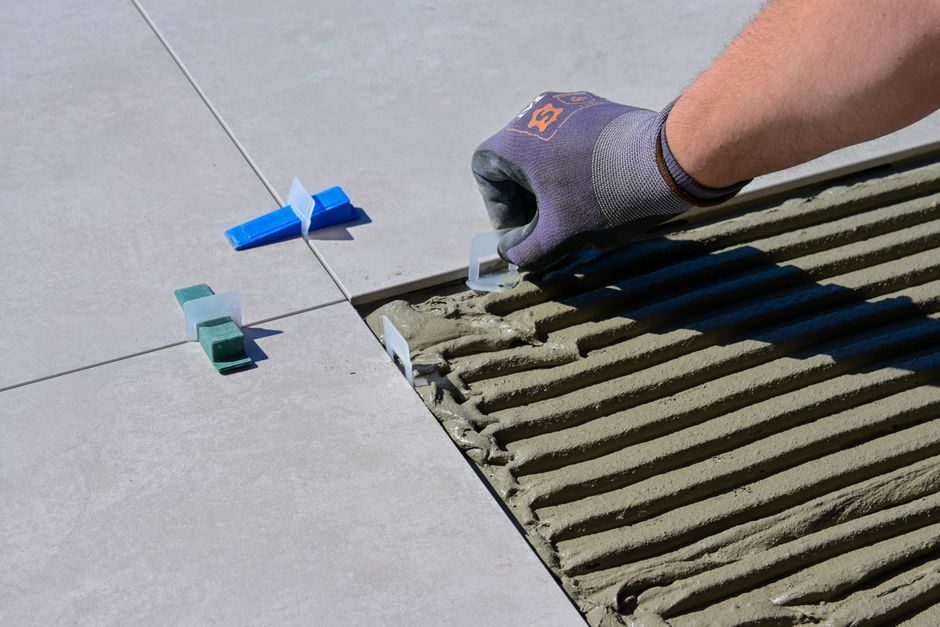
Ceramic tile is mechanically strong in compression but weak in tension across the body — a 600x600 mm tile supported only at corners will crack under a 150 kg point load. Installation failure modes are dominated by substrate prep: a tile laid on a non-deflection-rated subfloor will grout-crack within 6-18 months, and the failure will be attributed to the tile rather than the installer. Expansion joints are mandatory on any run over 8 m in either direction, and at all perimeter transitions per TCNA Handbook EJ-171. For wet zones (showers, commercial kitchens), specify a Class A waterproof membrane behind the tile; the tile itself is waterproof, the grout is not. [S1]
What not to buy: sub-US$ 4 / m² listings with no PEI class, no water-absorption figure, and no batch photo showing the actual print pattern repeat [S4]. What to buy for a generic floor: Bla porcelain at 9-10 mm thickness, PEI IV, DCOF ≥0.42, in a 600x600 or 600x1200 mm format with rectified edges for tight grout joints. For a design-led residential install, an Italian line via [S1] or a UK specialist via [S2] is the higher-cost but lower-risk route. For industrial or commercial-grade spec, treat ceramic tile as a sub-floor system, not a finish — the tile is the visible layer but the substrate, membrane, and joint pattern carry the long-term performance budget. For a broader view of process-engineered building products in 2026, see the Industrial Valve Production Technology: Process Map, Valve Types and Sourcing Reality overview of how Chinese OEM sourcing gates apply to other categories.
Trackable signals for the next 60-90 days: any new EN 14411 amendment covering ≥2 m slab formats, Chinese OEM MOQ drift on 600x1200 mm porcelain as oversupply pressure continues, and European distributor lead-time changes as Red Sea routing normalises further. Two practical checks before signing a PO — request the factory's EN 14411 test report with a batch number matching the production date, and ask for two reference addresses of projects over 2,000 m² installed for more than 24 months.
For component-level specifications, see ceramic tile, linear guide, and crossed roller guide.