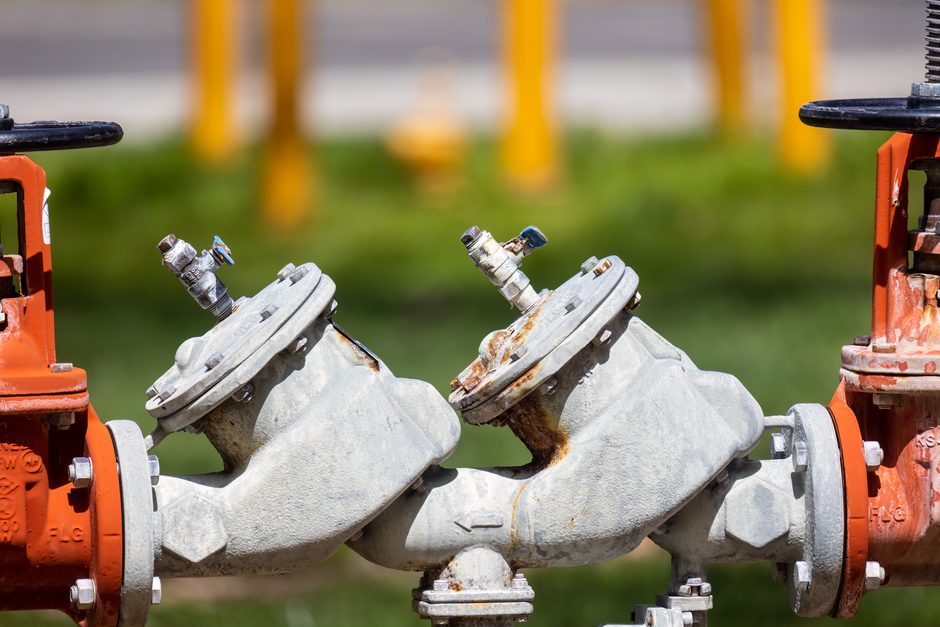
Industrial valve production is a four-stage process map — cast or forge the body, machine the seat and sealing surfaces, assemble the trim and actuator, then hydrostatically proof-test every unit before shipment [S1][S2][S5]. Bodies for general-service gate, globe and check valves are typically produced in carbon steel, stainless steel, alloy 20, duplex/super-duplex and bronze; the same SKU line usually covers ASME Class 150–600 ratings, with Class 900–2500 reserved for forged-steel units built for high-pressure steam and hydrocarbon service [S1][S5].
Self-aligning body geometry and rupture-pin technology — the design language Taylor Valve Technology has built its catalogue around — are used to keep the seat axis parallel to the pipe axis under thermal growth and to give a predictable, mechanical fail-safe trip point for emergency shutoff [S1]. A typical spec engineer evaluating an industrial valve line today will see solenoid, electric, pneumatic, control and safety-relief variants offered from the same factory, plus actuators and accessories, which is the bundled sourcing model Shanghai Best Automation Technology (66123456.com) and Alliance Industry Limited both list on their front pages [S4][S5].
Body Forming: Casting vs Forging, and Where Each One Wins
Casting dominates butterfly, gate and large-diameter globe bodies because sand or investment casting handles complex internal cavities (the disc seat of a butterfly, the wedge slot of a gate) more cheaply than forging once the bore exceeds roughly 2 inches / DN50 [S2][S5]. Forged bar bodies — turned from A105, A182-F11/F22/F304/F316 or LF2 stock — are reserved for Class 800+ service where the forging grain flow is needed to resist creep and shock loading, and where NACE MR0175 sour-service qualification requires controlled microstructures [S5]. Fortis Valve's product line, founded in the 2000s, lists butterfly, gate, check and globe families, which is the canonical cast-body mix for chemical, water and HVAC service [S2].
Material selection follows media, not pressure alone: stainless 304/316 for general water and chemical, 316L for welded hygienic lines, duplex 2205 / super-duplex 2507 for chloride-bearing service above 60 °C, alloy 20 / C276 for sulfuric and hydrochloric streams, and bronze or gunmetal for shipboard and fire-water lines where galvanic isolation matters [S1][S5]. Pressure class is set against ASME B16.34 valve design rules, with the rating stamped on the body and tied back to a documented pressure–temperature table.
Machining, Sealing Surfaces and Trim Hard-Facing
Seat leak-tightness to API 598 (soft seat) or Class V / Class VI (FCI 70-2) requires surface finishes in the 0.4–0.8 µm Ra range, achieved with CBN or PCD tooling on stainless bodies; for ball-valve seats, the polymer insert (PTFE, RPTFE, PEEK, Delrin) is then pressed or threaded in, which is why the same ball-valve SKU can be re-rated by swapping the seat rather than the ball [S5].
Trim components — stem, disc, seat ring, backseat — are hard-faced with Stellite 6, Stellite 21, Colmonoy 5 or tungsten carbide when the service is erosive, sour, or above ~400 °C; this is the single biggest lever a spec engineer can pull on a vendor data sheet, and it is the line item that separates a general-service valve from a qualified refinery unit [S5]. Self-aligning seat geometry, as marketed by Taylor Valve, is a body-side feature that lets the disc reseat concentrically after thermal cycling, which materially reduces wire-draw erosion on the sealing surfaces in steam and superheated hydrocarbon service [S1].
Actuation Stack: Solenoid, Electric, Pneumatic and Manual
Actuation is the second SKU axis: a single globe body can be sold bare-stem, with a handwheel, with an electric multi-turn actuator, with a pneumatic diaphragm or piston actuator, or with a solenoid pilot for on/off control [S4][S5]. Shanghai Best Automation Technology groups its catalogue into solenoid, electric, pneumatic, control, safety and ordinary valve families on the same homepage, which is the layout almost every Chinese one-stop valve platform uses [S4].
Solenoid valves are pilot-operated or direct-acting, typically rated 0–10 bar for pneumatic/water service with NBR, EPDM, FKM or PTFE seals, and are the default pick for instrument-air and clean-water on/off; electric actuators add 4–20 mA or 0–10 V positioner feedback and modulating duty, while pneumatic scotch-yoke or rack-and-pinion actuators are preferred for quarter-turn butterfly and ball duty because they deliver higher breakaway torque in a smaller envelope [S4][S5]. A spec team sizing one of these against an existing pipe run should read the companion pneumatic valve actuator 2026 buying guide for torque-derate curves and the 1.25–1.5× safety factor rule on breakaway torque.
Testing, Certification and the Audit Trail
Every valve leaves the line through a hydrostatic shell test (typically 1.5× the cold working pressure rating) and a seat leakage test to API 598 or FCI 70-2, with certificate-of-conformance, hydrostatic chart and material traceables in the dossier [S5]. For sour service, NACE MR0175 limits the materials, hardness (typically ≤ 22 HRC on wetted parts) and welding procedures; for offshore and subsea, PR2 documentation and DNV/ABS type approval sit on top of the same production line [S5].
Alliance Industry Limited explicitly markets "complete certification and approvals" as a sourcing pitch, and the same one-stop framing is used by Shanghai Best Automation Technology on its front page [S4][S5]. In practice that means the OEM holds ISO 9001, API 600 / API 6D monogram, CE / PED, ATEX for explosion-proof solenoid coils, and (for shipboard) CCS / DNV / LR / BV — and the cert list is the first filter a process engineer should apply before reading the price sheet.
Who This Process Map Is For — and Where It Breaks Down
This process map fits spec engineers and procurement teams evaluating gate, globe, ball, butterfly, check, solenoid, electric, pneumatic and safety-relief valves for general chemical, water, oil & gas, HVAC and OEM skid builds [S1][S2][S4][S5]. It does not fit exotic nuclear Class 1 safety valves, cryogenic LNG service, or ultra-high-pressure hydrogen compressor scrubbers, where the materials list, NDE regime (100% radiographic, magnetic-particle, liquid-penetrant) and traceability requirements are an order of magnitude heavier than the general-service stack covered here.
A direct line of comparison helps: cast-body gate/globe/butterfly (Fortis, Alliance, Taylor general line) wins on price and lead-time for Class 150–300 chemical and water service; forged-body gate/globe/Check (Alliance, Taylor high-pressure line) is the only correct answer above Class 600 or for sour NACE service; solenoid/electric/pneumatic (Shanghai Best Automation) covers instrument-air, skid OEM and modulating duty at Class 150–300; rupture-pin emergency shutoff (Taylor) is a different category altogether — a mechanical fail-safe trigger, not a modulating control element [S1][S2][S4][S5].
Adjacent Process Tech to Track Alongside Valve Sourcing
Valve production is downstream of metal casting and forging capacity, so steel production technology — BOF, EAF, continuous casting and seamless-pipe rolling — sets the lead-time and price floor for every carbon and low-alloy valve body on the market. The machining and assembly steps that consume most of the factory labour are increasingly being relocated onto additive manufacturing lines for prototype trim and complex internal flow paths, although the pressure-containing body is still almost universally cast or forged for cost reasons. [S1]
Trackable signals over the next procurement cycle: whether the OEM holds the full API 600 / API 6D monogram or only re-sells third-party bodies, whether the rupture-pin / self-aligning geometries are offered as standard catalogue SKUs or as engineered specials with longer lead-times [S1][S5], and whether solenoid and electric actuator lines carry ATEX/IECEx certification for Zone 1 — the most common spec-killer on European chemical-plant RFQs [S4][S5].
For component-level specifications, see industrial adhesive, and industrial borescope.