Chain conveyor line-item prices in 2026 are dominated by three levers: chain family and pitch, hourly throughput, and horizontal-versus-inclined run length, with European redler units commonly quoted in a 38–230 t/h bulk band [S4].
Specifying engineers should treat the chain itself — material, pitch and tensile rating — as the cost spine, then layer drive, frame and safety accessories on top, because the chain pitch and breaking load set both the sprocket size and the shaft torque a buyer must fund.
Cost spine: chain family, pitch and tensile rating
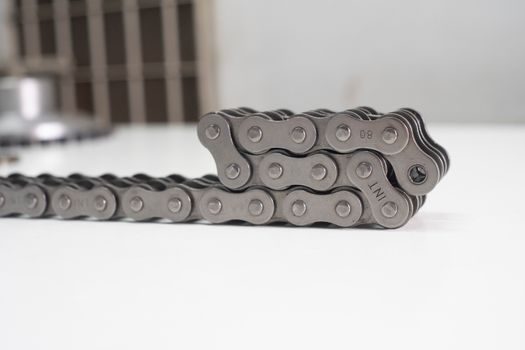
The cheapest variable in any chain conveyor quote is almost never the frame — it is the chain. A side-flexing POM slatted chain in the uni 440 TAB pattern runs a 19.1 mm pitch, 12.5 mm backflex radius, and a permissible tensile strength of 1,100 N (247 lbf) per strand, supplied as 3.048 m (10 ft) strands with 160 links per box [S3]. That rating bounds both the allowable line pull and the sprocket tooth count, so doubling conveyor length roughly doubles chain cost while leaving most other line items linear with shaft count, not length.
For heavier mineral, grain or cement duties, European redler (en-masse) conveyors are commonly engineered into a 38–230 t/h throughput envelope for horizontal runs, with chain speed and pitch selected to keep the permissible chain pull inside the reducer's continuous torque rating [S4]. A buyer comparing two like-tonnage quotes should therefore verify that both vendors have selected chain pitch and breaking load from the same duty factor, not just matched the headline tonnage.
Throughput, length and the t/h-to-cost relationship
Bulk-throughput conveyors in the redler class move 38 t/h at the low end of typical European OEM offerings and 230 t/h at the upper end for the same horizontal transport form factor, a roughly 6× spread that translates into a 1.8–2.5× spread in complete-unit price once drive and chain are right-sized [S4]. Going from horizontal to inclined adds flights, backstops and a heavier chain, and typically lifts price another 20–40 % over an equivalent-length horizontal unit before considering the structural supports.
For accumulation and small-package transport, a parallel-shaft table-top chain conveyor (for example the COLOMBO FILIPPETTI horizontal transport configuration) is priced per linear metre with the conveyor chain, drive package and frame quoted as separable line items; this is the form factor most often specified for food, beverage and pharmaceutical accumulation lines [S1]. When comparing quotes from different vendors, request the same scope boundary — frame, drive, guard, electrical — because Indian and Chinese mill-rate suppliers frequently quote bare conveyor and bill accessories separately [S5][S6].
Chain accessories: drive rollers, sprockets and wear rails
Chain-driven conveyor rollers in the Rulmeca 138 series use a PVC sleeve over a steel tube, with sprocket diameters of 40–63 mm and chain drive transmitting motion to the tube by friction through the sleeve rather than via a positive sprocket-to-roller mesh [S2]. This is a meaningful cost choice: friction-driven rollers are cheaper and quieter, but they cannot be used on inclined accumulation runs where positive drive is needed to prevent rollback under load.
For heavy-duty bulk and forging-industry conveyors, buyers routinely pair metric conveyor chain to standards such as DIN 8165 FV, DIN 8167 M, SMS 1698 and drop-forged chain variants, with manganese wear rails sold as a matched consumable line. The wear-rail line item is often omitted from initial quotes and surfaces as a 5–10 % lifetime-cost adder; for any abrasive duty (clinker, slag, sinter ore) it belongs inside the capex quote, not as a service contract afterthought.
Standards, materials and the audit trail
Metric conveyor chain should be specified to the governing DIN or SMS standard, not by a generic "conveyor chain" label, so that sprockets, attachments and connecting links remain interchangeable when the chain reaches end-of-service life. DIN 8165 (FV), DIN 8167 (M) and SMS 1698 cover the three most commonly specified metric bulk-handling chain families, and drop-forged chains are the standard choice for the most punishing en-masse and pan conveyor duties. ISO 9001 certification is the minimum supplier gate used by both Indian and Chinese OEM-export channels; the certificate scope must explicitly cover chain and sprocket production rather than a generic "machinery" wording [S6].
Material selection follows duty: POM (acetal) slat chain at the 1,100 N class is the typical food-grade and light-accumulation choice [S3], stainless or zinc-plated carbon steel for wash-down or outdoor service, and case-hardened or through-hardened alloy chain for cement, steel and mining redlers. A useful pre-purchase gate is to ask the vendor for the alloy grade, surface treatment and the permissible chain pull at the operating temperature, not the room-temperature breaking load.
Who chain conveyors are for — and who should look elsewhere
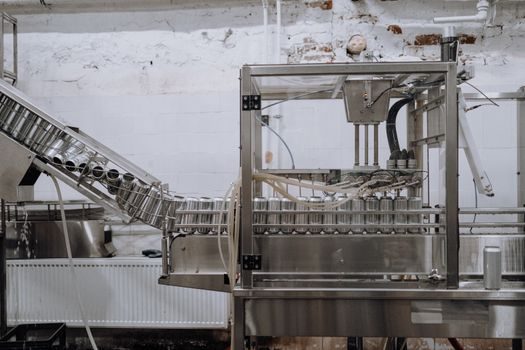
Chain conveyors are the correct primary choice for horizontal and inclined transport of granular, powdery, hot, oily or abrasive bulk (grain, cement clinker, fertiliser, wood chips, foundry sand), for in-line accumulation of bottles, cans and packaged goods on table-top chain, and for heavy-pan or slat conveyors in forging, sugar and steel plants [S4]. They are the wrong primary choice for sanitary food conveyors where a belt conveyor is the established solution, for long-haul overland transport where a belt conveyor is dramatically cheaper per tonne-metre, and for high-speed sortation where cross-belt or roller-sorter architectures are required.
For buyers who already know they need a chain conveyor, the next decision gate is chain type: roller chain for medium-duty accumulation, slatted or table-top chain for hygienic and small-package lines, and drop-forged or FV chain for heavy bulk and forging-duty redlers. That single selection resolves 60–70 % of the cost difference between otherwise comparable quotes.
Channel, lead time and procurement notes
The 2026 export-channel picture splits cleanly into three tiers. Tier 1 — Italian and German OEM (BECCARIA, COLOMBO FILIPPETTI, Rulmeca, ScanChain) — prices the highest per metre but ships fully engineered, with European certification and matched sprocket/wear-rail documentation [S1][S2][S4]. Tier 2 — Indian OEM-export (ESBEE, Star Machine) — typically 25–45 % below European equivalents for comparable chain spec, with ISO 9001 documentation and full mill traceability [S5][S6]. Tier 3 — Chinese mill-direct (Changzhou Dongchuan, ShineLink) — the most aggressive pricing and the longest engineering-review burden for the buyer.
For all three tiers, request the same evidence pack: ISO 9001 certificate with chain/sprocket in scope, chain pitch and tensile-strength test report, sprocket hardness certificate, and a written warranty of at least 12 months on the chain under documented duty cycle. Quotes that do not include all four should be normalised before price comparison, because the apparent cheap option is almost always the one that has quietly dropped one of those four items.
Two verifiable follow-up checkpoints: the vendor's most recent factory audit date and the lead time on a replacement strand of the same chain part number — both tell you more about total cost of ownership than the headline unit price.