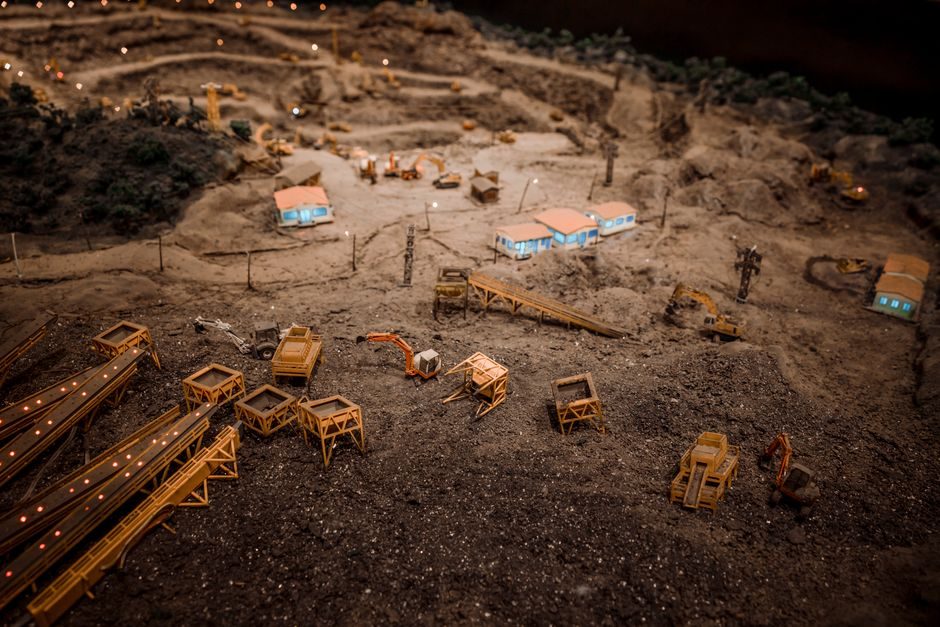
DirectIndustry's 2026-06-03 industrial directory lists 511 belt conveyor manufacturers offering 1,218 distinct models, with horizontal, rail-mounted, wedge, vibrating, pneumatic, and screw variants grouped alongside the dominant belt-driven category [S3].
Price data from Made-in-China 2026-03-31 shows belt conveyor parts (idlers, frames, pulleys) listed at US$1.00-2.00 per piece at 10-piece MOQ from Qingdao Jinchuan Machinery, while complete customized conveyors from Shanghai Yingyong Machinery span US$1,200-7,800 per set at 1-piece MOQ.
What a belt conveyor actually is and where it fits
DirectIndustry's 2026-06-08 taxonomy defines belt-driven conveyors as a discrete category separate from timing-belt conveyors, with manufacturers including Shanghai Dongmeng, Soco System, Suzhou APOLLE, THIMON, Transnorm, TRAPO, and TÜNKERS all fielding belt-driven units [S1].
Belt conveyors are continuous-handling machines using an endless belt on idlers and pulleys; the structural difference between light-duty and heavy-duty frames decides the application envelope. Interroll's BM 8360 is a driven-roller curved accumulator module rated for a 20 kg maximum load at 0.5 m/s (1.64 ft/s), pressure-less, marketed for light-duty food, automotive, and logistics transport [S2]. Vanguard's B-series heavy-mining frame uses a C-section main beam and delivers 60-1427 t/h on 4-37 kW drives with a 0-300 mm feed window, deployed in mining, metallic minerals, recycled aggregate, and building-stone plants [S6].
Selection criteria: load, speed, incline, environment
Weifang Luton states 2026-05-13 that ordinary belt conveyors are limited to slopes below 18°, while large-inclination variants can run steeper; this is the cleanest single threshold separating the two sub-types. [S1]
Four engineering criteria drive a 2026 buy decision. Load: light-duty (≤50 kg, e.g. Interroll BM 8360 at 20 kg) vs heavy-duty mining (60-1427 t/h, e.g. Vanguard B-series). Speed: 0.5 m/s for accumulation, up to several m/s for long-haul aggregate. Incline: ≤18° standard, >18° chevron/cleated. Environment: food-grade PU/PVC, oil-resistant nitrile, or high-temperature silicone — belt cover material is the gating spec for washdown, oily, or hot-aggregate service. Tianhe Type34/Type60 units from made-in-china (2026-03-29) are ISO 9001/14001 certified and ship with a 100,000-unit annual capacity from Shanghai, a useful capacity sanity-check when qualifying Chinese OEM supply.
Comparing the four common belt types
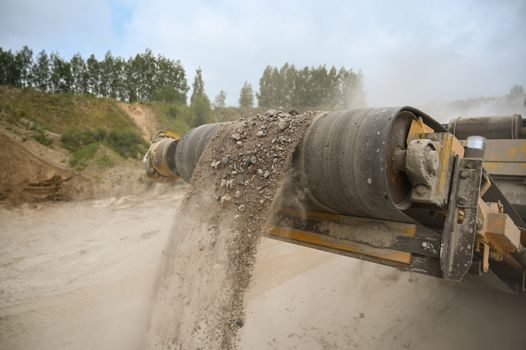
Made-in-China listings on 2026-03-29 list PVC, PU, PVK, and rubber as the four common belt cover materials specified on curved 90°/180° turning machines, each with a different cost-and-duty profile. [S2]
PVC belts are the cheapest general-purpose cover, suited to dry parcel and warehouse sorting; PU belts carry food-contact approvals and resist vegetable oils; PVK (polyester-fabric-reinforced PVC) is a middle tier with better tear strength for light industrial; rubber covers (natural or chlorobutyl) take the abuse of mining and aggregate, with thicknesses 6-15 mm typical. The dinglei2022 en repository's Bando catalog file (2026-06-15) covers lightweight fabric-ply belts with multi-ply construction for general conveying [S5]. When the duty is washdown or direct food contact, spec PU; for abrasive ore at >18° inclines, spec rubber with chevron pattern; for general dry parcel, PVC is the cost-effective default.
Frame, idlers, and guide-rail subsystem
Robotunits' COP 4561 side-guide base (catalog dated 2024-12-24) uses a PA6 black base, PA6 GF30 brackets, PE-LLD end caps, and galvanized-steel fasteners, tightened to 6 Nm on the M5×25 IBS and 10 Nm on the M8×30 EXNIKO bolt, and is designed to fit the supplier's full Modular Automation System [S4].
Frame decisions split into two camps. Modular aluminum T-slot systems (Robotunits, item-profile automation) give fast reconfiguration and integrated side guides at the cost of a per-meter price premium; they pair well with belt conveyors used in light packaging and pharmaceutical cells. Heavy welded-steel frames (Vanguard B-series, Luton aggregate series) take the abuse of mining and quarry service and are designed for fixed-route, long-life installation. Idler choice is a hidden cost driver: steel tube + rubber disc for standard, ceramic-disc for sticky/clay ores, and impact idlers at load zones. Belt tensioner selection (screw, gravity, or pneumatic) follows from the take-up arrangement shown on the OEM general arrangement drawing. Side guides — like the Robotunits PA6/PE-LLD assembly — are the part that wears fastest in dirty service; spec them as a separately-replaceable item rather than welded.
Drive, power, and control
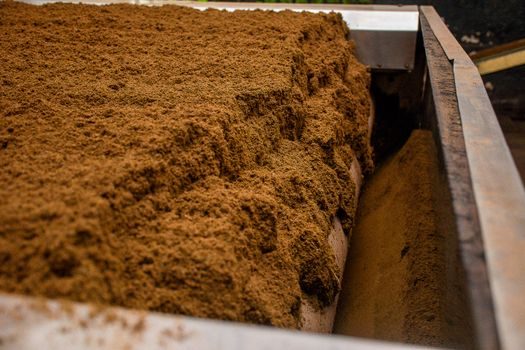
Vanguard's 2026-06-10 B-series datasheet ties power to capacity: 4 kW at the low end through 37 kW for the 1427 t/h head, with motor selection handled by the OEM's standard drive package [S6].
Three drive decisions dominate a 2026 spec. Motor: direct-coupled gearmotor for fixed-speed; VFD for variable-speed accumulation (Interroll BM 8360 uses an electric drive for light-duty accumulation at 0.5 m/s [S2]). Coupling: drum-motor (sealed, hygienic, common in food-grade conveyors) vs external motor + shaft-mounted gearbox (cheaper, easier to service, dominant in mining). Control: across-the-line starter for fixed-speed heavy mining; VFD + encoder for accumulation and inclined service, typically with a soft-start ramp to prevent belt slip. Brake and backstop are mandatory on inclined (>18°) heavy-duty belts carrying aggregate — a separate point the Luton documentation makes implicitly by separating ordinary from large-inclination types.
Standards, documentation, and what to demand at PO
Tianhe's Type34/Type60 belt conveyor ships with ISO 9001/14001 certification, listed in the made-in-china 2026-03-29 product record. [S3]
Request four documents with every quote: (1) general arrangement drawing with take-up, drive, and tail pulley dimensions; (2) belt spec sheet — cover material, ply count, cover thickness, splice type (mechanical fastener vs vulcanized); (3) idler and roller load-life calculation per ISO 5048 / CEMA equivalent; (4) electrical schematic with motor, VFD, E-stop, and backstop wiring for inclined units. Belt-related standards worth naming: ISO 5048 for idler rolling resistance, ISO 14890 for rubber belt construction, and EN 12882 for safety requirements. For food-grade, demand an EU 1935/2004 or FDA 21 CFR declaration. Heavy mining conveyors should reference the relevant CEMA or DIN 22101 standard, and ship with a nameplate that includes belt speed, max load, and motor kW — the same three numbers Vanguard publishes in its B-series spec [S6].
Common failure modes and how to avoid them
The two highest-cost failures in belt conveying are belt mistracking and cover wear, both of which the Robotunits 2024-12-24 side-guide design tries to address with separately-adjustable PA6 GF30 brackets [S4].
Mistracking is the dominant chronic failure: 80% of cases trace to misaligned idlers, off-square loading, or inconsistent belt tension. A properly specified belt tensioner with adequate travel — typically 1.5-2% of belt length — is the first-line defense. Cover wear at the load zone: solved by impact idlers and skirtboards, not by over-spec'ing belt cover thickness. Splice failure: vulcanized splices outlast mechanical fasteners by 3-5x on heavy-duty belts but cost more and require site vulcanizing equipment; mechanical fasteners are field-repairable and acceptable on light-duty. Mistracking will eventually destroy the belt edge; pairing a robust side-guide system (Robotunits COP 4561 spec at 6 Nm/10 Nm torque gives repeatable adjustment [S4]) with a flat belt rated for the duty is the standard mitigation. Mesh belt conveyor variants — for washdown food, parts washing, or high-temperature parts — solve different problems and should be specified only when the application actually demands open-mesh drainage or airflow.
Trackable signals: (a) ISO 14890 and EN 12882 standard revisions tracked through the next CEN TC 188 meeting; (b) CEMA conveyor safety committee output on inclined-belt backstop practice; (c) Chinese OEM capacity announcements, with Tianhe's 100,000-unit annual output one benchmark of stable supply versus the small-shop entries that appear and disappear on Made-in-China's 2026-05-23 customized conveyor listings.
For related coverage, see Moisture Analyzer Buying Guide 2026: Technique, Sample Form and Specs.