
A channel-type induction furnace, including the salt-bath variant, will not start cold: the induction loop is only electrically complete when the channel is filled with molten metal, so a heel of liquid must be maintained between shifts and through every idle period [S3][S8].
That same constraint is why channel units are usually specified for high-throughput, single-alloy production, and why a salt-bath version inherits the rule: the salt is the conductive loop, not the workpiece, so it must stay molten even when no parts are being treated [S1][S2].
Why the Heel Is a Hard Operating Requirement, Not a Recommendation
The induction coil on a channel furnace wraps a laminated steel core through which a narrow channel passes; current is induced into the molten metal inside that channel, so an empty channel means no secondary circuit, no eddy-current heating, and no way to start the bath [S3]. The molten heel is therefore the conductive secondary winding of an air-gap transformer, and draining the furnace to switch alloys is treated as a multi-day, energy-expensive event rather than a normal changeover [S8][S10]. For a salt-bath configuration the same physical rule applies, only the conductive medium is fused salt instead of molten aluminum, copper, or zinc [S4].
Magnethermic-channel and Ajax TOCCO stationary channel furnaces, for example, are routinely built to hold and maintain a bath of molten zinc at temperature, which is functionally identical to maintaining a heat-treat salt heel: the bath stays liquid 24/7 and the coil only ever heats a loop that is already full [S1]. Otto Junker channel holding furnaces for ductile and gray iron apply the same logic, keeping a permanent heel so the foundry can pour on demand without a cold-start cycle [S9].
Channel Furnace vs Coreless Furnace: When the Heel Rule Disqualifies One Type
The heel requirement is the single biggest differentiator between channel and coreless induction designs, and it directly shapes process selection for heat treatment and foundry cells [S3][S7]. The trade-off in spec terms looks like this:
Channel furnace: best for metals with lower melting points such as aluminum, copper, and zinc; heating concentrated in a narrow channel at the bottom of the bath; requires a permanent molten heel; lower capital cost; efficient for high-throughput, dedicated-alloy campaigns and continuous casting schedules [S3][S7][S8].
Coreless furnace: capable of melting difficult metals such as cast iron and stainless steel; induction heating takes place around the crucible body rather than in a channel; can be started from a cold, empty crucible; better suited to frequent alloy changes and smaller batches [S3][S6][S8].
For a heat-treat shop that runs multiple alloy recipes or has long gaps between batches, the channel furnace's heel rule is a hard disqualifier, and a coreless or resistance-heated salt bath becomes the right tool, as covered in the induction furnace reference page.
Salt-Bath Heat Treatment: What the Channel Induction Variant Actually Heats
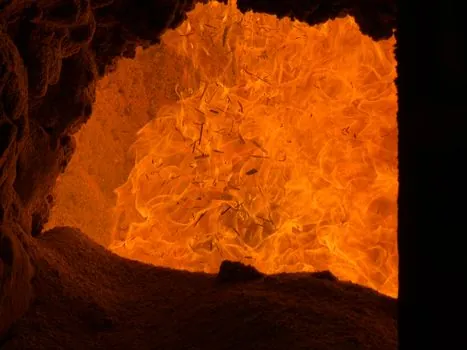
Salt-bath heat treating is a conduction process where workpieces are fully immersed in a fused salt mixture, and the heat source can be electrodes, gas firing, or, in the channel-induction variant, an induction loop wrapped around the bath shell [S2][S5]. The process is fast because more than 90 percent of the energy delivered to a salt bath goes directly into the part, compared with roughly 60 percent for an atmosphere furnace, and bath temperature uniformity is typically held within ± 3 °C, with some processes requiring holds as long as 60 hours at temperatures up to 2400 °F (about 1316 °C) [S2][S5].
A 25 mm steel section reaches austenitizing temperature in about 4 minutes in a salt bath, versus 30 minutes or more in a standard radiation furnace, and the molten salt ranges are typically split as low (150 to 620 °C), medium (650 to 982 °C), and high (982 to 1287 °C), with chemistry chosen for the operation [S5]. The induction-heated salt-bath design patented in CN2633897Y uses a semi-saddle copper coil and silicon-steel magnetizer to drive a transverse magnetic field directly in the bath, which is exactly why the salt must remain molten: it is the secondary loop of the transformer [S4].
Operating Limits, Hazards, and What the Heel Costs You
Keeping a permanent heel sounds simple, but it is a continuous parasitic energy load and a corrosion load on the channel refractory, which is why channel furnaces are paired with clean, single-alloy duty rather than campaign flexibility [S7][S10]. The ASM iron and steel melting chapter treats the heel as a designed-in feature: the metal channels are physically connected to the main cylindrical portion of the furnace, and the heel is maintained as part of normal operation rather than drained between heats [S10].
For salt-bath service the same continuous-melt rule has additional safety implications, because molten salt above about 1287 °C and cyanide-bearing carburizing salts require controlled handling, neutralization, and disposal, so an induction-heated channel bath must be paired with the same pot-material, atmosphere, and ventilation discipline used in electrode or gas-fired salt pots [S2][S5]. In an aluminum HPDC cell, by contrast, the same heel logic drives the furnace choice, as mapped in the aluminum HPDC cell equipment list reference, where channel holding furnaces are kept full of metal between shots.
Sourcing and Verification Signals to Track

For a 2026-09-22 specification check, the verifiable public data points are: Magnethermic/Ajax TOCCO channel furnaces dedicated to molten zinc holding, Ajax Electric salt-bath ratings up to 2400 °F with 60-hour holds, and the CN2633897Y induction salt-bath patent which describes the transverse-field coil geometry that forces a permanent heel [S1][S2][S4]. Two signals worth watching are whether a vendor publishes a heel-volume-vs-coil-power curve (the relationship that lets a buyer size the idling energy cost) and whether a foundry cell's investment casting foundry equipment list explicitly assigns a channel holding furnace with a heel rather than a drainable coreless unit.
The underlying component specifications are covered under dry type transformer, and open channel flowmeter.