
A casting ladle functions as a refractory-lined buffer vessel that receives molten metal from the melting or treatment furnace, holds it at controlled temperature, allows final composition and inclusion adjustments, and delivers it to the mold at a tightly defined pour rate [S6][S8]. Because this is the last processing step before solidification, the ladle stage governs final steel cleanliness, casting temperature stability, and downstream yield on the casting ladle line.
Continuous-caster practice requires a tapping temperature roughly 20 to 50 °C above the equivalent mold-casting target, with stable fluctuation across the ladle sequence to avoid breakouts and slab-quality defects [S7]. The same vessel also acts as a small EAF-style holding unit in some foundries, equipped with induction or resistance heating to keep the metal above the liquidus during transfer [S8].
Ladle preheat: why the refractory must already be at red heat
Foundry manuals specify that every ladle be thoroughly dried and brought to a red heat before receiving metal, a step that protects the refractory lining from thermal shock and removes absorbed moisture that would otherwise boil violently on contact with liquid steel [S2]. Bottom pour ladles in steel foundries commonly employ one-shot or multiuse monoblock stoppers, and preheating the stopper is highlighted as important to prevent failure on immersion [S5].
For steel-foundry ladles between 0.5 and 40 tonnes, monoblock stoppers are limited to about 2150 mm overall length, so taller ladles must use an assembled stopper with a clay-graphite head, ceramic sleeves, and a vented metallic rod to let remaining moisture escape during preheat and filling [S5]. A typical preheat cycle brings the ladle interior to roughly 1500 °C, measured by a fibreoptic infrared pyrometer mounted at the top of the ladle, capable of reading through the flame and viewing the refractory directly [S3].
Temperature trim and composition adjustment in the ladle furnace
A ladle furnace is used to refine and adjust the temperature and composition of liquid steel before it is cast into final products, functioning as the metallurgical finishing step after primary melting [S6]. In the steel-route ladle station, the operator trims carbon, manganese, aluminium, and microalloying additions, drives desulphurisation under reducing slag, and holds the bath within a narrow superheat band before the slide gate or stopper opens to the tundish [S1][S6].
Process-control and energy-saving work on the ladle stage emphasises that tight temperature and composition control at this point directly governs final product quality, refractory life, and per-ton energy consumption in the downstream caster [S1]. Real-time bath-temperature measurement, automated alloy feeders, and argon-stirred sampling lances are the standard toolset; temperature, hydrogen, and nitrogen sensors built into the ladle support closed-loop trimming rather than pour-and-pray chemistry.
Lip pour, bottom pour, and teapot: which ladle fits which job

Three ladle geometries dominate industrial practice, and the choice is driven by part size, slag-handling philosophy, and stopper preheat infrastructure rather than by casting temperature alone. [S5]
Lip pour ladles are the simplest, with metal poured over a spouted lip and slag carried into the mold with the stream; they suit smaller steel castings and iron foundries where stopper complexity is not justified, and for very small ladles under 500 kg a stopper is rarely used at all [S5]. Bottom pour ladles in the 500 kg to 40 t range use a refractory stopper to gate metal through a nozzle in the base, giving zero-slag casting, direct placement over the sprue cup, shorter casting time, and the ability to gas-purge the stream [S5]. Teapot ladles are the first choice for investment casters who need a gentle, controlled stream without investing in a stopper station [S5].
Preheating infrastructure often decides the technology. Where a foundry cannot install a proper stopper preheat station, an assembled stopper with a vented metallic rod is the only safe option, because the vented rod lets residual moisture escape during preheat and fill without cracking the head [S5]. Comparing the three on four criteria, capacity range, slag control, preheat complexity, and stream control: lip pour covers a wide capacity range but carries slag; bottom pour gives the cleanest stream and best gas-purge ability at the cost of mandatory stopper preheat; teapot is the lowest-complexity choice for small investment-cast parts.
Failure modes: cold ladle, wet stopper, and excessive superheat
If a ladle is too cold when metal is tapped, the refractory can crack and the bath can flash on the walls, which is why the preheat target sits at glowing red rather than warm-to-touch [S2]. Overheating the ladle before fill is the opposite failure mode: very high preheat reduces the insulating properties of the refractories, accelerating shell wear and shortening ladle campaign life [S3].
Moisture in the stopper or in the ladle lining is the most dangerous failure: steam expansion in a closed pore network can rupture a monoblock stopper or eject a stopper head on contact with steel, which is why venting the metallic rod and running a controlled preheat curve are non-negotiable [S5]. On the process side, tapping too cold pushes the caster below the practical superheat window of 20 to 50 °C above the mold-casting reference, inviting ladle freeze-offs and tundish clogging; tapping too hot burns electrodes, eats refractory, and increases nitrogen pickup in the bath [S7].
Sensor stack and instrumentation on a modern steel ladle
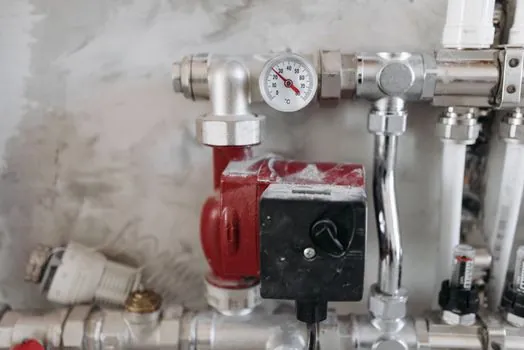
A fibreoptic infrared pyrometer aimed at the refractory from the top of the ladle handles the preheat phase across roughly 600 to 3200 °C and can read through the burner flame to the brick surface [S3]. Once the ladle is filled, an immersion thermocouple or a black-body-tip lance gives the bath temperature, while a stationary thermal-imaging or spot pyrometer at the ladle lip provides continuous surface verification during holding and pour.
The same instrumentation feeds the ladle-furnace control loop, which trims alloy additions, manages argon stirring, and schedules the slide gate or stopper to the caster. In a complete sand casting foundry line, this ladle instrumentation connects upstream to the melt furnace and downstream to the pouring station, forming the temperature-and-composition control chain that defines the casting's metallurgical pedigree. For foundries looking at higher-pressure processes like squeeze casting wrought 6061 aluminum, similar ladle-stage temperature discipline applies because the transition from ladle to shot sleeve sets the entire solidification profile.
Standards, sourcing, and the equipment chain to track next
Foundry-side ladle practice sits on documented safety rules around refractory preheat, stopper venting, and operator lock-out for pour stations, while the temperature and composition targets are set per heat in the steelmaker's internal procedure. Sourcing-grade ladle hardware should be evaluated against the operating band the foundry actually needs: a 0.5 to 40 t bottom-pour system with a monoblock stopper, a vented metallic rod, and a matched preheat station is the minimum credible package for steel castings above 1 tonne [S5].
Track the next three signals: published ladle-preheat curves and stopper-venting guidance from refractory suppliers, real-time bath-temperature integration between the ladle furnace and the continuous caster, and the migration of bottom-pour stoppers into mid-size iron foundries previously served by lip-pour ladles.
For component-level specifications, see construction machinery and equipment, and lamps and light fittings.