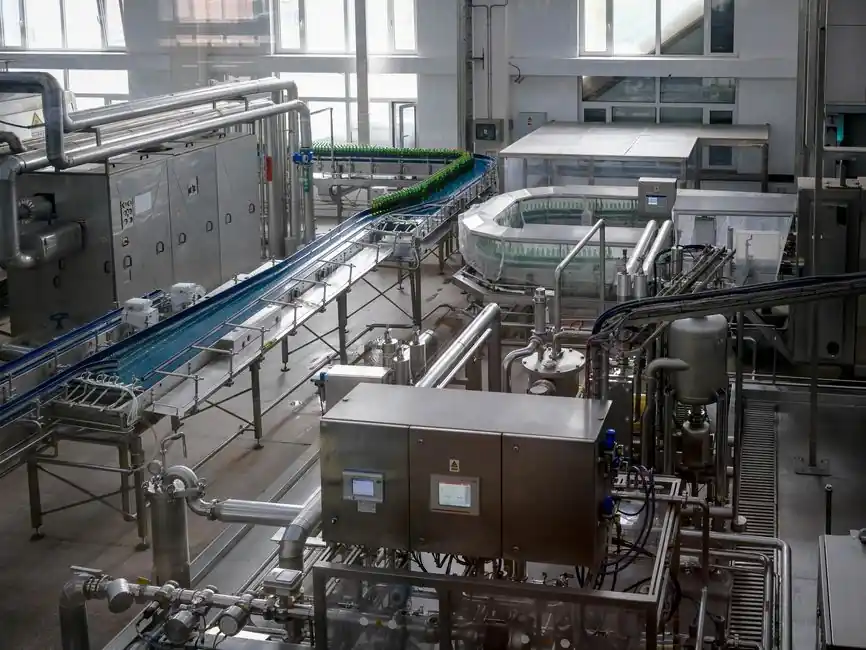
Checkweighers are classified first by motion state (static vs in-motion), then by build variant (benchtop, washdown, combination, multi-lane, capsule), with selection driven by throughput, IP rating, accuracy class, and regulatory regime [S2][S4].
The functional job is the same across classes: compare a measured weight against pre-set zones and flag underweight, overweight, or exact-weight product for reject, rework, or pass [S3]. A 100% in-motion checkweigher delivers 100% inspection rate and removes manual handling, while a static benchtop unit is sized for sample-based QC and portability [S2].
Static vs in-motion: the primary split
Static checkweighers require the product to stop on the weighing platform before a reading is taken, and the same hardware is commonly used as a portable or general-purpose bench scale when not in checkweighing mode [S2]. The trade is operator time: every unit must be loaded and unloaded by hand, so static systems are matched to low-volume or sample-based QC rather than a production line's full throughput [S2].
In-motion checkweighers, also called dynamic, belt, conveyor, in-line, or in-motion scales, weigh the product as it travels on a conveyor and trigger an automated rejector, so 100% inspection is achievable without manual handling [S2][S6]. The classification step happens against pre-set weight zones, and the controller's pass/fail output drives diverter hardware downstream [S3][S8]. Anritsu's SSV series cites a 0.03% error margin and 3-sigma accuracy, with system length as small as 545 mm (21.5 in) for compact-line integration [S3].
Build variants inside each motion class
Within the in-motion family the variants are sized to product format and hygiene regime. Dual-lane and multi-lane checkweighers run two or more product streams through one frame, capsules and small bottles get dedicated low-mass heads, and aerosol or grading-system heads handle pressurised cans and sort-by-weight applications [S3]. Minebea Intec describes the dynamic checkweigher's task as checking completeness and ejecting incomplete product with sufficient margin from the production process, which is the formal wording behind the rejector-classification step [S8].
Combination checkweighers add a second inspection technology inside the same frame: metal detection, X-ray, vision, or barcode scanning, which collapses two quality gates into one footprint and is common in food, beverage, and pharmaceutical lines [S1][S4]. Washdown checkweighers extend the in-motion architecture with sealed load cells, stainless frames, and IP-rated enclosures so the line can survive high-pressure cleaning and chemical disinfection typical of dairy, meat, and pharma hygienic zones [S4].
Selection criteria: speed, environment, regulation
Three selection criteria dominate the spec sheet. First, speed and efficiency: the product's fragility and mass set the maximum belt speed, and any rate above the rated packs-per-minute is a hard ceiling on line throughput [S2]. Second, environment: temperature, humidity, dust, vibration, and air currents all feed into the load cell noise budget, and the unit must communicate with PC software for product-ID storage, transaction logging, and report generation [S2]. Third, regulation: NTEP, Legal for Trade, IP rating, and washdown certifications are non-negotiable for food, pharma, and retail-by-weight applications [S2][S4].
Rice Lake's published comparison (2025-07) frames the trade directly: static units increase operator time, need minimal maintenance, have no process-control loop to service, and carry a lower initial cost, while in-motion units decrease operator time, eliminate manual error, raise productivity, and reach 100% inspection rate [S2]. For a high-speed packaged-food or pharmaceutical line the in-motion class is the default, and for a QC lab or low-rate hand-pack station the benchtop static class is the rational pick [S2][S4].
Comparison: where each type wins
Stacked against four decision criteria, the main classes separate cleanly. On throughput, in-motion and combination win because of 100% inspection and automated reject; static benchtop loses on operator-time cost [S2]. On accuracy headroom, in-motion systems using high-frequency load cells or electromagnetic force restoration cite sub-0.1% error margins at production rates, and the Anritsu SSV figure of 0.03% sits in that band [S3][S4]. On hygiene and ingress, washdown and combination washdown variants are the only options for high-pressure cleaning regimes, and static benchtop units are limited to dry or lightly cleaned areas [S4]. On footprint, the SSV-h/i/f family at 545 mm (21.5 in) system length and benchtop units at bench-scale dimensions are both compact, while dual-lane and multi-lane heads trade footprint for parallel-stream throughput [S3].
The classification that ties these criteria together is mechanical and electrical: load cell type (high-frequency strain gauge vs electromagnetic force restoration), conveyor architecture (single, dual, multi-lane), enclosure rating (IP65, IP66, IP69K for washdown), and rejector interface (pusher, drop-flap, air-blast, swing arm) [S4][S8]. Customs ruling NY K81066, the U.S. tariff precedent, classifies the equipment by method of operation and by how it distinguishes conforming from non-conforming product, so import-code planning follows the same motion-state split [S7].
Limitations and failure modes

Every checkweigher class has a known failure band. In-motion accuracy degrades as belt speed rises and as product mass drops, because the load cell's signal-to-noise ratio falls below the 3-sigma threshold and false rejects rise; Anritsu's "Smart Measurement Function" exists to suppress that mode [S3]. Static units are throughput-limited and depend on operator discipline, so they cannot guarantee 100% inspection on a running line [S2]. Washdown ratings buy cleaning tolerance but reduce sensor access, so calibration cycles shorten in caustic chemical regimes [S4]. Combination systems inherit the union of all sub-systems' failure rates, which raises mean-time-to-repair and the required spares holding [S1][S4].
Mechanical rejects also carry their own constraint: a drop-flap rejector is not safe for glass or pressurised containers, so aerosol and small-bottle variants use dedicated reject profiles [S3]. Regulatory mis-classification is the most expensive failure: a checkweigher on a Legal-for-Trade retail line without the correct NTEP certificate forces a re-spec and a line rebuild [S2].
Standards, sourcing, and where the spec is going
No single IEC or ISO standard governs the checkweigher as a whole; the relevant certifications are NTEP Handbook 44 for U.S. Legal-for-Trade, OIML R76 for non-automatic weighing instruments, the European MID (Measuring Instruments Directive 2014/32/EU) for EU trade, and IP ratings IEC 60529 for ingress, plus HACCP and GMP overlays for food and pharma lines [S2][S3]. For material handling context, see the checkweigher encyclopedia entry, and for the broader plant-instrument taxonomy, the pressure transmitter and flow meter references sit alongside it in process control. Pharma buyers should also cross-reference pharmaceutical equipment sourcing in 2026, where CDMO consolidation is reshaping fill-finish lead times.
Trackable signals for the next 6 to 12 months: (1) OIML R76 revision activity around dynamic-weighing tolerances; (2) washdown IP69K adoption rate on dairy and meat lines, which usually leads stainless conveyor specs; (3) combination-system pricing convergence as X-ray sensor costs fall, which historically forces standalone checkweigher vendors into bundle pricing. None of these are predictions, just the regulatory and commercial nodes worth monitoring from the spec side.