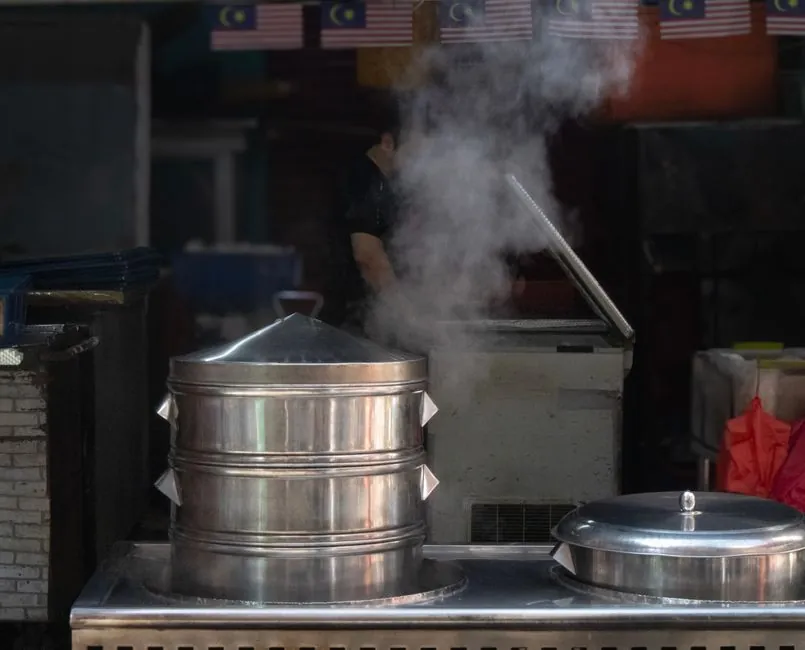
Sourcing food processing equipment from China delivers landed-cost savings of 30–50% versus equivalent European or US-built lines, with regional hubs specializing in distinct equipment categories: Jinan/Shandong for grain and flour, Guangzhou/Guangdong for fruit, vegetable, and beverage lines, and Zhejiang for bakery and stuffed-pastry systems [S2][S4].
The savings are real, but the failure modes are equally real: a Guangzhou showroom address is no guarantee the production site sits in the same city, a catalogue of certificate logos does not certify the specific machine, and a low FOB price typically excludes the documentation, FAT, and spare-parts scope that determine whether the line runs six months after commissioning [S1][S6]. This guide lays out the decision logic a process engineer or procurement lead should follow before wire-transferring a deposit.
Match Supplier Role to Order Complexity Before Comparing Quotes
The first sourcing decision is which supplier structure leaves the fewest critical responsibilities unowned for a given order, with the right fit split across four scenarios [S1]: a specialized factory for one standard machine, a factory plus export-capable commercial partner for repeat OEM orders, a transparent exporter for mixed equipment packages, and an engineering-led integrator for a complete processing line. A broad catalogue or a city-center address is a poor proxy for which role a supplier actually performs [S1].
Capacity and capability benchmarks matter: buyers should look for at least 10,000 m² of dedicated production space, documented in-house inspection processes, in-house production of critical wear parts, and a dedicated R&D team, with one named Shandong-based manufacturer citing 12,000 m² of floor space and an 18-engineer R&D headcount [S5]. For grain and flour machinery specifically, Jinan factories routinely quote 100 kg/h compact flour mills, 500 kg/h grain cleaning lines, and 2,000 kg/h pasta production lines as their standard product tiers, with minimum order quantities of 1–5 units depending on the scale [S2].
Hub Specialization: Where Each Equipment Category Actually Gets Built
China's food processing machinery industry is regionally specialized rather than uniformly distributed, and aligning the equipment category with the right hub is the single highest-leverage sourcing decision [S2]. Jinan in Shandong is the established center for grain, flour, and starch processing, with 100 kg/h flour mills starting near 2,000 USD, 500 kg/h grain cleaning lines at 8,000–15,000 USD, and 2,000 kg/h pasta production lines at 30,000–60,000 USD [S2]. Guangzhou/Guangdong specializes in fruit washing, cold-press juicing, vegetable cutting, and bottle filling lines, with 50 kg/h fruit juicers starting near 1,500 USD and 200 kg/h filling lines sitting in the mid-range price band [S2].
Zhejiang, particularly Jiaxing, has emerged as a strong base for bakery and stuffed-pastry production lines, covering Arabic pita, baguette, burger bun, maamoul, and kibbeh formats, with manufacturers typically offering single machines, modular line components, and full production line packages [S4]. Buyers chasing heavy/precision equipment should also factor logistics early: custom wooden crates with anti-vibration padding, port pickup at Qingdao, Shanghai, or Ningbo, and freight-forwarder support for Canton Fair coordination all influence the landed-cost calculation [S2].
Stainless Steel Selection: 304 vs 316L by Food Matrix
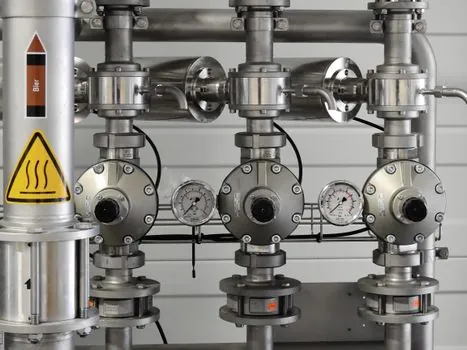
Material grade is the single most consequential food-contact spec, and Chinese factories offer 304 stainless steel as the default and 316L as the upgrade for corrosive or high-acid product matrices [S1][S2]. For dry goods, neutral pH ingredients, and general-purpose wet washdown, 304 is acceptable and cost-effective; for high-acid fruit products, salt brines, dairy, and aggressive cleaning chemicals, 316L is the correct specification [S1][S2].
Beyond the stainless grade, buyers should pin down surface finish (mirror polish, electropolish, or 2B), gasket material (EPDM, silicone, or FKM), and any food-contact compliance documentation tied to destination market requirements. The 304 vs 316L decision should be made per subsystem, not at the line level: a juice line might run 304 on structural frames and 316L on all product-path wetted parts, which keeps cost proportional to risk [S1]. For a deeper stainless procurement read relevant to the same spec discipline, see this stainless steel procurement brief.
Destination Compliance: CE, FDA, and Why ISO 9001 Is Not Enough
Destination compliance is not a generic certificate package, and a one-size-fits-all "CE / FDA / ISO" sticker set is a known warning sign [S1]. For the European Union, the machinery safety directive plus EN 1672-2 (food processing machinery safety and hygiene) is the relevant framework, with CE marking on the assembled machine, not just on individual components [S1][S5]. For the United States, FDA 21 CFR 177.2600 governs rubber and elastomer food-contact articles, while NSF/ANSI 3 or 8 standards cover commercial food equipment depending on the equipment class [S1].
ISO 9001 certifies the manufacturer's quality management system, not a specific machine, and it should be treated as a baseline filter rather than a substitute for machine-level documentation [S1][S5]. For buyers shipping into regulated markets, the practical minimum documentation set includes the declaration of conformity, the test report against EN 1672-2 or the relevant US standard, a full material declaration for food-contact parts, and a wiring diagram with the actual PLC model and firmware version listed [S1]. Buyers running lines with automated motion should also spec washdown-rated linear modules; a food-grade linear module spec map is a useful cross-reference for that subsystem.
Compare Quotations on Landed Scope, Not FOB Price
Chinese equipment typically lands 30–40% below European or US alternatives with comparable build quality, and the payback period on the price differential is commonly cited at roughly 18 months for a well-run installation [S5]. That headline saving evaporates fast if the quotation excludes documentation language, on-site commissioning, operator training, FAT witnessing, and a defined spare-parts kit, all of which routinely sit outside the base FOB price [S1][S5].
A land-equivalent comparison should normalize each bid to the same scope: identical model number, identical final configuration, identical destination compliance documents, identical FAT protocol, and identical warranty terms with named response times [S1]. One named Shandong manufacturer's published warranty-period failure rate is 0.8%, well below a self-reported industry average of 2.5%, but that figure only holds value if the buyer verifies it against the supplier's own service records rather than marketing copy [S5]. For buyers also evaluating control-panel instrumentation sourced separately, this digital panel meter sourcing logic covers the same "verify the exact module, not the brand" discipline applied to a related subsystem.
Factory Acceptance Test: Treat the FAT as the Acceptance Event, Not a Demo
The Factory Acceptance Test is the buyer's last leverage point before the container is sealed, and it should be written as a pass/fail procedure against the frozen configuration, with the FAT protocol signed by both parties before testing starts [S1]. A wet run with the buyer's actual product matrix (or a close simulant) is the only test that surfaces cleaning, residue, and capacity issues that a dry run misses; a video record of the FAT, timestamped and referenced to the protocol line items, is the minimum evidence package [S1].
Key test items should include throughput at the rated capacity with a defined tolerance band, electrical safety checks against the destination standard, noise and vibration measurements, control system HMI walkthrough, alarm and interlock testing, and a documented cleaning cycle that the buyer's sanitation team can replicate [S1][S5]. Spare-parts delivery, commissioning scope, and warranty start date should all be locked in the FAT sign-off document, not in a follow-up email after the equipment is already on a vessel [S1].
5-Step Workflow and Decision Signals to Track

A repeatable workflow compresses to five steps: (1) define the supplier role for the order, (2) verify the legal entity and the exact production site, (3) freeze the final configuration and destination compliance in writing, (4) execute a written FAT with the buyer's product matrix, and (5) compare landed-cost quotations on identical scope [S1]. Verifiable signals to watch over the next sourcing cycle include the share of Chinese OEMs publishing machine-level EN 1672-2 test reports versus component-level CE stickers, the proportion of Zhejiang and Shandong integrators offering remote FAT video with timestamped protocol references, and the emergence of 316L-as-standard pricing for mid-range juice and dairy lines rather than as a costed upgrade. Buyers who track these three signals on each new RFQ will spot the suppliers that have actually invested in destination compliance versus those still selling certificate logos.
Spec-level background on the components involved: linear guide, crossed roller guide, and ndt equipment.