A linear module running on a wet, chemical-cleaned filling or packaging line must be picked on its hygienic envelope first and its stroke second, because a 1,000 mm unit with the wrong seal or finish will fail washdown long before it reaches rated cycle life [S5].
The 2026 catalog pool for food and beverage linear modules now sits around 29 SKUs across 4 brands, spanning belt-drive long-stroke units (100–5,600 mm stroke, 150–2,000 mm/s) and ball-screw precision units with ±0.005 mm positioning accuracy and 6–45 kg horizontal load ratings [S1].
Hygienic enclosure: IP rating, materials, and surface finish
IP65K or IP69K ingress protection, paired with a smooth anodized-aluminum or stainless-steel housing, is the baseline enclosure spec for any linear module landing in a splash or washdown zone, because a Ra value above 0.8 µm harbours bacteria even after CIP cycles [S5].
Rexroth's MKR hygienic linear module uses a smooth aluminum profile specifically to prevent build-up of liquids and foreign debris, with stainless steel hardware at product-contact fasteners [S4]. For acidic products such as fruit juice or soda, electroplated finishes outperform anodized ones, because anodizing can chip and flake into the product stream and contaminate both food and downstream equipment [S5].
Seal chemistry is the second decision axis: housings, wipers, and bellows must be checked against the actual CIP/SIP detergent list (typically NaOH 1–3% at 80 °C, followed by nitric or phosphoric acid rinse), and nitrile or EPDM is incompatible with some sanitizers that are routine in dairy plants [S5]. Drainage channels and sloped covers are mandatory on any linear actuator housing, because standing water at seal lips is the dominant premature-failure mode in washdown audits.
Drive choice: belt, ball screw, or linear motor
Belt-drive modules (FPB Series, FBL80) deliver 150–2,000 mm/s at strokes up to 5,600 mm and are the default for end-of-line packaging, pick-and-place, and long transfer conveyors where 0.1 mm repeatability is acceptable [S1].
Ball-screw modules (FSL60, FSL80, FSL120, KK series) trade speed for rigidity, with 0.001–0.005 mm repeatability, 600–14,000 N thrust, and horizontal load capacities of 6–45 kg on the FXZ family, which makes them the right pick for indexing heads, label applicators, and volumetric fillers where a single step of backlash shows up as a giveaway [S1].
Linear-motor stages are reserved for cleanroom-adjacent bottling or pharmaceutical-style food lines where contact-less force and zero-backlash positioning outweigh the higher controller cost, but they require a separate review of the cooling circuit against the washdown envelope.
Load, stroke, and speed: matching the actuator to the duty
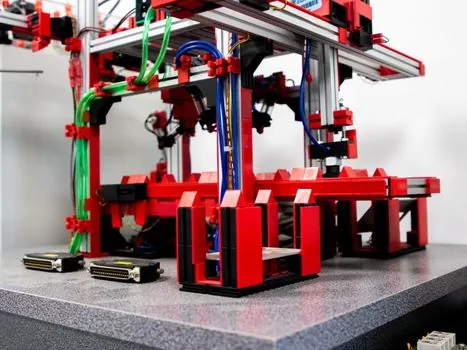
Stroke must be specified as useful stroke plus 10–20 mm safety overrun on each end, because most fully integrated linear modules lose 30–50 mm of catalog stroke to internal end blocks and stroke-confirmation sensors [S6].
Horizontal load is rated separately from moment load, and the FXZ family quotes both: 6–45 kg horizontal versus 3–30 kg side-mounted, with peak thrust from 180 N to 1,300 N, so a vertically mounted pusher on a case packer must be checked on the moment curve, not the catalog axial number [S1].
Linear guide life is rated in kilometres of travel, and a 24/7 bottling line at 2 m/s covers about 173 km/day, so a 50,000 km-rated carriage needs replacement inside four months if the lubrication schedule slips [S2].
Food-zone classification and what each zone demands
Equipment designers separate food-contact zones from splash zones from non-contact zones, and each tier drives a different spec for the same linear motion component. [S1]
Food-contact zones require FDA-compliant lubricants (typically H1 food-grade grease), stainless or polymer wetted parts, and a documented allergen-control program, while splash zones can accept engineering plastics and coated aluminum provided the IP rating holds under daily CIP [S5]. Non-contact zones outside the washdown envelope can use standard industrial modules, which is where most of the cost reduction on a packaging line is found.
The U.S. Food and Drug Administration and the European Hygienic Engineering and Design Group (EHEDG) publish both regulations and design guidance for hygienic processing, and machine builders are expected to map each linear module to one of those zone definitions on the drawing, not on the purchase order [S5].
Installation, support, and integration pitfalls
Unsupported structured installations are the norm for belt-driven long-stroke modules, but a span above roughly 1,500 mm without an intermediate support will visibly deflect under side load and the linear encoder signal will glitch before the deflection becomes a mechanical problem [S9].
Fully integrated linear modules can be versatile and cost-effective for linear transport in packaging machinery, but the integration bill of materials (motor mount, cable carrier, pneumatic manifold, servo drive) is often 40–80% of the module price, so the comparison must be made on the integrated system, not the bare slide [S6].
Cable carriers and energy chains routed in the washdown zone need the same IP rating as the module, and any pneumatic fittings should be mounted facing downward to keep them out of direct spray, a frequent finding on third-party hygienic audits of retrofit lines.
Selection workflow and side-by-side comparison
A practical 2026 selection workflow for a food-line linear module starts with four inputs: zone classification, stroke, peak speed at payload, and the washdown chemistry list, then narrows to drive type from a decision matrix, not from catalog browsing [S2].
Five key factors for selecting precision linear modules are consistently listed as load, stroke, speed, accuracy, and drive type, and these map cleanly onto the FUYU catalog split between belt (FPB, FBL80) and ball-screw (FSL, KK, FXZ) families [S1][S7].
For comparison, the main drive options line up against food-line criteria as follows: belt drives win on cost-per-metre-of-stroke and top speed, ball-screw drives win on repeatability and thrust, and linear-motor stages win on cleanliness and dynamic response but lose on washdown robustness and controller complexity. A spec map for steel-mill duty, which is a useful contrast, is laid out in Linear Module Spec Map for Steel Mills: Drive, Housing, and Duty Cycle, and the chain-and-sprocket hardware map in Roller chain selection for steel mills: pitch, horsepower, heat treatment covers the related transfer hardware that often sits downstream of a food-line linear module.
For 2026 spec work, the watch items are the roll-out of myRollon's expanded configurator (which integrated cam followers and locknuts on 25 June 2026 and is now a single source for both linear bearing sizing and actuator configuration), and any new MKR-series variants from Rexroth aimed at IP69K bottle-filler retrofits, both of which will reset the price-performance curve for hygienic modules in the next two quarters [S3].