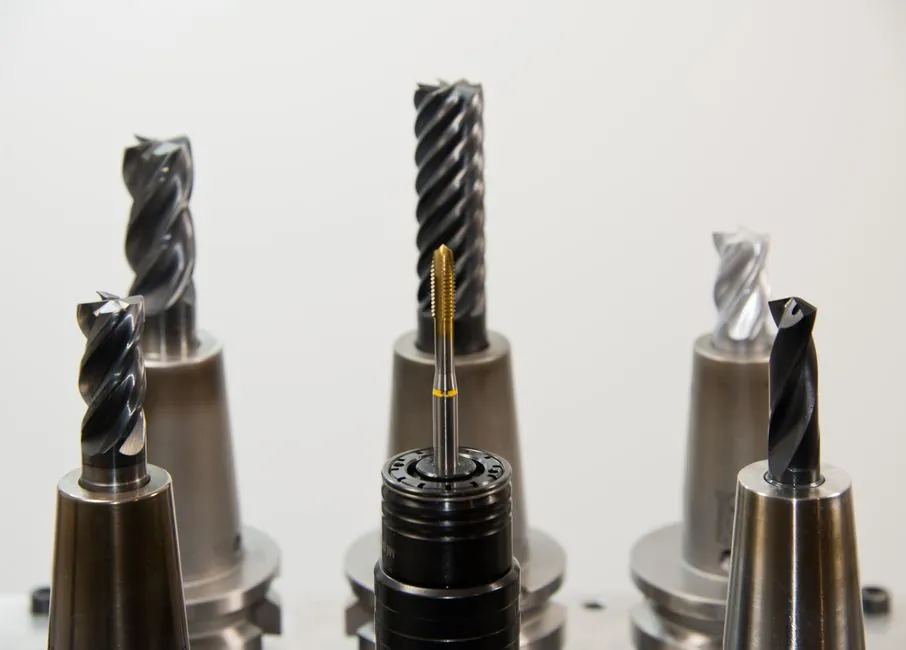
A chisel-tip (two-cutter) carbide masonry bit and a cross-tip (four-cutter / quad-tip) bit are not interchangeable when the host tool is a rotary hammer, because the cutting geometry changes how impact energy fractures aggregate and how the bit survives a rebar strike [S3].
For most contractor work in the 1/8" to 1/2" range, the working distinction is: two-cutter bits win on brick, block, and light concrete where the matrix is uniform and rebar is unlikely; cross/quad-tip bits win on poured concrete with hard aggregate and any hole where rebar is a possibility [S1][S3]. This decision map is built around SDS Plus (10 mm shank) and SDS Max (18 mm shank) rotary hammers, since plain round-shank bits in a keyed chuck cannot transfer hammer energy efficiently [S1][S3].
Tip Geometry: What the Carbide Actually Does
The carbide insert is brazed or sintered onto a steel body specifically because tungsten carbide is harder than the aggregate in concrete and the fired-clay matrix in brick, so it abrades and fractures material instead of trying to slice it like a HSS twist bit would [S1]. The geometry on top of that carbide is what separates a chisel-tip bit from a cross-tip bit. A two-cutter design concentrates impact force on a single pair of carbide wings, which shears a clean cylindrical chip and clears dust through two flutes [S3]. A four-cutter / cross-head design spreads the load across four carbide points, which is the structural reason it survives rebar encounters without the bit locking up [S3]. Champion Chisel notes that quad-tip layouts "hold up longer in abrasive mixes," and that single-tip layouts remain productive in lighter concrete and brick [S1].
Flute count is coupled to the tip design: two-cutter bits ship with two flutes (faster dust evacuation, lower cost), while four-cutter bits typically use a matched multi-flute body because the extra cutters generate more swarf per revolution [S3]. That is also why a two-cutter bit usually carries a lower price tag on retail listings: a 10-piece 1/8"–1/2" carbide masonry set was listed at $12.98, and a comparable 12-piece set at $9.98 on the Amazon best-sellers list, both built around two-cutter / U-groove geometry [S2]. Cross/quad-tip SDS-plus bits in the same size range from professional lines carry a meaningful per-bit premium, and the price gap widens as diameter grows because the carbide mass per tip scales with bit diameter [S3].
Shank System: Why SDS-Plus or SDS-Max Is Non-Negotiable
SDS (Slotted Drive System) shanks have machined locking grooves that let the bit slide axially inside the chuck while still rotating, which is what converts hammer piston stroke into percussive impact at the tip [S3]. SDS Plus uses a 10 mm shank and covers the bulk of tradesperson work in brick, block, and light concrete; SDS Max uses an 18 mm shank and is specified for dense concrete, stone, and reinforced substrates where higher impact energy per stroke is required [S3]. A round-shank bit tightened in a keyed chuck cannot replicate this: energy is lost to slippage, and the bit will either burn out the chuck or just spin without transferring useful impact [S1].
Spline-shank bits serve the same energy-transfer role on certain rotary hammers and remain common on heavy demolition and construction tools, though the market is consolidating around SDS Plus for the under-1" range and SDS Max for larger core drilling and deep-hole work [S1]. The practical rule for a percussion drill user: if the host tool is a true rotary hammer with an SDS chuck, the bit must be an SDS bit; if the host is a hammer drill with a standard three-jaw chuck, the bit must be a round-shank masonry bit with carbide tip, and the operator should not expect rotary-hammer-class productivity.
Material Match: Concrete, Brick, Block, and Rebar

Material drives the bit choice more than any other variable. Concrete with heavy aggregate such as river gravel or granite pulls more carbide per inch than limestone-aggregate mixes, so a quad-tip layout is the correct call for abrasive pours [S1]. Brick and standard CMU block are more forgiving because the aggregate is finer and the density more uniform, which is why two-cutter bits remain the default and the workhorse in the 1/8"–1/2" retail range [S1][S2]. When brick shows up as hard-face or silica brick, the bit starts skating and losing diameter at the tip faster than expected, and that is the field signal to step up to a quad-tip configuration rather than push the two-cutter harder [S1].
Rebar is the second decision driver. A two-cutter bit that strikes rebar can snag, bind, and either chip a carbide wing or twist the body; a cross-head / four-cutter design gives the bit multiple shear paths through the steel so it cuts the rebar instead of locking against it, which is why four-cutter layouts are described in SDS guidance as the option that "helps prevent the bit from snagging and extend overall lifespan" when steel reinforcement is in the cut path [S3]. For any poured-concrete specification where the structural drawings show rebar, or where the operator cannot verify the rebar layout, the conservative call is a four-cutter bit. For clean brick and block, the two-cutter is faster and cheaper without giving up meaningful life.
Diameter, Depth, and Heat: The Under-1/2" Variables
Below 1/2" diameter, heat and pressure concentrate on a very small carbide footprint, so the operating discipline is to pull the bit every few seconds in deep holes and never run continuous dwell time in one spot [S1]. Above 1/2", the dominant failure mode shifts from heat to rebar contact and lateral deflection in deep holes, which is where SDS Max (18 mm shank) starts to make sense over SDS Plus because the larger shank transmits more impact energy per stroke and resists deflection in long hole lengths [S3]. The retail best-seller sets in the 1/8"–1/2" range cover the vast majority of anchor, sleeve, and through-hole work in commercial masonry, and the operator does not need to leave that range unless the specification calls for core drilling or large-diameter through holes [S2].
For deep-hole work in reinforced concrete, a four-cutter SDS Max bit is the right tool, and a standard two-cutter SDS Plus bit in the same diameter will underperform both on rate of penetration and on survival of the inevitable rebar strike [S3]. Practitioners running production anchor patterns on bridge decks, parking decks, or tilt-up walls tend to standardize on four-cutter SDS Max once hole diameter passes roughly 5/8", because the cost of a stuck bit and a torch-out exceeds the per-bit premium several times over.
Cost, Life, and Sourcing: What the Market Actually Shows
The retail cost spread between a consumer-grade two-cutter set and a professional four-cutter SDS Max bit in a comparable diameter is real but justified by life-per-inch and rebar survival, not by tip metallurgy alone [S1][S3]. Amazon best-seller listings in the 1/8"–1/2" range cluster around $9.98 to $12.98 for full multi-piece sets built on two-cutter / U-groove carbide geometry with round or 3-flat shanks for standard drill chucks [S2]. Professional SDS Plus and SDS Max four-cutter bits from industrial suppliers (Champion Chisel, Bosch, and equivalent lines) sit in a different price band per bit, and the value calculation is done on holes-per-bit rather than bits-per-dollar [S1][S3][S4]. Bosch's masonry and concrete drill bit catalog is structured around carbide-tip durability for "even the toughest concrete and stone" applications, which positions the line against the same contractor use case Champion Chisel addresses with its SDS Max and spline masonry lines [S1][S4].
Procurement guidance for a B2B buyer: stock two-cutter SDS Plus bits as the high-turnover consumable for brick, block, and light concrete, stock four-cutter SDS Max bits for any poured-concrete or rebar-likely specification, and verify the shank system against the host rotary hammer before purchase, because an SDS Max bit in an SDS Plus chuck (or vice versa) is a non-starter regardless of tip quality [S3]. For a related decision on capital tooling for carbide bit manufacturing, the breakdown of a carbide saw blade brazing and grinding line capital cost covers the upstream production economics for similar tungsten-carbide consumables.
Operating Pitfalls and Cross-Reference to Adjacent Decisions
The most common field failure on percussion drills is running a standard round-shank masonry bit in a true rotary hammer (or the reverse) and concluding that the bit is bad when the actual problem is shank-to-chuck mismatch [S1][S3]. The second most common is choosing a two-cutter bit for poured concrete with rebar, which produces a stalled bit and a chipped carbide wing instead of a clean hole [S3]. Spec writers should pin the bit type to the substrate in the method statement: two-cutter for clay brick and CMU, four-cutter for poured concrete and any substrate where rebar is plausible, and SDS Max rather than SDS Plus once hole diameter crosses roughly 5/8" in reinforced concrete [S1][S3].
For context on adjacent tooling decisions in the same percussion-drill workflow, the counterbalance vs reach truck operating cost comparison covers the material-handling side of moving bit inventory and consumables on a jobsite, while the ASTM A536 ductile iron spec decision map is relevant where cast-iron bit bodies or carbide-retaining fixtures are part of the specification. Encyclopedia anchors used in this article cover the broader category (industrial valve is unrelated and was excluded, while silicon carbide ties to the carbide-tip material family) and the masonry insulation page, which addresses the substrate side of the work rather than the tooling.
Trackable signals to watch over the next two quarters: retail listings shifting from two-cutter to four-cutter as the default SKU in the 1/4"–1/2" SDS Plus range, and SDS Max bit pricing compressing as more professional-line four-cutter product reaches the same distribution channels that currently stock two-cutter consumer sets [S2][S3].
