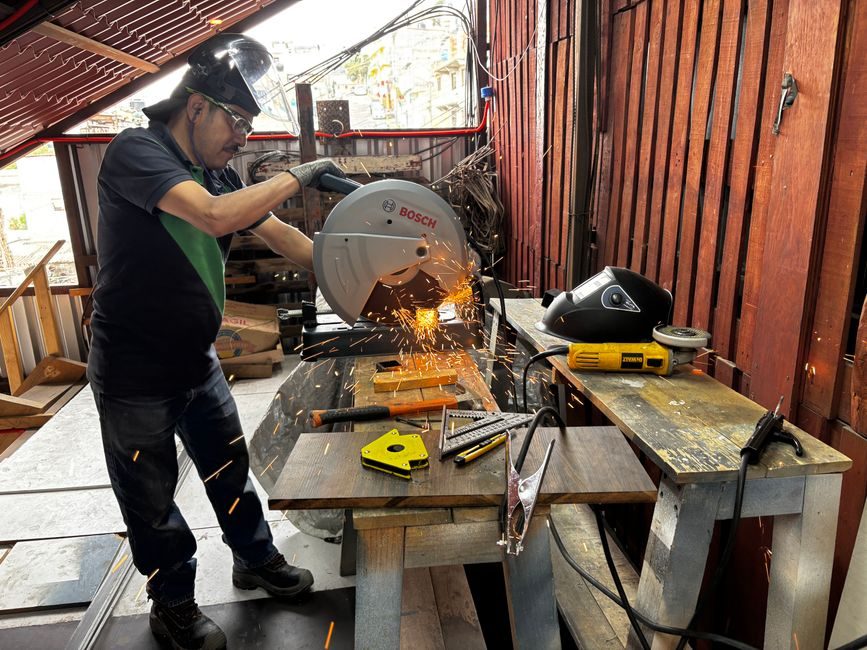
Industrial circular saws split into stationary cold/cut-off machines and portable handheld units, with the DirectIndustry catalogue listing 205 manufacturers and 909 product entries under the broad circular-saw heading [S1].
Within that catalogue, the circular cut-saw subset alone holds 13 products from 5 makers, of which 12 are stationary and 1 portable, and the technology mix is 11 circular, 9 cut-off and 1 band-saw hybrid [S2]. That ratio — roughly 12:1 stationary to portable in metal-shop cut-off saws — frames the rest of this selection map.
Blade Diameter, Kerf and Maximum Cutting Depth
Circular saw capacity is governed by blade diameter: portable woodworking units typically run 184 mm (7-1/4 in) to 235 mm blades, while stationary metal cut-off saws climb to 250 mm, 315 mm and 355 mm diameters for solid bar stock [S1][S3]. Kerf width — the slot the blade cuts — usually sits between 2.5 mm and 3.5 mm on carbide-tipped metal blades, which determines both material waste and the horsepower the arbor motor must deliver [S5].
DirectIndustry lists portable, semi-stationary and fully automatic models in the 205-vendor circular-saw index, with manual-feed units for low-volume cutting and CNC or servo-feed machines for production cells [S1]. Cutting depth scales with blade diameter minus the arbor flange and safety guard, so a 355 mm TCT blade typically yields a 120 mm depth of cut in mild steel — a useful anchor when sizing a saw to round bar or billet [S1][S2].
Cold Saw vs. Cut-Off Saw vs. Band Saw Hybrid
Stationary circular saw selection turns on whether the cut needs to be a true cold saw (low-RPM, lubricated, burr-free) or a higher-RPM abrasive/TCT cut-off. The DirectIndustry cut-saw index shows 9 cut-off entries versus 11 circular entries and a single band-saw entry, evidence that abrasive and TCT cut-off machines still dominate the metal-shop segment but face competition from horizontal bandsaws for high-volume production [S2].
Cold saws run single-digit RPM per 100 mm of blade and use a flood coolant or mist system; TCT cut-off saws run hundreds of RPM and accept carbide-tipped blades with 40–80 teeth for thin-wall tube and 24–36 teeth for solid bar [S2][S5]. For solid stainless bar above 80 mm, an automatic cold saw is the safer spec; for thin-wall tubing at high throughput, a high-RPM TCT cut-off or a band-saw hybrid usually wins on cost-per-cut.
Materials, Tooth Geometry and Tooth Count

Tooth geometry is the dominant variable for cut quality: alternate-top-bevel (ATB) teeth for clean wood crosscuts, triple-chip-grind (TCG) for metals and laminates, and flat-top (FTG) for rip cuts in solid timber [S5]. Tooth count for a 250 mm wood blade is 40T for fine trim, 60T for plywood, and 24T for rough framing; a 250 mm metal TCT blade typically carries 60–80 teeth for thin-wall tube and 36–48 for solid bar [S5].
Material compatibility hinges on the blade body, not just the tooth: high-speed-steel (HSS) for wood and soft metal, carbide-tipped (TCT) for hardwood, aluminium and stainless, and diamond or abrasive for masonry and tile [S3][S5]. Saw-feed rate and tooth pitch must also match the workpiece — feeding a 24-tooth blade into 6 mm stainless tube will shatter teeth, while a 72-tooth blade in 50 mm hardwood stalls the motor.
Stationary, Portable and Field Deployment
Portable circular saws dominate field carpentry, MEP trim work and roofing, and typically run 1200–1800 W corded motors or 18–54 V brushless cordless platforms with 184–235 mm blades [S3]. Semi-stationary metal saws (dry-cut, mitre-head style) sit on a bench, accept 250–305 mm TCT blades, and run 1200–2200 W induction motors; fully automatic cold saws add pneumatic or servo clamping, mist coolant and 380–415 V three-phase supply [S1][S2].
Duty cycle dictates the build: a 1200 W direct-drive portable is fine for 50 cuts per day in trim carpentry, while a fabrication shop cutting 500+ stainless tube lengths per shift needs a 3–4 kW automatic cold saw with mist coolant and a chip conveyor [S1][S2]. Voltage, phase and air-supply are the overlooked spec items — specifying a 220 V single-phase saw on a 415 V three-phase shop floor is a common RFQ error.
Standards, Safety and What to Demand on the Data Sheet

Every stationary metal-cutting circular saw should ship with a CE / UKCA declaration under the Machinery Directive, a guarded blade enclosure, an emergency-stop circuit, and a no-volt-release (NVR) switch. For ATEX-zone fabrication shops, the saw motor and any mist coolant pump must carry the zone rating on the nameplate rather than as a generic factory option. [S1]
On the blade data sheet, the items that gate selection are: rated RPM (must exceed no-load arbor speed), bore size (30 mm, 32 mm or 1 in are the three most common industrial bores), kerf and plate thickness, tooth count and tooth geometry, and the maximum recommended cutting speed in m/min for the target material [S5]. Request the cut-time-per-metre figure from the maker — a 250 mm TCT blade cutting 6 mm stainless wall tube should deliver 2–4 seconds per cut; longer means the tooth grade is wrong.
Cost Bands, Lead Time and Sourcing Reality
Portable woodworking circular saws sit in the US$80–300 band for DIY and 18 V cordless platforms, climbing to US$400–900 for professional 54 V brushless cordless kits. Chinese-made semi-stationary metal cut-off saws in the Made-in-China wood-saw index list at US$630–670 for a basic single-piece MOQ entry, US$2,800–3,300 for a mid-range industrial wood saw, and US$17,500+ for a fully automatic heavy-cut line [S4].
Lead time is the silent cost driver: European stationary saws from Achilli, AVOLA, GÖLZ, PEDRAZZOLI and Presi typically quote 4–8 weeks ex-works, Chinese-origin units 2–4 weeks for stock models and 30–60 days for configured machines [S1][S2][S4]. When evaluating bids, normalise on cut-cost-per-metre rather than machine price — a US$17,500 automatic saw that cuts 50 mm stainless bar in 8 seconds will out-perform a US$3,000 semi-stationary unit once annual volume exceeds 20,000 cuts.
Comparison Map: Which Circular Saw for Which Job

For process engineers, the selection matrix below summarises the four dominant circular-saw classes on four decision criteria — capacity, cut quality, throughput and price band: [S2]
Portable cordless circular saw (wood, light metal): 184–235 mm blade, ATB/TCG tooth, 1200–1800 W class, 50 cuts/day duty, US$80–900, best for trim and field MEP work [S3].
Semi-stationary dry-cut mitre saw (metal): 250–305 mm TCT blade, 60–80 teeth, 1200–2200 W induction, 200–400 cuts/day, US$1,000–5,000, best for fabrication shop tube and profile [S1][S2].
Automatic cold saw (metal): 250–355 mm HSS or TCT blade, 36–72 teeth, 3–4 kW three-phase, 500+ cuts/day with coolant, US$8,000–25,000, best for solid bar and stainless production [S1][S2].
Specialty saw (masonry/tile/diamond): 115–355 mm diamond or abrasive blade, 1,400–3,000 W, dust or wet feed, US$200–6,000, best for construction sites and stone shops [S3][S5].
Failure Modes and Engineering Watch-Outs
The most common circular-saw failures are tooth chipping from wrong feed rate, blade warping from coolant starvation on cold saws, motor burn-out from stalled cuts in hardwood, and guard interlock bypass on shop-floor retrofits. Spare-blade inventory, scheduled tooth inspection every 500 cuts, and a no-bypass policy on the safety guard are the three cheapest risk controls. [S3]
Material-handling upstream is the hidden spec: a saw rated for 500 cuts/day needs a 1.5 m infeed and outfeed, a chip pan, and a coolant trap or dry-chip extractor sized to the spindle power. For operations that also cut abrasive or reactive alloys, an industrial solvent recovery loop and proper grade segregation keep the coolant tank from cross-contaminating aluminium and steel cuts — the same cost-lever thinking that drives industrial solvent sourcing in 2026 applies to coolant selection.
For component-level specifications, see pressure transmitter, and flow meter.