
Specifying a low-voltage circuit breaker in 2026 is a numbers game: rated current (In), ultimate breaking capacity (Icu), service breaking capacity (Ics), tripping curve, pole count, and the certification envelope that has to match the installation zone [S1][S2]. ABB's SACE line and CNC Electric's low-voltage final-distribution catalogue both organise their product trees around exactly these parameters, which means a buyer's first pass is to lock the six or seven values before brand or price even enters the discussion [S1][S2].
The term "circuit breaker" itself covers an unusually wide equipment class: a device that trips like a switch and opens the circuit when overloaded [S3][S4], spanning miniature circuit breakers (MCB), moulded-case circuit breakers (MCCB), air circuit breakers (ACB), residual-current devices (RCD/RCCB/RCBO), smart communicating breakers, and specialised switches such as AFDD, ATS and change-over units [S2]. Choosing between them is fundamentally about matching electrical stress to a tested envelope, not about brand prestige.
Rated Current (In) and Tripping Curve: Match the Load, Not the Busbar
The first gate is rated current In, expressed in amperes at a reference ambient of typically 30 °C inside the enclosure, with derating factors applied for grouping, altitude, and ambient temperature. The second gate is the tripping curve: B (3–5 × In, resistive), C (5–10 × In, mixed/lighting), D (10–20 × In, motor inrush), and K (8–12 × In, motor protection with thermal delay) are the four common families used on the same MCB form factor [S2]. A motor soft-starter panel will quietly fail if a B-curve breaker is dropped in where a D or K is required, and an office lighting panel will nuisance-trip on every transformer inrush if a D-curve sneaks in.
For three-phase motor feeders, the rule of thumb is In ≥ 1.25 × motor full-load current, paired with a D or K curve and an Icu that comfortably exceeds the prospective short-circuit current at the busbar. For final-distribution MCBs in residential and commercial panels, C-curve with 6 kA or 10 kA Icu is the default; higher Icu is specified only where the panel is close to the transformer secondary. Reference: circuit breaker selection starts with these two numbers, not the brand badge.
Breaking Capacity: Icu, Ics, Icw and the Prospective Short-Circuit Story
Breaking capacity is where most under-spec'd panels fail a type test. Three related values govern it: Icu (ultimate breaking capacity, the one-shot test value under worst-case conditions), Ics (service breaking capacity, the value the breaker can interrupt three times in a row and still carry rated current), and Icw (short-time withstand current, used for selectivity studies on ACB and MCCB frames above ~250 A) [S1][S2]. A common industry pattern is Ics = 50–100 % of Icu on modern moulded-case frames, but the exact ratio is family-specific and should be read from the manufacturer datasheet rather than assumed.
The gate that controls the decision is the prospective short-circuit current (Icc) at the breaker terminals, calculated from transformer kVA, impedance percentage, and cable impedance. The chosen Icu must exceed Icc at the point of installation, otherwise the breaker is technically out of certification for the job. Typical reference values seen in 2026 catalogues: 6 kA, 10 kA, 15 kA, 25 kA, 36 kA, 50 kA, 65 kA, 100 kA and 150 kA at 400–415 V AC [S1][S2]. Selecting one step above the calculated Icc is common engineering practice; selecting two or more steps is over-engineering unless future transformer upsize is on the table.
Number of Poles, Neutral Handling and Single- vs Three-Phase Topologies
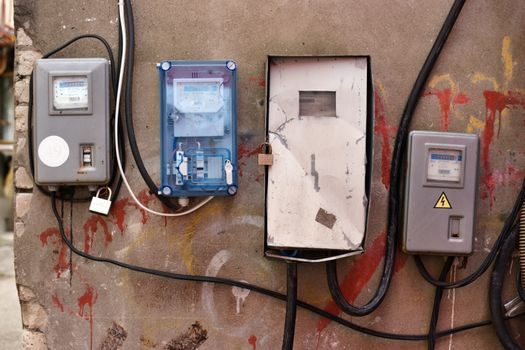
Pole count is a wiring decision masquerading as a spec decision. Options run 1P, 1P+N, 2P, 3P, 3P+N and 4P, with the key differentiation being whether the neutral is switched, protected, or both [S2]. For single-phase final-distribution circuits feeding sockets, a 1P+N MCB paired with a separate RCCB upstream is the typical European pattern; for three-phase motor loads, a 3P device is standard, while 4P is reserved for cases where the neutral is genuinely switched (ATS, generator change-over, or systems where a single-pole ground fault on the load side must not back-feed through the neutral).
On three-phase supplies feeding mixed single- and three-phase loads, an unbalanced neutral current is normal, and a 3P device with a switched neutral is not the same product as a 4P. RCBO devices (RCD + MCB combined) come in 1P+N and 3P+N form factors and are increasingly specified for branch circuits in commercial builds because they save DIN-rail space and simplify coordination with the upstream RCCB [S2]. When the application is a PLC-driven control panel, the breaker decision also has to clear with the safety relay and contactor coordination, which is a separate calculation but starts from the same In/Icu pair.
Residual-Current Protection: RCCB, RCBO, AFDD and Where Each Earns Its Slot
Residual-current protection is its own gate, bolted on top of the overcurrent gate. RCCBs (residual-current circuit breakers, no overcurrent trip) come in 30 mA, 100 mA, 300 mA and selective 300 mA–500 mA variants, and are the default for human-protection (30 mA) and fire-protection (300 mA) per common wiring-rules practice [S2]. RCBOs combine the RCCB and MCB into a single module, useful where panel space is tight and discrimination with the upstream RCCB must be engineered. AFDDs (arc-fault detection devices) are a newer gate, specified in some 2026 residential codes for bedroom and timber-frame circuits to catch series and parallel arcing that a thermal-magnetic breaker will not see [S2].
For most industrial control panels, 30 mA RCD protection on socket-outlet circuits and 300 mA selective RCD on the main incomer is a typical 2026 baseline. Type A (AC + pulsating DC sensitivity) and Type B (smooth DC sensitivity, required for some VFD-driven loads) are not interchangeable: a Type AC RCCB on a modern three-phase inverter output is a misapplication that has been documented to fail to trip. Smart circuit breakers with metering and remote-trip coils are a separate category that overlays communication protocols (Modbus, IEC 61850, or wireless) on top of the same thermal-magnetic core, and are increasingly bundled into energy-monitoring flow meter and sub-metering strategies in process plants [S2].
Certification and Zone Matching: IEC, UL, ATEX, CCC and Marine

The fifth gate is the certification envelope, and it is the gate that procurement most often gets wrong by accepting a lower-cost, mis-certified device. Common families seen in 2026 OEM catalogues include IEC 60898-1 / IEC 60947-2 performance certification, CE marking under the EU Low Voltage Directive, ATEX/IECEx for explosive atmospheres (paired with an Ex d or Ex e enclosure), UL 489 / UL 1066 for the North American market, and CCC for mainland China [S1][S2]. A breaker marked to IEC 60898-1 is household-and-similar-installations grade and is not interchangeable with an IEC 60947-2 industrial-grade device, even at the same In and Icu.
For explosive-atmosphere installations, the breaker itself is rarely Ex-rated in isolation; it is the enclosure assembly (typically Ex d cast or Ex e increased-safety) that carries the rating, and the breaker inside is selected for its thermal limits inside that enclosure. For marine and offshore use, additional type approval from IACS members (DNV, Lloyd's, ABS, BV) is standard. The cost premium for a fully certified breaker against an exotic-agency approval list is typically 15–40 % over a base CE/IEC 60947-2 unit, but on a hazardous-area retrofit the alternative is a refused commissioning, which is far more expensive.
Comparison: MCB vs MCCB vs ACB vs Smart Breaker Across Six Decision Criteria
Across the four main low-voltage breaker families, the differentiation breaks down along six criteria: rated current range, breaking capacity, adjustability, communication, panel footprint, and price. MCBs cover 0.5 A to 125 A, Icu typically 3–25 kA, fixed thermal and magnetic settings, no native comms, single-module DIN-rail width, and the lowest unit cost [S2]. MCCBs cover 16 A to 1600 A, Icu 10–150 kA, adjustable Ir/Ii on higher frames, optional Modbus/comm modules, fixed or withdrawable mounting, mid-tier cost. ACBs cover 630 A to 6300 A, Icu 65–150 kA, fully adjustable with trip-unit logic, native IEC 61850/Ethernet comms on modern frames, withdrawable, top-tier cost [S1]. Smart MCBs and smart MCCBs add metering, remote trip, and load-shedding at a 20–60 % cost premium over the equivalent thermal-magnetic device [S2].
For final distribution (residential, light commercial sockets, lighting), MCB with optional RCBO is the standard answer. For feeder and sub-feeder protection in commercial and light-industrial panels, MCCB is the default. For main incoming on a low-voltage switchboard above ~800 A, ACB is the engineering default because of adjustability, withdrawability, and discrimination engineering. For renewable, data-centre and microgrid applications where remote tripping and metering are specified, smart MCCB or smart ACB is now common. A pressure transmitter loop in a hazardous area will commonly have its own Ex d enclosure next to the breaker cabinet, but the breaker selection is governed by the same IEC 60947-2 / ATEX 2014/34/EU logic.
Selection Pitfalls: Discrimination, Back-up, Derating and the Hidden Costs
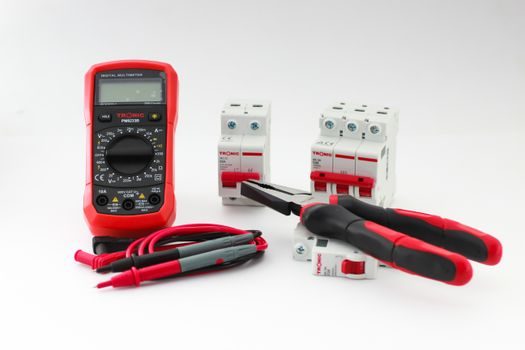
Four pitfalls show up again and again in 2026 panel builds. The first is discrimination (selectivity): upstream ACB/MCCB should not trip for a downstream MCB fault, and this is engineered through time-current curves, Icw ratings, and sometimes zone-selective interlocking on premium trip units. The second is back-up protection: an MCCB with 36 kA Icu can be used downstream of a limiter to extend effective breaking capacity to 65 kA or 100 kA, but only if the limiter-breaker combination is type-tested together; mixing brands breaks the certification. The third is derating: a 25 A MCB in a sealed cabinet at 50 °C ambient will not carry 25 A; the derated In can drop to ~21 A, and a 32 A MCB may be required to deliver 25 A continuously in that location. The fourth is harmonic heating on LED and inverter-driven loads, which inflates neutral current on three-phase supplies and pushes 3P+N breakers harder than their nameplate suggests [S2].
On a real build, the practical workflow is: calculate Icc at each busbar, pick Icu ≥ Icc with one-step headroom, pick In ≥ 1.25 × load current with derating, pick the curve to match load type, decide residual-current gating (none, 30 mA, 300 mA, selective), pick pole count and neutral handling, pick the certification envelope, then sanity-check selectivity against the upstream device. Only after those gates are locked should price and lead-time enter the conversation; the cheapest breaker on a non-matching Icu is the most expensive breaker on the project. Engineering buyers pairing breaker selection with adjacent industrial valve or pressure sensor decisions are also likely weighing similar remote I/O module choices, where the same principle — lock the spec gates before the brand — applies.
Signals to Track in the Next Procurement Cycle
Two signals are worth watching in the next 90 days. First, the rollout of mandatory AFDD protection in new residential circuits is gaining pace in several European and APAC jurisdictions, and breaker suppliers are extending AFDD-in-MCB modules into wider current ranges; specifiers writing 2026-Q3 panel specs should check whether their jurisdiction is in the current or next adoption wave [S2]. Second, smart-MCB and smart-MCCB communication is moving from proprietary protocols to standard Ethernet-APL and IEC 61850 on the ACB side, and to Modbus TCP and MQTT on the MCB side; buyers who can standardise on one protocol stack across breaker, PLC, and metering will save on integration hours. Trackable nodes: the next ABB SACE catalogue revision (typically Q3) and the next CNC Electric low-voltage catalogue update, both of which will likely tighten the smart-breaker and AFDD ranges against the IEC 60898-1 / IEC 60947-2 baseline [S1][S2].