A 7-1/4 in. corded circular saw retails between $40 and $140, a cordless 7-1/4 in. kit between $80 and $260, and a premium cordless 18V–60V set between $150 and $400 in U.S. channels as of August 2026 [S2][S5].
Behind those numbers, three subassemblies set the bill of materials: the stator-and-armature motor pack, the helical/spur gear train that drops spindle speed from motor RPM to usable blade RPM, and a die-cast housing cluster (motor housing, gear case, blade guard hinge, base plate) where most of the tonnage sits.
Where the dollars actually sit in a circular saw BOM
IMARC's April 2026 plant report ranks high-speed steel (HSS) and tool-steel stock at 60–70% of OpEx for a circular saw manufacturing facility, reflecting both the blade and the pinion/bevel gears that share the same metallurgical supply chain [S1]. Material line items in a finished saw carry the same weight: U.S. retail cost builds show the materials bucket at $40-$260 per unit, dwarfing labor ($20-$80) and delivery ($5-$30) on the same quote sheet [S2]. For a basic $50 corded 7-1/4 in. model, the materials column is effectively the entire bill; for a $260 cordless kit, the same materials bucket still dominates at roughly 60-75% of the landed cost [S4].
The retail price gap between a $90 mid-tier 7-1/4 in. corded saw and a $230 60V cordless pro unit is not a feature tax, it is a stack-up of copper mass in the motor, lithium cell cost in the battery pack, and tighter machining tolerances on the helical pinion that engages the larger blade-driving bevel gear [S5].
Motor winding: copper mass, magnet type, and why cordless is a different motor
Universal (brushed) motors for corded 7-1/4 in. saws typically draw 13–15 A at 120 V, with armature and field windings sized around 1.0–1.6 kW continuous output; the move to a brushless DC (BLDC) platform in 18V/20V cordless models replaces the field winding with rare-earth magnets but adds a stacked-laminated stator that must be hand-wound or wound by a needle winder, which is the single largest labor content in motor subassembly [S2][S4].
Vacuum-pressure-impregnated (VPI) or trickle-impregnated Class H or Class F insulation, copper purity of C11000 or C10100 for the field coils, and balanced rotor assemblies are the spec-level deltas that separate a $90 mid-range saw from a $230 pro saw, and they are largely invisible to the buyer on the box.
Gear cutting: hobbed steel vs sintered vs die-cast worm/pinion
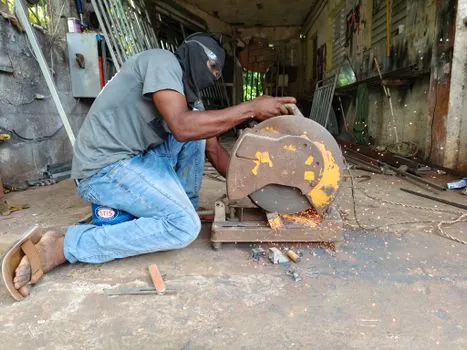
The gear train in a typical 7-1/4 in. saw is a two-stage reduction: a small pinion on the motor shaft drives a larger helical gear, which in turn drives the spindle that carries the blade. In corded 15 A models this reduction is on the order of 4:1 to 6:1 from ~30,000 RPM armature speed down to ~5,800 RPM blade speed; in pro cordless models the motor spins lower and the ratio is similar, but the gears are wider to absorb higher torque peaks. [S2]
Cold-rolled steel gears hobbed from alloy steel such as AISI 4140 or 8620, case-hardened to ~58–62 HRC, are the standard for the primary reduction; mid-range saws often drop to sintered powder-metal gears for the second stage, where loading is lower, and entry-level saws frequently use a zinc or aluminum die casting worm-and-wheel pair for the final stage, with the worm hobbed from steel and the wheel cast around a sintered bushing. Tolerances on the pinion-to-gear mesh are typically AGMA Q8 or Q9, and any deviation shows up as noise, vibration, and premature bearing failure inside the die cast gear case.
Die-cast subassemblies: motor housing, gear case, guard, and base
Aluminum high-pressure die casting supplies the structural skeleton of a circular saw: the motor housing (also called the field case), the gear case that holds the bearings and gear pair, the blade-guard pivot housing, and in many corded models the shoe or base plate. A typical 7-1/4 in. corded saw uses 2–4 die-cast aluminum parts totaling roughly 1.2–1.8 kg of cast weight, with the gear case alone near 0.6–0.9 kg; cordless models shift some of that volume to magnesium or glass-filled nylon for weight reduction, but the gear case and motor housing stay aluminum for heat dissipation [S1].
The die-cast content is the single largest variable in tool-to-tool material variance: a $60 basic 7-1/4 in. corded saw with a stamped steel motor housing and a cast gear case has noticeably less cast tonnage than a $180 mid-range corded saw with a fully cast clamshell motor housing and a cast magnesium shoe, which is part of why the materials column can swing from $40 to $260 across retail SKUs [S2][S4]. For comparison, an aluminum die casting machine in the 800–1,200 ton clamp range is the typical workhorse for these parts, and a gravity die casting machine is sometimes used for the larger base plate where porosity tolerance is looser.
Putting it together: a cost-driver stack for the BOM engineer
Ranked from largest to smallest share of unit cost in a mid-range 7-1/4 in. corded saw sold for ~$120 retail, the stack is: motor winding (copper, magnet, stator stack) ~18–24%; HSS or carbide-tipped blade ~12–18%; die-cast aluminum housings ~10–15%; gear-train pair (hobbed steel plus optional sintered stage) ~5–8%; bearings, switches, cord set, and electronics ~10–15%; packaging, blade wrench, manual ~2–4%; assembly labor ~5–8% [S1][S2][S5].
For a premium 60V cordless kit at ~$300 retail, the stack reshuffles: battery pack and electronics climb to 28–35%, motor winding holds at 18–22%, blade drops to 8–12% because the buyer already owns blades, die-cast housings sit at 8–10%, and the rest is gear-train, bearings, and assembly [S4][S5]. The die-cast content is roughly the same in absolute kilograms, but its share of the total falls because the battery pack has entered the cost equation.
Selection guidance for sourcing and design teams
Spec the gear case and motor housing as A380 or A383 die castings, with a minimum wall of 2.5–3.0 mm and bearing bores finished by post-cast machining to ISO 286-1 H7 fit, when the saw is rated for continuous 15 A corded duty; for cordless 18V–60V platforms, consider a hybrid motor housing (cast aluminum core, overmolded polymer skin) to drop 100–200 g without sacrificing heat dissipation [S1].
Buy pinion gears as hobbed AISI 4140 case-hardened to 58–62 HRC for primary reduction, and reserve sintered powder metal for the secondary stage where loading is below ~3:1 ratio at full load torque; avoid die-cast worm-and-wheel pairs for any stage loaded above 2 Nm continuous. On the motor, use C11000 copper with Class F (155 °C) or Class H (180 °C) insulation, VPI-impregnated, and balance the rotor to G2.5 or better for handheld vibration compliance. These three choices (casting alloy and tolerance class, gear material by stage, motor copper and insulation) explain roughly 70% of the unit-cost variance between a $60 and a $300 circular saw on the same retail shelf, and they are the levers a sourcing engineer can actually pull rather than negotiating sticker price.
Failure modes and where the savings actually leak
Three failure modes drive warranty cost in this product class, and each maps back to one of the cost drivers above. Worn commutator and field-coil failure on brushed corded saws is almost always a thermal issue: insufficient die-cast surface area on the motor housing, or a Class A (105 °C) insulation that was substituted for the Class F spec, shows up as field-winding shorts inside 200–400 hours. Gear-train stripping in cordless models traces to a sintered second-stage gear that was spec'd where a hobbed steel gear should have been, or to a mesh misalignment caused by a gear-case bore that drifted out of H7 tolerance after casting. Blade-guard pivot failure is a casting-defect issue: porosity in the pivot boss of the die-cast guard housing creates a crack initiation site under repeated kickback loading, and the fix is either a die redesign with a thicker boss or a switch to a gravity die casting process for that part where porosity tolerance is tighter. [S4]
The cost of getting these wrong shows up not in the BOM line but in warranty reserves, which on a $120 retail saw can run 4–7% of revenue on a problematic SKU versus 1.5–2.5% on a clean one, and that gap is large enough to wipe out the saving from a cheaper die-cast source or a thinner gear stage [S1][S2].
Total cost of ownership across the saw's service life
Purchase price is roughly half the story for a pro user; the other half is blade replacement, energy, and downtime. A carbide-tipped 7-1/4 in. blade runs $5–$25 retail and lasts 50–200 cuts depending on material, which means a carpenter pulling 20 cuts a day spends $0.10–$0.50 per cut on blades over a year, often more than the electricity to run a 15 A corded saw for the same cuts at ~$0.05–$0.08 per hour of loaded runtime [S2][S4].
Cordless total cost of ownership is dominated by battery cycle life: a 5 Ah 18V pack rated for 1,000 cycles adds roughly $0.08–$0.12 per cut in amortized cell cost, and 60V pro platforms with larger 6–9 Ah packs stretch that to $0.15–$0.25 per cut, which is why contractors who burn 3–4 batteries a year on a $200 replacement cost carefully weigh cordless convenience against corded reliability [S5]. For an engineering buyer building a fleet, the 5-year TCO math is therefore: purchase 30%, blades and consumables 25–30%, energy 5–8%, battery replacement 20–30% (cordless only), and warranty/service 5–10%.
Track these signals through 2026: the IMARC forecast of a 4.0% CAGR for the global circular saw market through 2034 implies steady raw-material cost pressure rather than a spike [S1], while the widening retail gap between $90 mid-range corded and $230 60V cordless indicates that the cordless premium has not yet compressed and remains the most elastic line item for cost-down engineering [S2][S5]. For a closer look at how aluminum and copper feedstock move downstream prices, see the parallel piece on Aluminum wire rod prices and cable demand: 2026 market signals.