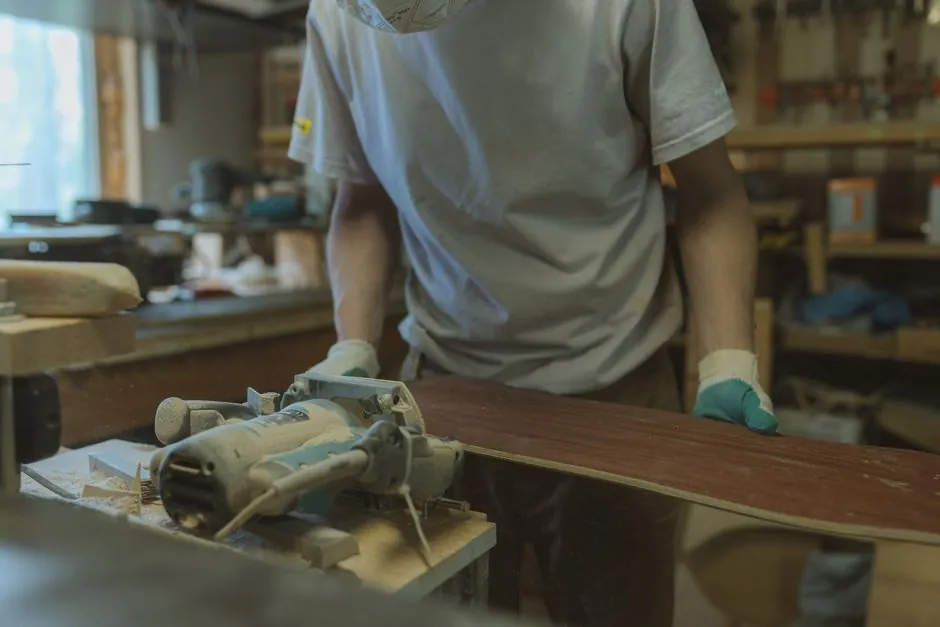
Portable circular saws cause a disproportionate share of jobsite lacerations and kickback injuries because the cutting tool, the workpiece, and the operator's hands share a single reactive plane. Three failure paths recur across regulatory guidance: a dull or wrong-RPM blade that binds, a defeated or sluggish retracting lower guard, and inadequate eye, hearing, or respiratory protection against fine wood dust [S1][S3].
CCOHS lists approved safety glasses, goggles, or a full face shield as the baseline for every cut, and adds an approved respirator or dust mask whenever the stock generates harmful or nuisance dust, which is essentially every cut in MDF, OSB, or treated lumber [S1]. SafeWork SA echoes the dust-control requirement and explicitly bans forcing the saw, with a standing rule to keep both the upper housing and the retracting lower blade guard free of compacted sawdust before placement [S4].
Blade Selection, RPM Match, and Depth-of-Cut
The blade is the single most failure-prone component on a portable circular saw, and the published rule is non-negotiable: the maximum RPM printed on the blade must be equal to or greater than the no-load RPM on the saw's nameplate, and the arbor hole must match the saw's spindle [S3]. A mismatched bore or underspeed-rated blade can shatter at speed; a dull blade instead binds, stalls the motor, and initiates kickback against the operator [S3].
Depth-of-cut is set to no more than 1/8 in. to 1/4 in. greater than the material thickness, which keeps the blade's tooth exit below the workpiece surface and reduces the chance of the lower guard riding up on a splintered edge [S3]. Carbidetipped blades are specified for OSB, plywood, and framing lumber; fine-tooth panelsizing blades are reserved for sheet goods where chip-out is unacceptable. Stock condition matters as much as blade choice: pitchy, knotty, or warped material is flagged across trade guidance as the leading setup for a kickback event [S3].
Guards, Kickback Geometry, and Two-Handed Control
The retracting lower guard is the saw's primary engineered control, and the published safety position is that it must never be tied back, blocked open, or removed for any cut [S1][S3][S4]. The guard is spring-loaded to close the instant the shoe lifts off the workpiece, and a guard that is slow to return or hangs up must be adjusted or repaired before the saw returns to service [S3]. SafeWork SA lists keeping the upper and retracting lower guards clean of compacted sawdust as a prerequisite for placing the saw down, since dust-packed pivots are the most common reason a guard fails to self-close [S4].
Two-handed control on a securely clamped workpiece is the matched mechanical control to the guard: the saw is held with both hands, the workpiece is clamped rather than held in the hand or across a leg, and small pieces that cannot be secured are not cut on a portable saw [S3][S4][S6]. For a "blind" cut where the material behind the blade is hidden, hidden electrical wiring and water pipes must be confirmed absent or disconnected at the panel by a qualified person before the cut starts, and the tool is to be gripped only by its insulated grasping surfaces [S3].
PPE Specification: Eyes, Hearing, Lungs, Feet
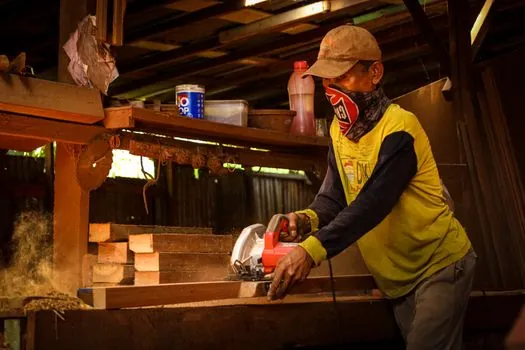
Eye protection is required on every cut, with safety glasses or goggles meeting the current national standard, plus a full face shield for overhead or high-debris work [S1][S3]. Hearing protection is added during extended periods of operation, since circular saws at full throat on framing lumber routinely measure in the 95–105 dB(A) range at the operator's station [S3]. An approved respirator or dust mask is added whenever the cut generates harmful dust; this is a hard requirement on engineered wood products, treated lumber, and any cut that produces visible airborne fines [S1].
Site-level PPE for circular-saw work is documented in OSHA-aligned toolbox talks and includes safety-toe footwear, hard hat, and task-appropriate gloves, with the explicit note that glove use must not interfere with trigger control [S7]. Loose clothing, jewelry, and untied long hair are excluded from the work area because rotating arbors do not discriminate between wood and fabric [S1][S2][S3]. These PPE layers are not redundant: eye protection guards against tooth-ejected chips, hearing protection guards against cumulative cochlear damage, and respiratory protection guards against the respirable crystalline silica load generated by cutting stone composites or fibre-cement boards, a hazard treated as foundational across modern construction safety guidance [S1][S5].
Workpiece Setup, Cord Routing, and Kickback Triggers
Workpiece setup drives a large share of kickback events: stock must be clamped, supported, and checked frequently because a clamp that walks under vibration turns a controlled cut into a pinch [S3]. The power cord and extension cord must be routed out of the blade path and have sufficient length to complete the cut without a sudden jerk, since a snagged cord yanks the saw backward into the operator's body [S3].
Kickback is a reactive torque event, not a random failure: it is triggered by the blade pinching in the kerf, by the blade being forced into the cut, or by the shoe lifting and exposing the upper teeth of an under-depth set [S3]. The published response is to release the trigger immediately on a partial cut or power interruption and to keep the saw in the material until the blade has stopped, rather than to pull the saw back across the still-spinning arbor [S3]. Material condition is the leading controllable variable: pitchy, knotty, or warped stock must be approached with reduced feed rate, and warped stock is best stabilized against a straightedge fence to prevent the kerf from closing on the blade [S3].
Siting This Guidance Against the Wider Power-Tool Safety Stack

Portable circular saws sit in the middle of the hand-held power-tool risk band: above drills and drivers, below chainsaws and abrasive cut-off saws. The shared safety chassis across the category includes two-handed control, intact guarding, matched-RPM accessories, and PPE scaled to the dust and noise load, all of which transfer directly from circular-saw guidance to machine safety programs on a jobsite. The dust and respiratory controls are also where circular-saw practice intersects with fire safety planning, since fine wood dust accumulations are a documented ignition-source concern in enclosed shop environments [S1][S5].
For procurement and contractor pre-qualification, the circular saw selection criteria that hold up across CCOHS, SafeWork SA, PTI, and OSHA-aligned guidance are: a spring-loaded retracting lower guard that self-closes from any angle, a no-load RPM marked on the nameplate, an accessible and lockable trigger, and a depth-of-cut adjustment that locks positively at the set position. Construction machinery and equipment fleets that buy on these four criteria, rather than on peak wattage alone, consistently produce lower cut-rate injury frequency in trade self-reports, though published frequency figures vary widely by source and survey method and are not reproduced here.
Limitations and Failure Modes Not Covered by Generic Guidance
Generic circular-saw guidance is built around wood and wood-composite cutting and does not cover metal-cutting circular saws, abrasive cut-off wheels, or masonry saws, which carry additional guarding, coolant, and respiratory requirements under separate standards. Battery-powered saws introduce a separate failure mode: a stalled blade on a high-capacity lithium pack can deliver enough reactive torque to cause a kickback before the electronic brake engages, which is why battery-platform saws are subject to the same depth-of-cut and two-handed rules as corded units [S3].
Shop-grade guidance also assumes a trained adult operator on stable ground; ladder-held and scaffold-held cuts, common in framing and roofing, are outside the scope of portable-saw baseline guidance and require a separate fall-protection and tool-tethering review. Operators are directed to follow the manufacturer manual for the specific tool and to treat the published CCOHS, SafeWork SA, and PTI positions as a floor, not a ceiling [S1][S4][S5].
Trackable signals for the next quarter: revised PTI member guidance on battery-platform circular saws, any update to the Power Tool Institute circular-saw safety video curriculum, and SafeWork SA's planned construction-safety campaign for engineered-stone workplaces, all of which will fold back into the PPE and dust-control language cited above.
Related analysis: Pipe Fitting Types and Classifications: A Spec-First Reference.