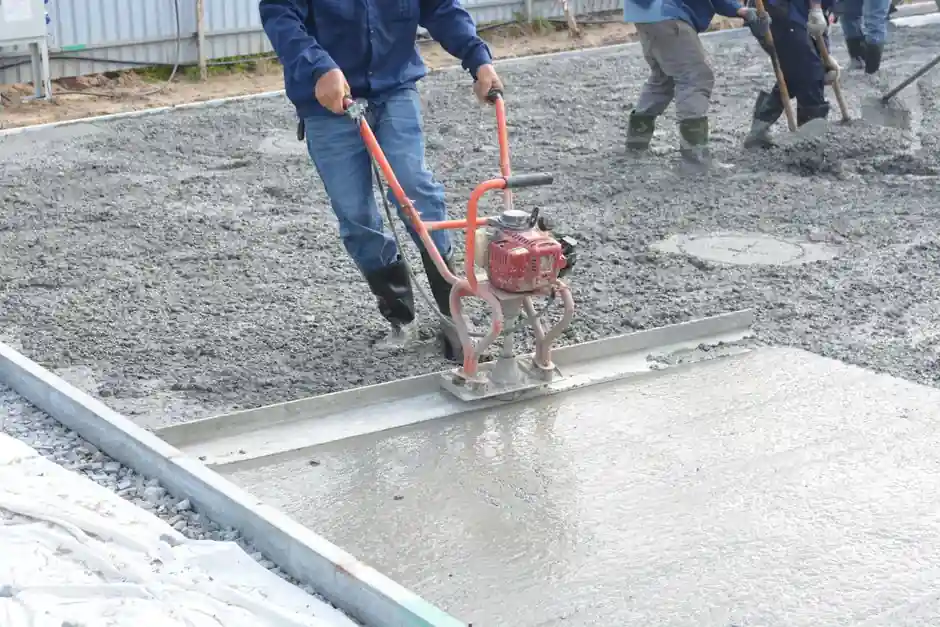
Power trowels used to finish the concrete housekeeping pads beneath rooftop units, air handlers, and chiller bases are subjected to a punishing environment: high-dust slab pours, start-stop cycles around duct penetrations, and tight finish tolerances on the 100-150 mm thick pads that anchor power distribution skids. Field service manuals from BISON Machinery, Junqi, and Multiquip converge on the same baseline: wash the machine before concrete cures, grease every shift, change gearbox oil every 50 hours, and replace blades in matched sets [S1][S2][S4].
For HVAC-specific pours, where the floor flatness requirement under equipment feet is typically FF 25-40 per ACI 117, a trowel that sputters or leaves swirl marks on the slab is not a cosmetic problem; it is a vibration and shim problem once the power meter cabinets or air-handler rails are bolted down. A poorly maintained trowel is the single most common cause of "furrow" chatter in contractor reports, defined by Stone Construction Equipment's engineering project manager Ed Varel as dents left by jerking blades on wet concrete [S5].
Pre-Operation Checks: Blades, Emergency Stop, Belts, Air Filter
The walk-around takes 5 minutes and prevents 90% of the callbacks cited by Multiquip's STR46SP manual [S4]. Inspect the float pans and finishing blades for uneven tilt, cracks, or aluminum-foil-like flaking; all blades on a rotor must be replaced as a matched set to keep rotor balance within tolerance [S1][S2]. Test the emergency stop by starting the engine at idle, then flipping the E-stop; the engine must shut down immediately, with the switch snapping freely between on and off without friction. A disabled E-stop is the single failure mode BISON flags as the root cause of high-speed spin-outs on small walk-behind units [S1].
Check belt tension before the first run, then re-tension after the first hour; new belts stretch 2-3% on initial heat-up, and machines with multi-belt drives must have all belts replaced at the same time to keep the rotor balanced [S1]. Examine the air filter element for concrete-dust loading; Wacker Neuson's product support lead Troy Halverson identifies choked air filters as the most common cause of low-power trowels in the field, and a 2-3 psi restriction on a 5 hp engine cuts rpm enough to leave swirl marks on the pad [S5]. For engine oil and gearbox oil, daily level checks plus a 50-hour drain interval on the crankcase and at least one annual change on the gearbox are the published baselines [S1][S2].
Concrete Cleanout: The 30-Minute Rule
Dried concrete is the dominant failure cause for ride-on trowels returned to rental yards, and the fix is procedural, not mechanical. Bartell Global's service team recommends pressure-washing the unit immediately after the slab is finished, while residue is still wet, and applying a concrete-release product such as Liquid Hammer on-site before the slurry hardens onto rotating parts [S3]. For rental fleets, Multiquip and Whiteman's product manager Ben Wiese notes that dry concrete falling off a dirty trowel during the final finish passes scratches the polished slab and cannot be repaired without re-polishing the surface [S5].
Two operational rules matter for HVAC pad pours specifically. First, refuel only with the engine stopped and the exhaust cool; the Multiquip STR46SP manual lists hot-exhaust contact during refueling as a documented burn-source hazard on ride-on units, where the fuel cap sits within 300-400 mm of the manifold [S4]. Second, never direct the pressure washer at bearing seals, control cables, or the E-stop switch; Junqi's maintenance guide specifies a brush or low-pressure compressed air for the bearing and gearbox housings, with washing pressure limited to the pan and frame [S2].
Lubrication, Hardware, and Engine Care Schedule
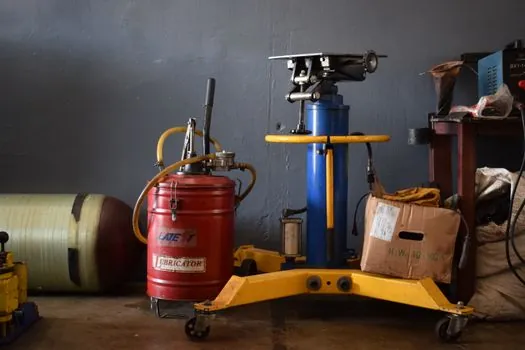
Engine and bearing lubrication is the other half of the daily routine. Use fresh gasoline (less than 30 days old, no ethanol phase separation) and the engine manufacturer's specified oil grade, typically SAE 10W-30 for ambient pours above 4°C [S3]. Grease every pivot, spider bearing, and throttle linkage per the chart in the operator's manual; Bartell Global notes that grease-starved spider bearings on ride-on units fail at 200-400 hours, a fraction of the 1,500-2,000 hour design life of a properly serviced unit [S3][S5]. Torque the blade-attachment bolts to the manufacturer spec before each pour; Husqvarna's Scott Brening flags loose blade bolts as the cause of rotor imbalance that produces visible wobble and is dangerous once rotational speed exceeds 120 rpm [S5].
A working 60-90 minute slab finishing cycle on a 200 m² HVAC equipment room typically consumes 2-3 litres of fuel and accumulates 0.5-1.0 kg of concrete dust on the machine, so the daily service interval should be tied to slab count rather than engine hours. A practical schedule for a two-trowel HVAC pad crew: full wash and grease between every slab, engine oil check at start of shift, air filter inspection every 4 hours of dust exposure, and a 50-hour crankcase drain. For the gearbox oil, drain annually at minimum, or sooner if the oil shows a milky emulsion indicating water ingress through the spider-bearing seal [S1][S2].
Troubleshooting: Swirl Marks, Vibration, Power Loss
Three failure modes cover the bulk of HVAC slab troweling problems. Swirl marks on the final pass are almost always bent blade arms, mis-pitched blades, or a clogged air filter starving the engine of rpm; check arm straightness with the rotor removed on a flat bench before assuming engine problems [S1][S5]. Lateral wobble at speed is 90% of the time a single loose or worn blade throwing the rotor off balance; replace blades as a matched set and re-torque to spec [S1][S5]. Loss of top-end power, the symptom Halverson flags most often, is air filter restriction roughly 80% of the time, with the remainder being stale fuel, fouled spark plug, or low gearbox oil dragging the driveline [S5].
Electrical trowels used inside enclosed mechanical rooms add a fourth failure mode: cord damage. Junqi's pre-operation list calls for inspection of the entire power cord for exposure, tears, and aging, plus routing the cable away from sharp rebar and hot ductwork; a cut jacket on a 110 V or 230 V unit in a damp pour is a ground-fault risk, and GFCI protection on the supply is mandatory under typical site-electrical practice [S2]. Replace any cord with visible copper exposure, not just tape it. For the broader selection logic on matching trowel class to slab area, a useful parallel is the spec-driven mapping approach used for Food Processing Belt Tensioner Selection: Spec-First Map, where the daily-versus-annual service split mirrors the trowel walk-around versus 50-hour service split. When the failure is the engine itself rather than peripheral maintenance, escalate to the engine OEM service network; do not attempt to rebuild a Honda GX-series or Briggs Vanguard powerplant in the field, since warranty voidance and balance-of-machine risk outweigh the cost of a service exchange [S3][S4].
Replacement vs Repair: When to Walk Away
Two thresholds justify retirement rather than repair. First, a gearbox housing with scored bearings, milky oil that does not clear after two drains, or a spider plate with visible cracking has reached end-of-service life; rebuild cost on a ride-on gearbox is typically 60-70% of replacement, and the rebuilt unit inherits the used bearings in the yoke [S2][S4]. Second, a bent rotor arm or twisted frame is a structural reject; straightening a bent arm alters its resonant frequency and the imbalance will return within hours of operation [S1][S5]. For everything else (blades, belts, air filter, throttle cable, E-stop switch, spark plug, oil seals), scheduled replacement at the published interval is cheaper than the labor cost of a field failure on a pour day.
Track three signals going into the next HVAC pour season: the OEM-published revision of the engine operator manual (most are updated on a 3-5 year cycle, with Honda GX-series and Briggs Vanguard service intervals occasionally revised), any change to local silica-exposure rules that affect dry-cutting vs wet-cutting trowel dust suppression, and rental-yard fleet refresh cycles, which often pull 5-7 year old machines out of service and shift the used market for walk-behind units. Two cross-references worth keeping alongside the trowel service log: the marine HVAC spec map for enclosed mechanical-room ventilation when running gas trowels in tight spaces, and the power mixer maintenance reference for the drum-style mixers feeding the slab pour that the trowel will finish.