
A circular saw is a power saw with a steel disc carrying cutting teeth on its periphery, rotating on a fixed spindle — and the 2026 DirectIndustry catalogue still lists the Metabowerke KS 55 FS at a 160 mm (6 in) blade diameter with a 39–55 mm (2 in) round-piece capacity for aluminum precision cutting [S1].
Industrial catalogs now group circular saws along four axes: power source (corded, cordless/18–36 V, pneumatic, hydraulic), frame style (handheld, miter, sliding-miter, bench/table, radial-arm, cold-cut metal saw), blade composition (HSS, carbide-tipped, segmental diamond, abrasive), and the workpiece they are designed to cut (wood, aluminum, mild steel, stainless, masonry, composites) [S1].
Definition, Working Principle and Scope
A circular saw cuts by rotating a toothed disc at high peripheral speed and feeding the workpiece into the rim; the tooth geometry (raker, ATB, TCG) is chosen to match chip thickness, material hardness and cut finish [S1].
U.S. saw-plate specialist Grasche USA, manufacturing custom saw bodies in North Carolina since 1979, builds saw plates by laser cutting, heat treating, reaming, surface grinding and tensioning (hammering) German cold-rolled saw steel — establishing the steel-plate tolerance envelope that every other classification inherits [S2]. The core spec layers are: blade diameter (typically 160–457 mm / 6–18 in for stationary metal saws, up to 1,200 mm for industrial wood rip saws), bore, kerf (1.6–4.0 mm), tooth count (24–120 for wood, 36–80 for metal), and tip material (HSS M2/M42, tungsten carbide K10–K20, or diamond segment).
Classification by Power Source and Frame
Corded mains-driven units dominate stationary metal-cutting lines for thermal stability, while 18 V and 36 V cordless platforms have closed the gap on handheld wood framing to within 10–15% of corded RPM under load since the 2023 brushless motor generation [S1].
By frame, the working categories are: (1) handheld circular saw (skil-saw style, bevel up to 56°), (2) miter saw / chop saw (single-bevel, 0–48°), (3) sliding compound miter saw (e.g. Metabowerke KGSV 216 MC for aluminum, 216 mm blade) [S1], (4) bench-top / sliding table saw (e.g. TKHS 315 C for wood, 315 mm blade, ~3,000 W) [S1], (5) radial-arm saw, (6) cold-cut / dry-cut metal saw (140–355 mm HSS or TCT blade, 30–130 rpm), and (7) production cut-off saw with hydraulic feed.
Classification by Blade Material and Tooth Geometry

Blade material is the harder spec gate: HSS M2 reaches ~62 HRC and is used for thin-wall steel and aluminum up to 600 m/min peripheral speed; carbide-tipped (K10–K20) reaches 1,400 HV and handles MDF, melamine, stainless and non-ferrous at lower surface speeds; diamond segments cut cured concrete, stone, composites and abrasive refractories with water or dry cooling [S2].
Standard tooth patterns in 2026 catalogs include flat-top raker (FTR) for ripping wood, alternating top bevel (ATB) for crosscut and finish, triple-chip grind (TCG) for metal and laminates, and high-ATB (40–45°) for melamine-faced chipboard. Saw-plate flatness is held to ≤0.05 mm across the body by tensioning — a hammertune step Grasche lists as part of its standard process [S2].
Spec Comparison: Main Circular Saw Options
For spec-driven selection, the working comparison for industrial buyers is: [S1]
Handheld cordless (e.g. 18 V platform, 165–190 mm blade) — best for jobsite framing, rip cuts in wood up to 62 mm depth at 90°; not for repetitive production metal cutting. Sliding compound miter (KGSV 216 MC class, 216 mm blade, 1,500 W class) — best for trim aluminum and small-section steel at 0–48° bevel; not for full sheets or thick plate. Cold-cut metal saw (355 mm TCT blade, 1,300–1,800 W, 30–50 rpm) — best for clean, low-burr cuts in steel tube and bar up to 130 mm; not for wood or stone. Diamond-segment masonry saw (300–450 mm, 2,200 W) — best for cured concrete and stone; not for metal. Carbide-tipped sliding table saw (TKHS 315 C, 315 mm, ~3,000 W) — best for wood panel breakdown with scoring; not for metal [S1].
Selection Criteria and Application Fit
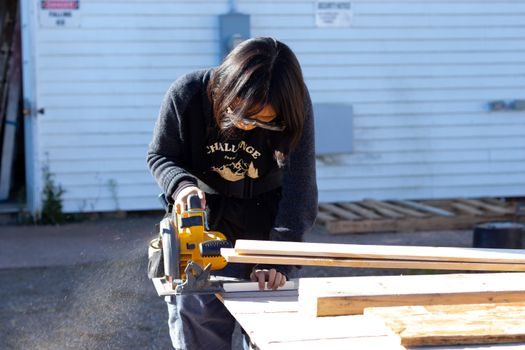
Spec-driven selection starts with four gates: workpiece material (chip load dictates tooth count), required cut finish (ATB vs TCG), duty cycle (corded mains vs battery amp-hour budget), and depth-of-cut envelope (blade diameter − arbor offset) [S1].
Wood framers typically specify 184–235 mm blades with 24–40 carbide teeth at 5,000 rpm; finish carpenters go to 60–80 teeth; cabinet shops add a scoring blade set. Metal fab shops default to cold-cut saws with TCG carbide at 30–80 rpm; aluminum extruders specify blades with tooth pitch 1.5–2× the wall thickness to prevent grab. For abrasive dust environments, dust-port Ø 35/38 mm is now standard on handheld and miter units [S1].
Limitations, Safety Gates and Failure Modes
Circular saws have three hard limits: kickback risk on small workpieces (push-stick or anti-kickback pawl required), heat build-up in abrasive cuts (coolant or pulsed feed required above 3 mm/pass in stainless), and tooth-chippage when feeding too slowly into TCG metal blades [S1].
Plunge-cut and track-saw designs (KS 55 FS class) address finish tear-out by fixing the cut geometry to an extruded guide rail — that rail interface is now cross-compatible across Metabo, Mafell, Bosch, Festool, Makita, HiKOKI and Hilti, which effectively defines a track-saw interface standard at the OEM level [S1]. Saw-plate tension must be rechecked after any impact event; a de-tensioned plate is the leading root cause of wobble and tooth-loss in industrial forensics.
Standards, Manufacturing and Sourcing

No single ISO or EN standard governs the circular saw family as a whole; instead the spec stack borrows from EN 60745 (handheld motor tools safety), EN 61029 (stationary motor tools), ANSI/UL 987 (stationary), and OSHA 29 CFR 1910.213 (woodworking machinery) for guarding and riving-knife geometry. Saw-plate makers such as Grasche USA publish flatness and parallelism to in-house tolerances since the major standards bodies treat blade geometry as a fit-for-purpose declaration by the manufacturer [S2].
Two trackable signals from the 2026 supply base: first, OEM catalogs are consolidating cross-brand track-saw rail compatibility into a single interface, reducing accessory SKUs for trim-cut aluminum and finish woodwork [S1]; second, custom saw-body lead times from U.S. shops running German cold-rolled steel are tightening against Asian imports, driven by the laser-cut, heat-treated, surface-ground and tensioned process chain that defines premium saw-plate quality [S2]. Buyers should request the mill cert for the cold-rolled steel, the post-grind flatness report, and the tensioning (hammer-tune) curve before accepting a custom plate run.
For component-level specifications, see pressure transmitter, and flow meter.
For related coverage, see Pneumatic Impact Drill ST-4250 Installation & Commissioning Guide.