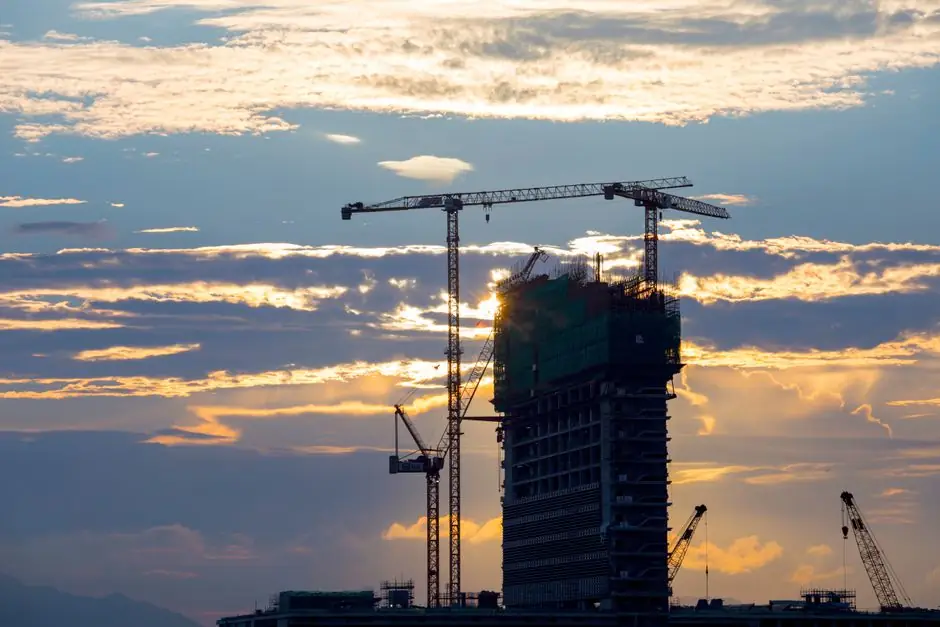
Crane-climbed jumpform remains the default for HVAC shaft and mechanical-room riser pours below roughly 30 storeys, while self-climbing (automatic) systems are increasingly specified once a project crosses the 40-storey mark, where a single hydraulic ring main can drive up to 20 climbers in unison and the core climbs without dedicated crane time [S5].
For an HVAC contractor, the decision is less about the wall and more about how the riser shaft, the plant-room slab edges, and the cooling-tower or boiler house envelope will be cast: the climbing system dictates daily cycle time, crane demand, weather window, and the number of embedded anchors left in the mechanical riser for later duct and pipe support [S1][S2].
Crane-Climbed Systems: When the Tower Crane Already Has Slack
Crane-climbed (crane-assisted) units are lifted as single assemblies by the site tower crane after each pour, and the TECON CB 180 / CB 240 line is a typical example: triangular brackets anchor to the previously cured lift, the whole panel-and-platform unit is unbolted, hooked, and re-seated one storey up, which keeps equipment cost low but commits the project to a daily crane window [S1]. Sharp Ply's CCF line follows the same logic, with reinforced frames sized for stable load transfer under dynamic crane movement and alignment features that survive the swing onto the next anchor [S3].
For HVAC work the practical limit is the tower crane's available picks per day: most contractors plan 1 pour per core per shift, and a typical 3.0–4.0 m lift height keeps the daily cycle on a single crane hook, which is why crane-climbed systems still dominate on residential and mid-rise commercial packages where the mechanical riser is cast ahead of the MEP follow-trade [S2][S5].
Self-Climbing (Automatic) Systems: When Crane Time Is the Bottleneck
Self-climbing systems use hydraulic long-stroke cylinders anchored to the cured wall and climb without a crane pick; the PERI ACS Core 400 raises one level in about 20 minutes per 40 t cylinder, while Doka's SKE50 and SKE100 automatic climbers are rated at 5 t and 10 t per unit, with a hydraulic ring main allowing up to 20 climbers to be driven from one power pack so the whole core platform lifts together [S5].
For HVAC this matters in two cases: tall mechanical risers above 40 storeys where crane picks per day are already saturated by the structural pour, and core-walled plant rooms with dense rebar where a crane swing would not clear the rebar cage. Doka's cooling-tower SK175, originally designed for hyperbolic concrete shells, shows the same self-climbing logic on a non-vertical envelope, with telescopic railed platforms that stay gapless during the climb and a 1-day casting section cycle once the crew is familiar with the system [S4].
Comparison: Three Climbing Families Against HVAC Decision Criteria
Side-by-side, the three families rank differently against the criteria that drive an HVAC riser build: crane-climbed, guided-climbing, and self-climbing (automatic). Crane-climbed (e.g. TECON CB 180/240, Sharp Ply CCF) has the lowest hire cost and the simplest anchorage, but ties each cycle to a crane pick and is vulnerable to wind stoppages above the operating threshold, so it fits projects below roughly 30 storeys with a dedicated tower crane [S1][S3]. Guided-climbing sits in the middle: the unit retracts on rails against the structure, so no crane pick is needed for the climb but the unit still has to be craned into place for the first set-up, and it suits repetitive cores between 20 and 50 storeys where the wall geometry is constant [S5]. Self-climbing (PERI ACS Core 400, Doka SKE50/SKE100, Doka SK175) removes the crane from the cycle entirely, allows up to 20 units on one hydraulic ring main, and pushes the operating wind threshold higher because the unit stays anchored throughout the climb, which is why it is the default for cores above 40 storeys and for cooling-tower and chimney shells where wind exposure is the controlling load case [S4][S5].
Selection Criteria Specific to HVAC Riser Geometry
An HVAC riser shaft is rarely a simple rectangular core: it usually has a small floor footprint (often 3 m × 4 m to 6 m × 8 m), frequent openings for duct and pipe penetrations at every level, and a high aspect ratio once the project passes 25 storeys, which biases selection toward guided-climbing and self-climbing because crane-climbed units need clear crane access above the wall [S2][S5]. Openings are handled by leaving a framed block-out in the formwork face and casting a sleeve or a header around the duct later, so the formwork panel layout is normally standardised on a 1.2 m or 2.4 m module to align with the riser's structural rebar spacing [S2].
For cooling-tower and boiler-house envelopes, the geometry tilts away from vertical: the Doka SK175 self-climbs a hyperbolic shell with a single central spindle that adjusts the scaffold inclination for the changing radius, and the steel form-facing gives a consistently high concrete surface that MEP hangers and duct supports can be fixed to without remedial drilling [S4]. Where the HVAC plant sits inside a slipformed silo, FORPRO's high-safety slip climbing system runs continuous pours for the silo wall and lets the mechanical riser be embedded in the same operation, which collapses two trades into one cycle [S6].
Loads, Pressure and Standards That Govern the Spec
Every climbing system is sized against the fresh-concrete pressure from DIN 18218, the falsework performance class from EN 12812, working-scaffold load classes from EN 12811-1, and the wind actions from EN 1991-1-4, and for North American work the equivalent anchor is ACI 347 for formwork and BS 5975 for temporary-works management; these standards fix the maximum placing rate, the tie spacing, and the operating-versus-survival wind speeds that the supplier has to declare on the data sheet [S5].
The practical consequence for HVAC risers is that the pour rate has to be coordinated with the MEP follow-trade's shift pattern, because a faster pour rate raises the lateral pressure on the form face and therefore the tie load, and a self-climbed core with a 40 t hydraulic cylinder will carry a different tie pattern than a crane-climbed triangular-bracket unit anchored only at the top of the previous lift [S1][S5]. Cantilever climbing formwork, used where the wall cannot take a through-tie, leans the load back into the structure with inclined struts and is one of the options Lianggong supplies for large-scale concrete cores where one-sided forming is required [S7].
Failure Modes, Weather Windows and When Not to Climb
The two recurring failure modes on climbing-formwork HVAC risers are tie-oversight and wind overrunning the operating threshold. Tie-oversight shows up as form face bulging or a stepped joint at the cold joint between lifts, and the corrective action is to drop back to the previous pour, re-tighten to the supplier's torque value, and reduce the placing rate; the acceptance criterion is a wall verticality within the tolerance stated on the data sheet, normally ±10 mm over a 3 m lift [S5]. Wind overrun is the more common stoppage: most crane-climbed units stop climbing once the 10 m gust exceeds roughly 12–15 m/s, while self-climbed units stay anchored and continue to operate at higher wind speeds because the hydraulic climb does not require a free-hanging load, which is the single largest reason self-climbed systems are preferred on exposed cooling-tower and chimney shells [S4][S5].
Two cases where the answer is not to climb at all: very short risers below 6 storeys, where conventional handset wall formwork is faster and cheaper than mobilising a climbing package, and high-temperature HVAC enclosures with composite cladding, where the climbing formwork cannot be reused once the geometry changes and a dedicated climbing formwork system hire is hard to amortise [S5]. For an HVAC contractor choosing between a tower-crane-friendly and a self-climbing package, the tie-breaker is almost always the number of crane picks the structural trade will release per day; if that number is below the core's daily demand, the project should plan a self-climbed core from day one, even if the riser itself is only a few storeys tall, because the same climbing platform is then available for the riser and the plant-room slab edge.
For a procurement engineer, the next verifiable node is the supplier's project-specific data sheet covering pour-rate limits, tie pattern, operating and survival wind speeds, and the maximum single-line hydraulic pressure, all of which should be cross-checked against EN 12812 and EN 1991-1-4 before the climbing system is signed off, and a side-by-side review of variable speed drives for textile mill HVAC helps frame the plant-room MEP package that has to be coordinated with the core's cycle. A second trackable signal is whether the site team has confirmed the tower crane's free-hook hours per shift, because that number alone decides between TECON CB 180/240-class crane-climbed units and PERI ACS Core 400 / Doka SKE-class self-climbed units for the HVAC riser [S1][S5].
Component reference pages worth checking: marine hvac, and asrs system.