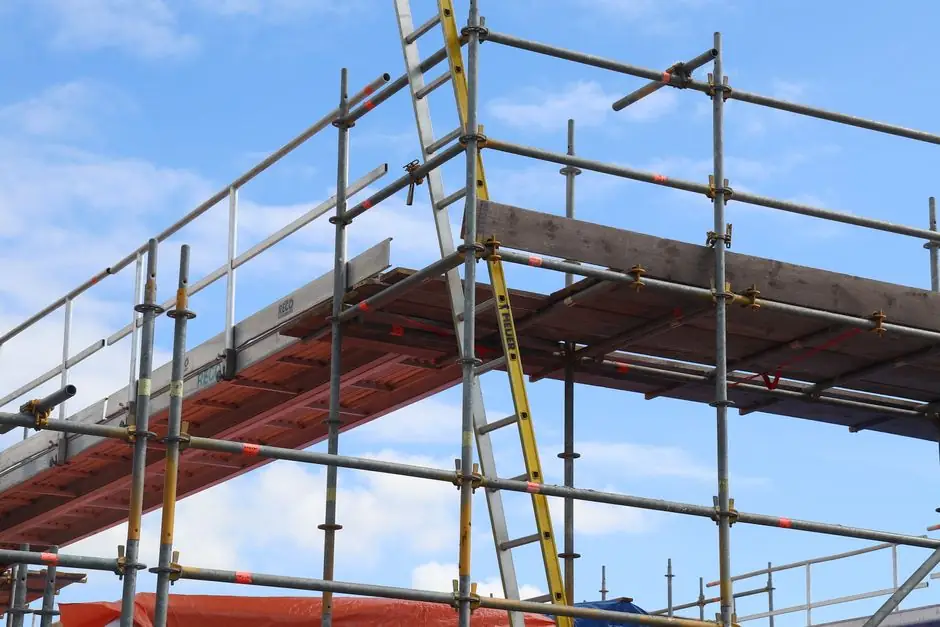
For steel-construction cores and composite shear walls, climbing formwork is selected in three families: crane-dependent, self-climbing (SCE / automatic hydraulic), and single-sided, with the boundary between them driven mainly by storey count, wind exposure, and crane-availability on site [S1].
Across published manufacturer guidance, a wall formwork is mounted on a climbing scaffold, anchored to the structure through climbing brackets fixed to preset anchors cast into the first concrete pour, so that wind load and dead load of the formwork are transferred back into the cured wall [S1]. Once concrete reaches strip strength, suspension shoes and screws are re-attached and the entire climbing platform is lifted to the next pour cycle, removing the need for repeated external scaffold erection [S1].
Crane-Dependent vs Self-Climbing vs Single-Sided: Decision Criteria
On sites with a service crane and cores up to roughly 8 storeys, crane-dependent (also called conventional) climbing formwork remains the cost baseline, since the only lifting energy is the crane hook and the system hardware is lighter per set [S1].
Above that range, hydraulic self-climbing formwork, which uses hydraulic rams anchored to the previously cast slab to lift the scaffold, secondary formwork and main formwork together without crane assistance, becomes the dominant specification, with the additional benefit that pours can continue in wind conditions that would normally shut down crane lifts [S1][S4].
Single-sided climbing is specified only where the opposite face of the wall is not accessible for tie-rod anchoring, so the formwork transfers concrete pressure into the lower pour through braces and wall struts; this is the standard detail for dams, sluices, and one-face retaining walls [S1].
Hydraulic Self-Climbing System Architecture for Steel Cores
An automatic hydraulic climbing system integrates the formwork, climbing brackets, platform system and suspension brackets directly with the concrete structure, so once concrete reaches the required strip strength the hydraulic cylinders drive the brackets along guided climbing rails to the next level, repeating the cycle as the core rises [S5].
Published component breakdowns list six functional groups: a climbing system (climbing rail, hydraulic cylinder, climbing head, vertical profile, main horizontal profile, diagonal bracing spindle strut, supporting carriage), a main platform beam (H200 + 20# U-channel), lower platform hanging brackets at -1F and -2F with vertical and horizontal profiles, a formwork travelling unit with vertical walers and diagonal bracing, an anchoring system (attachment supports, embedded climbing cones, M36 screws, stop anchors, sealing sleeves), and upper platform brackets with flip platforms [S5].
This integrated travelling-unit approach is what allows the formwork to move with the climbing brackets as one assembly, which in turn enables a fully enclosed protective screen around the working deck and cuts fall-from-height exposure during the lift cycle [S5]. For site engineers comparing this to traditional climbing formwork layouts, the practical difference is that the steel screen and formwork panel are no longer separate lifts.
Steel vs Aluminium Panels: Mass, Wind, and Cycle Time
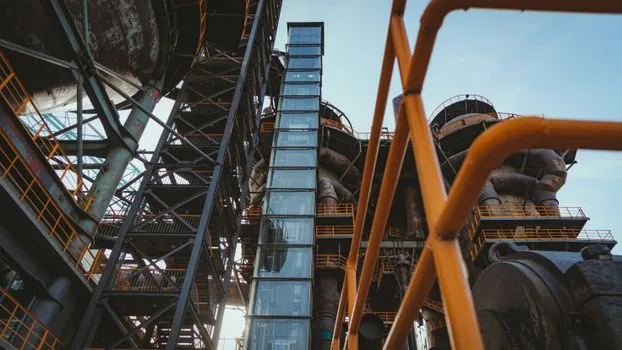
Cantilever and self-climbing panels come in two primary material families: steel-framed panels (heavier, higher flexural stiffness, longer life) and aluminium-framed panels (roughly 30 to 40 percent lighter per square metre, faster manual handling, but lower panel stiffness so the maximum concrete pressure rating is reduced) [S3].
For high-rise cores where panels cycle many times, the lower per-cycle crane hook time of a lighter aluminium set can offset its higher purchase cost, but the same logic does not hold for dam piers where pressure rating governs and cycle count is low [S3]. Steel-hardened climbing brackets, platforms, and protective screens remain the standard for high-rise self-climbing because they raise the fire resistance and the overall structural stiffness of the lift assembly [S5].
Site engineers running a steel-construction project should also cross-check panel mass against the lifting capacity of the climbing hydraulic ram, because a steel-clad panel set on a 6 m core wall can exceed the rated vertical lift per stroke and force a re-spec of the cylinder [S5]. When the panel mass moves outside the rated envelope, the fix is rarely bigger steel: it is to switch the face sheet from steel to aluminium or to split the pour height.
Anchoring, Concrete Pressure, and Safety Loads
All climbing systems rely on embedded climbing cones and M36 screw anchors cast into the previous pour to take the wind load on the screen, the dead load of the formwork, and the live load of workers and equipment, so the anchor pull-out capacity is the single load path that must be verified pour-by-pour [S5].
On the formwork side, the governing pressure is the hydrostatic head of fresh concrete, transmitted through the walers into the climbing brackets and back into the anchors; single-sided systems replace the tie-rod reaction with diagonal braces and wall struts that resolve the same pressure into the cured lift below [S1].
Safety features that the published guidance treats as non-optional for self-climbing cores include fully enclosed steel protective screens on the climbing brackets, guard rails on every working platform, non-slip surfaces on main platform beams, and an emergency evacuation plan sized to the workface crew [S3][S5]. Compliance with local occupational safety codes is referenced as both a legal and a productivity issue, because an unenclosed screen will stop the cycle on most regulatory sites [S3].
When Self-Climbing Pays Off on a Steel-Construction Site
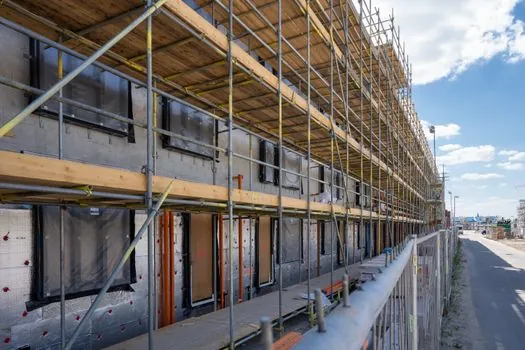
On a typical 30 to 60 storey steel-frame tower with a central RC core, self-climbing formwork becomes economic once crane time is fully booked on the steel erection programme, because each saved crane lift on the formwork frees the hook for steel members and reduces overall programme float [S1][S4].
The same logic applies to bridge towers, silos, and chimneys, where the construction sequence is dominated by repetitive vertical pours and the climbing system can stay on the structure for the full height without being struck and re-set [S5]. Internal shafts, facade walls, core walls, shear walls, massive columns, bridge towers, signal towers and silos are all listed as standard applications for automatic hydraulic climbing systems [S5].
Crane-dependent climbing, by contrast, remains the right call for low-rise commercial slabs and shear walls under roughly 8 storeys, where the cost of mobilising a hydraulic system and its anchoring cones outweighs the saved crane time, and where the project schedule can absorb a slower vertical cycle [S1].
Failure Modes and Common Pitfalls in Specification
Three failure modes dominate climbing-formwork incident reports: anchor pull-out from under-strength concrete, panel over-pressure from a too-fast pour rate, and wind-induced sway of the climbing screen during a lift [S3][S5].
Each maps to a different spec check: anchor pull-out to the climbing cone embedment depth and the strip-strength test of the previous lift; over-pressure to the maximum fresh-concrete head the panel system is rated for; wind sway to the screen-area-to-anchor-ratio and the maximum permitted wind speed during a lift, which is why self-climbing is preferred on exposed high-rise sites [S1][S5].
On steel-construction projects, a fourth pitfall appears when the steel erection crew and the formwork crew share the same crane: if the formwork is still crane-dependent past the point where steel lifts dominate, every formwork cycle steals a steel hook and the steel programme slips, which is the single most common reason a project retrofits to a self-climbing system mid-contract [S1].
Standards, Sourcing, and Crew Capability
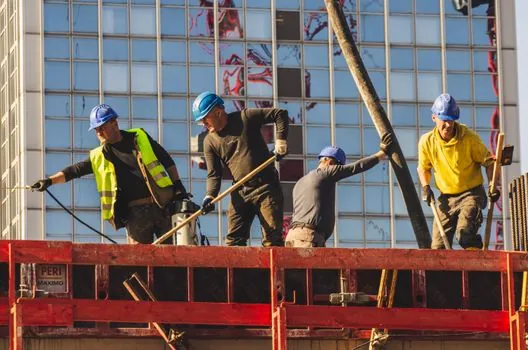
Load assessment, anchor capacity, and pressure rating for climbing formwork are normally verified against the manufacturer's design tables and the project's structural engineer's calc package, with local occupational safety codes governing the screen, edge protection, and evacuation provisions [S3].
Cantilever climbing formwork in particular is described in published guidance as requiring a balanced read of weight, stability, and adaptability, with expert advice recommended for design-complex cases, since minor miscalculations on a cantilever system translate directly into safety and integrity issues at the slab edge [S3].
For procurement, suppliers listed in the public domain include MEVA (MGC-F rail-guided climbing system), Zolo (ZClimb ACF50/80, ACF100, CF210/240), and GETO (GTP100 automatic hydraulic system), with most stocking both steel-framed and aluminium-framed panel options and offering pre-assembled delivery to reduce site labour [S1][S4][S5]. Crew training on the specific hydraulic power pack and climbing-rail interface is the last spec item to lock, because the cycle-time advantage of self-climbing is fully realised only when the crew can fault-find the hydraulic circuit without calling the supplier back to site [S4][S5].
For related tooling on the same steel-construction programme, an electroslag pressure welder selection guide covers the column-to-column welds that typically run alongside the core pour, while a sander selection map handles the surface prep between pour and fireproofing. The next signal to track is whether more Chinese OEM automatic climbing systems publish third-party wind-tunnel ratings, since current public guidance is still mostly anchor-pull-out and pressure-rating driven.
Component reference pages worth checking: construction tools, and construction machinery and equipment.