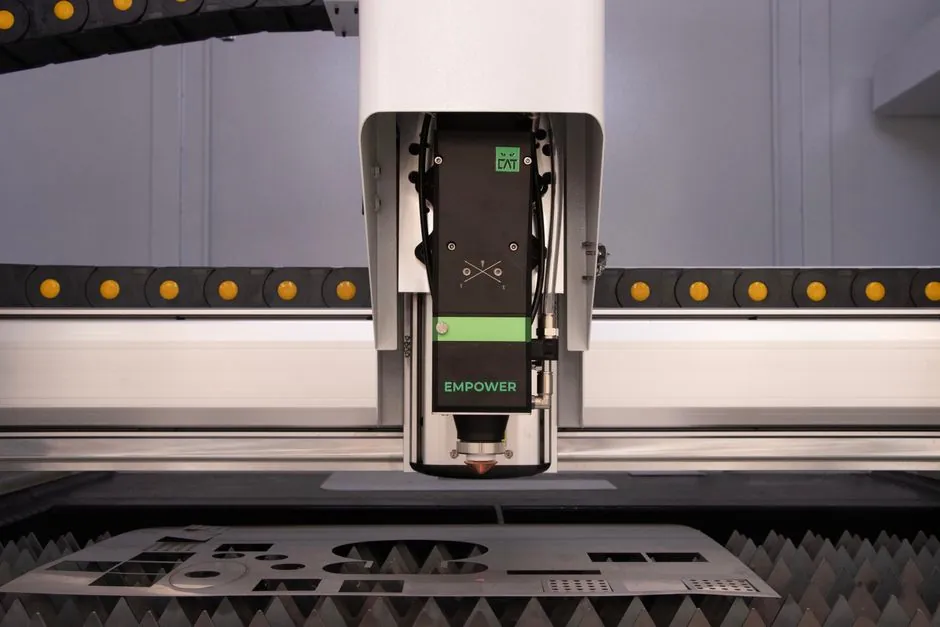
FANUC holds approximately 65% of the global CNC controller market, with its strongest grip on high-precision and multi-axis machine segments, per a March 2026 Market Research Future figure cited by Force One [S7]. The Japanese firm, founded in 1956, has sustained the leading controller share for decades on the strength of its Series 0i-MF, 30i/31i-MB5, and 32i-MB platforms used across milling, turning, and 5-axis centers [S6].
The standalone CNC controller segment sits inside a much larger CNC machine market valued at USD 116.57 billion in 2026 and projected to grow at 7.32% CAGR to USD 165.95 billion by 2031 [S2]. Controllers themselves captured 34.16% of that 2025 CNC market value [S2], with the controller-specific submarket forecast to reach USD 7.0 billion by 2033 at 6.6% CAGR [S3].
FANUC and the Japanese Incumbent Tier
FANUC's controller share is concentrated in mid-to-high-end milling and turning centers, with the Series 30i/31i-MB5 handling simultaneous 5-axis work and the 32i-MB targeted at high-speed aerospace and medical-implant machining [S6]. PLC integration through FANUC's PMC ladder logic and PROFINET-compatible I/O links is standard on these platforms, and Taiwanese lathe builders cite that ecosystem as the deciding factor when choosing controllers for export-bound machines [S7].
Mitsubishi Electric (M80/M800 series) and Okuma (OSP-P300) form the second tier of Japanese incumbents, both competing directly with FANUC on servo-loop tuning and 5-axis kinematics. Yamazaki Mazak supplies its own MAZATROL SmoothAi and MX Hybrid controller stack, which is tightly integrated with the company's Integrex multi-tasking platforms rather than sold as a standalone CNC [S5]. In Europe, Siemens' SINUMERIK ONE (840D sl successor) and Heidenhain's TNC 640/TNC7 are the principal non-Japanese alternatives, with Heidenhain particularly entrenched in mold-making and high-precision grinding where its iterative contour-pole control and 22 nm interpolator resolution are specified.
Market Size Anchors and the 34% Component Share
CNC controllers represented 34.16% of the 2025 CNC market value, ahead of spindle motors, ball screws, and rotary tables in component share [S2]. Digital servo drives are forecast to grow faster than the controller segment itself, posting a 9.45% CAGR to 2031 as closed-loop architectures spread [S2]. Closed-loop control systems already held 62.23% of 2025 control-architecture revenue, growing at 7.59% per year, which directly benefits controller vendors with native dual-loop feedback and Ethernet-based fieldbus support [S2].
The broader market provides the demand backdrop: the global CNC machine market is valued between USD 108.58 billion in 2026 (Fortune Business Insights) [S1] and USD 116.57 billion in 2026 (Mordor Intelligence) [S2], with the higher Maximize Market Research figure of USD 109.36 billion in 2025 carrying an 8.7% CAGR to USD 231.7 billion by 2034 [S4]. Europe alone accounted for USD 24.47 billion in 2025, expanding at 10.08% CAGR to USD 58.08 billion by 2034, with Germany holding 31.3% of that regional share [S5].
Axis Architecture and Why the Vendor Split Widens at 5-Axis

3-axis machines still generated 48.54% of 2025 CNC revenue, but 5-axis and above configurations are the fastest-growing slice at 8.98% CAGR through 2031 [S2]. Simultaneous 5-axis centers specifically are advancing at 8.04% CAGR [S2], and this is precisely the segment where FANUC's lead is hardest to dislodge because the kinematic compensation, RTCP (rotary tool center point) control, and thermal-displacement compensation are deeply integrated into the 30i/31i platform [S6]. Siemens SINUMERIK ONE and Heidenhain TNC 640 compete effectively in this band, particularly in German-speaking mold and aerospace tooling shops, but Mitsubishi and Fanuc continue to dominate Asian-built 5-axis centers.
By machine type, milling led with 46.23% of 2025 CNC market share [S2]; milling controllers from FANUC, Siemens, and Heidenhain therefore account for the largest absolute controller volume. Laser machines are the fastest-growing equipment type in Europe at 9.4% CAGR, but most laser-cutting controllers are proprietary to the laser source maker (Trumpf, Bystronic) rather than third-party CNC platforms, so they do not feed the standalone controller share tally [S5].
Regional Deployment and Who Each Vendor Fits
North America captured 47.87% of 2025 global CNC revenue, while Asia-Pacific is the fastest-growing region at 7.78% CAGR to 2031 [S2]. In the United States, Haas Automation ships its machines with a proprietary controller (Haas NGC) that is competitive on price but does not displace FANUC in high-end cells; FANUC's market position in the US is strongest in automotive tier-1 suppliers and aerospace job shops. In Germany, Siemens and Heidenhain together hold a majority of high-end controller share, with FANUC, Mitsubishi, and Mazak splitting the balance in automotive and general machining [S5]. Japan and South Korea are largely FANUC, Mitsubishi, and Okuma territory.
Integrated production cells (CNC plus cobot plus pallet changer under one controller) captured 53.34% of 2025 CNC value and are growing at 8.21% CAGR [S2], and this cell-level integration is where the motion controller layer inside a CNC increasingly shares code paths with general-purpose automation. Vendors that expose PROFINET, EtherCAT, or OPC UA on the controller are favored in these cells, and this is an area where Siemens SINUMERIK ONE and FANUC's Field Bus option boards both compete.
End-User Demand and Automotive Concentration
Automotive remained the largest end-user segment at 31.11% of 2025 CNC spending, while medical devices are expanding fastest at 9.87% CAGR to 2031 [S2]. For automotive cells, FANUC's dominance in high-volume engine-block, transmission-housing, and EV battery-tray machining remains the single largest concentration of controller revenue, particularly in Japanese, Korean, and US tier-1 lines [S7]. Medical-device machining (implants, micro-surgical tools) is a smaller but faster-growing share and is contested by FANUC (via its CCR/Servo Learning AI modules), Siemens (Run MyVirtual Machine plus SINUMERIK), and Heidenhain (TNC7 with its Dynamic Precision and KinematicsOpt packages).
Aerospace and defense in Europe is growing at 8.7% CAGR, fueled by titanium and Inconel structural parts for next-generation jet engines [S5]. This segment disproportionately specifies 5-axis controllers from the top three Japanese incumbents plus Siemens and Heidenhain; lower-tier controller brands rarely qualify for aerospace primary structures.
Where Smaller Vendors Fit and the Comparison Map
A criteria-based view of the top five controller vendors across decision criteria:
FANUC, founded in 1956, is recognized as the global leader in CNC controller manufacturing and, according to a Market Research Future report cited in industry sources, holds approximately 65% of the global CNC controller market, particularly dominating high-precision segments.
Lower-tier controller brands, including Fagor Automation (Spain), Syntec (Taiwan), GSK (China), and Huazhong CNC (HNC-848, China), compete primarily in price-sensitive Asian domestic markets and entry-level lathes. These vendors rarely break into the high-end 5-axis and aerospace segments where the top five dominate, but they matter for SME workshops in China, Taiwan, and Southeast Asia where the controller cost is the deciding factor.
Limits, Conflicts, and What to Track
The headline FANUC 65% share figure [S7] comes via a Market Research Future secondary citation rather than a direct OEM disclosure, and it spans CNC controllers specifically rather than total CNC machines; treat the number as the most-cited upper bound rather than a verified point estimate. Mordor Intelligence does not publish a brand-level controller-share breakdown in the material available, and Fortune Business Insights likewise covers the broader CNC machine market without vendor splits [S1][S2]. Differences in scope (controllers vs machines vs metal-cutting machines) explain why vendor-share figures vary widely between sources.
Trackable signals over the next 6 to 12 months: the actual vendor breakdown when the next full Grand View Research controller report lands (the current page returns a 403 block) [S3], any 2026 financial disclosures from Siemens Digital Industries and FANUC Corporation breaking out CNC controller segment revenue, and Chinese domestic-share gains by HNC and Syntec as Beijing's on-shoring subsidies flow to local machine tool builders [S2]. Aerospace and medical-implant 5-axis demand, growing at 8.04% and 9.87% CAGR respectively [S2], is the segment most likely to see the top-three controller share expand further at the expense of lower-tier brands.
For engineers selecting controllers today, the practical decision tree is: high-volume automotive and EV cells lean FANUC, German and central-European mold/aerospace shops lean Siemens or Heidenhain, Japanese and Korean heavy cutting leans Mitsubishi or Mazak, and cost-sensitive Asian SMEs default to FANUC 0i-TF, Syntec, or GSK. The PID controller tuning depth, servo-loop cycle time, and fieldbus openness are now the gating specs; raw axis count is no longer the differentiator it was a decade ago.
Related analysis: Solar Inverter Industry 4.0 Adoption: Spec Map, Vendor Moves, and 2026-2031 Numbers.