
Solar inverter suppliers are now selling grid-forming firmware, not just DC-to-AC boxes: the global Solar PV Inverter market sits at USD 15.24 billion in 2026 and is forecast to reach USD 21.16 billion by 2031, a 6.79% CAGR over 2026-2031, with Asia-Pacific holding 54.40% of 2025 unit shipments [S3].
Adjacent reporting pegs the broader solar inverter market at USD 15.16 billion in 2025 scaling to USD 26.4 billion by 2035 (5.7% CAGR) and the high-frequency sub-segment moving from USD 9.31 billion in 2025 to USD 13.56 billion by 2035 at 3.83% CAGR, so the headline 2026 numbers are within range of three independent trackers [S1][S2]. The U.S. alone is expected to compound at 7.8% through 2033, faster than the global average, driven by residential storage and 1,500 V utility builds [S4].
What "Industry 4.0" actually means inside a modern solar inverter
Industry 4.0 in this segment is the migration from dumb MPPT power stages to connected, firmware-upgradable edge nodes, with three concrete feature sets: high-resolution I/V curve tracing at the string level, Modbus TCP / REST API telemetry, and grid-support functions such as Volt-VAR, Volt-Watt, and synthetic inertia [S3].
Central inverters commanded 54.30% of 2025 revenue and three-phase units 71.20%, so the bulk of these smart functions ship in skid-mounted, SCADA-tied cabinets rather than residential micros [S3]. On-grid designs still captured 87.30% of 2025 revenue, which is why grid-code firmware (not off-grid autonomy) is the dominant revenue lever for IIoT features [S3].
Selection criteria: voltage class, topology, and IIoT stack
Specifying a 2026-vintage inverter comes down to four decision gates, and each one is moving under Industry 4.0 pressure [S1][S3].
1. DC input voltage. Utility developers are increasingly specifying 1,500 V string inverters, with 2,000 V in active pilot at OEMs like GE Vernova; this shift adds an estimated +1.2% to the global CAGR and concentrates in the U.S. and Spain [S3].
2. Topology vs. segment. Central inverters commanded 54.30% revenue share in the solar PV inverter market in 2025, and the market overall is forecast to grow at 6.79% CAGR over 2026-2031 [S3].
3. Connectivity. Modern units expose SunSpec Modbus, IEEE 1547-2018 grid-support profiles, and increasingly MQTT or REST endpoints for direct cloud ingestion; choosing an inverter without a documented API is the single most common retrofit mistake on 2026 plants [S1][S3].
4. Hybrid PV+storage readiness. Australia's bidirectional hybrid inverter growth is worth +0.7% to global CAGR and is being replicated in battery-incentive markets, so buyers in 2026 should treat storage-ready firmware as table stakes, not an upgrade [S3].
Who this is for, and who should stay on legacy strings
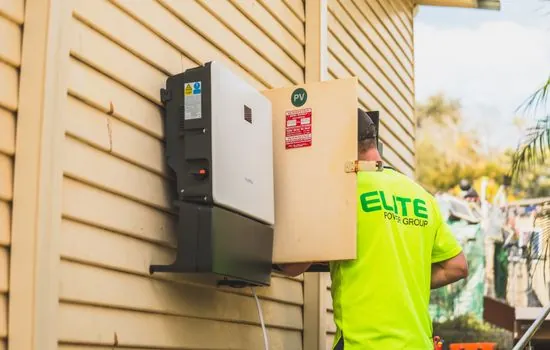
Connected, grid-forming inverters are built for three buyer profiles, and outside those profiles the IIoT premium is wasted spend [S3].
FOR: utility-scale developers (above 5 MW) needing Volt-VAR and ride-through for grid code compliance, commercial roof owners chasing demand-response revenue via API-controlled curtailment, and residential installers selling module-level monitoring as a subscription [S1][S3]. Enphase's June 2026 U.S. launch of the IQ9N-3P commercial microinverter is a direct play for the second profile: 480 V three-phase commercial output and module-level AC, aimed at rooftop portfolios that want per-panel telemetry [S5].
NOT FOR: sub-1 kW off-grid solar home systems in regions with weak cellular coverage (the API and cloud features never pay back), and any retrofit where existing transformers and combiner boxes are not rated for the higher short-circuit currents that 1,500/2,000 V DC architectures produce [S3].
Vendor and segment comparison against decision criteria
Stacking the three dominant topologies against four decision criteria sharpens the buy decision; all percentages are 2025 baseline revenue share or 2026-2031 CAGR from Mordor Intelligence unless noted [S3].
Central inverter: 54.30% 2025 share; 6.79% global CAGR; best on $/W and high DC voltage support; weakest on granularity for IIoT (one telemetry node per MW block) [S3].
String inverter: the workhorse 1,500 V class for commercial and small utility, gaining ASP from +0.9% Europe grid-support uplift; sits in the middle on connectivity (string-level Modbus) and on $/W [S3].
Microinverter: 7.96% projected CAGR through 2031, fastest of the three; best on module-level monitoring, O&M safety (no DC string at roof), and residential retrofit; worst on absolute $/W at utility scale [S3].
Key suppliers named across two trackers (Market Research Future 2026 update and Mordor Intelligence 2026) include Huawei, SMA Solar, SolarEdge, Enphase, Fronius, TMEIC, ABB, Schneider Electric, and Victron, with the top ten collectively controlling a "major share" of 2024 revenue, a detail that quantifies the supplier concentration new entrants face [S1][S3].
Failure modes and constraints in connected inverter fleets
Industry 4.0 introduces new failure paths that 2010s-era string inverters never had, and the 2026 service data bears that out [S3].
Cybersecurity exposure: every Modbus TCP or REST endpoint on a connected inverter is also an OT network ingress; a 2026 procurement spec should require signed firmware, role-based access on the local API, and a documented CVE disclosure policy, none of which appears in the marketing literature of most OEMs [S1][S3].
Component shortages: persistent SiC/IGBT supply tightness continues to temper the market's growth pace, and premium pricing for advanced grid-support functions is what keeps aggregate revenue trending upward despite unit-volume constraints, a point Mordor flags as a structural headwind through the forecast window [S3].
Curtailment and grid limits: rising curtailment in parts of China and weaker interconnect queues in the U.S. mean that even a grid-forming inverter cannot sell power the ISO will not accept, so site selection now matters as much as spec selection [S3].
Standards, sourcing, and what to track next
The two governing standards to anchor a 2026 spec are IEEE 1547-2018 for inverter grid interoperability and UL 1741-SB for the smart-inverter supplement, and any supplier quoting grid-support functions should be able to produce certificates against both, not just generic CE or UL marks [S1][S3].
For data sourcing, the 2026 figures from Mordor Intelligence, the August 2026 update from Market Research Future, and the May 2026 high-frequency sub-segment note from Spherical Insights diverge by less than 2 percentage points on 2030-2031 CAGR, which is enough cross-source agreement to treat the 6-7% global CAGR band as reliable for budgeting [S1][S2][S3].
Track three signals through the next two quarters: (a) 2,000 V utility inverter pilot deployments moving from announcement to commissioning, which would re-base the +1.2% CAGR uplift cited above, (b) the take rate of the Enphase IQ9N-3P in U.S. commercial retrofits, since it is the first 480 V three-phase microinverter in that company's lineup [S3][S5], and (c) how India and Brazil localization incentives shift the supplier concentration number currently held by the top ten [S3]. Buyers sizing 2026-2027 portfolios should also revisit how inverter telematics pair with PLCs on the plant side and how string-level monitoring integrates with flow-meter and pressure-sensor data lakes in co-located PV-plus-process sites, because the same OPC UA and MQTT plumbing is now common to both worlds.
For related coverage, see Linear Guide Selection for Agriculture Machinery: Sealing, Load, and Corrosion Gates.