Apparel distribution centers overwhelmingly specify polypropylene (PP) strapping machines because PP coils are light enough to relocate between packing stations, accept heat-weld sealing, and cost the least per metre of the three mainstream strap materials [S3][S4].
PP stretches more than PET, holds less retained tension, and is sensitive to UV and cold, but for parcel, carton, and bundle weights typical of finished garments, poly-bag bundles, and shelf-ready cartons those penalties stay inside the working envelope [S1][S3].
Why PP dominates the apparel end-of-line
PP strap is the lowest-cost-per-metre option in the catalog, and 5-12 mm PP covers most automatic small-package systems, which lines up with the carton and parcel geometry that apparel DC throughput actually runs on [S3].
Strapex's SGP4000, for example, is positioned squarely at PP-strap packaging duties and marketed as "mobile" because PP coils are light enough to be relocated by a single operator on 230 V single-phase power, a practical fit for DC pack-stations that reconfigure by season [S3]. A PP strapping machine automates feeding, tensioning, heat-sealing, and cutting in one repeatable cycle, so variability that comes from hand-tensioned manual strapping disappears from the audit trail [S1].
PP vs PET vs Steel: a four-criteria comparison
Side-by-side on the four criteria that matter for an apparel DC (cost per metre, retained tension after tensioning, UV/cold behaviour, typical strap width): PP is cheapest, retains the least tension, is sensitive to UV and cold, and runs 5-12 mm on automatic heads; PET retains 60-70% of breaking strength after tensioning, resists UV, and dominates 9-12.5 mm on pallet heads such as the Signode GCU-2600 with a 2,500 kg (5,511.56 lb) maximum clamping tension; steel (13-19 mm width, 0.4-0.8 mm thickness) is mandatory where heat of friction or sharp edges would cut plastic, which is not an apparel-warehouse condition [S3][S4].
The GCU-2600 publishes 130, 150, or 200 pallets/hour as three user-selectable rate points, well above what an apparel DC needs per station, and that is the signal: if a line is buying a pallet-press arch with active compression, the workload is not apparel cartons [S3]. Apparel buyers should default to PP and only escalate to PET when palletized garments sit in outdoor or high-humidity yards, where PP's UV and cold sensitivity starts to bite [S4].
Throughput, arch size, and seal method for parcel lines
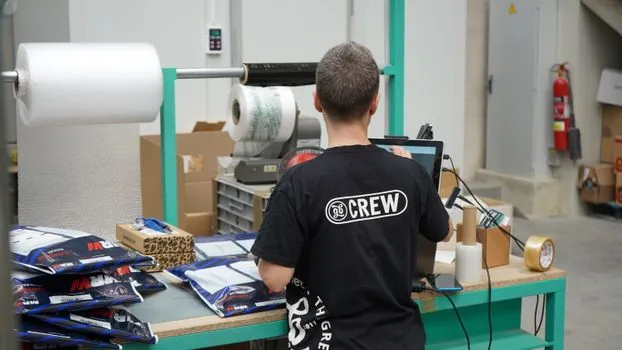
Cycle rate is driven by strap feed length, weld/cool time, and arch return, not raw motor speed, so a 600 mm x 800 mm arch handles the bulk of e-commerce apparel cases while 1,200 mm x 1,000 mm arches are reserved for palletized or sawn-timber workloads [S3][S4].
Entry-level semi-auto PP heads land at 20-30 straps/min, mid-range fully-auto PET pallet heads sit at 35-55 straps/min, and high-end inline newspaper or corrugated lines can exceed 60 straps/min with dual heads; the apparel DC that needs to clear a peak shift of poly-bag and carton bundles fits cleanly inside the 20-30 straps/min band on a semi-auto PP tabletop [S4]. The Strapex SGP4000 ships in mobile, walk-up, inline, and small-anvil variants for integration into conveyorised lines, and Strapack's JK-5000, SQ-800, RQ-8Y, and D-53Y arch/frame strappers handle cartons and parcels on the fully-automatic side of that same envelope [S3]. For clean-room or food-adjacent apparel lines, ultrasonic sealing shows up on the Xutian Q8AP and Q8LP automatic units, which run 9-12 mm and 10.5-11.5 mm respectively with heat-weld for PP and PET as the default method [S3].
Automation tier and what each tier costs in 2026
The DirectIndustry unmanned-machine catalogue lists 17 products across 4 manufacturers and a separate magazine/newspaper variant lists 20 products from 6 makers, mostly automatic (16 of 20) with 4 semi-automatic and a single manual offering, which is the same shape the global catalog shows at 329 automatic / 100 semi-automatic / 11 manual across 431+ listed units [S3][S4].
Fully-automatic strapping machines from Qingdao Sacpack Intelligent Equipment list in the US$ 3,500-6,500 / piece range, while Shanghai Bodinghui's competing fully-auto line sits at US$ 1,000-1,500 / piece, both at a 1-piece MOQ; the PP/PET tape head segment on Made-in-China runs US$ 295-1,270 / piece at the same MOQ, and steel-wire strap heads occupy a separate catalogue at higher unit cost [S4]. For apparel DC procurement, the practical spec gate is: pick semi-auto PP tabletop for sub-30-straps/min stations, move to fully-auto PP arch for conveyorised parcel lines, and reserve PET pallet heads for any unitized pallet that has to live outdoors [S3][S4]. A reference walk-through of selecting an automatic strapping machine across volume, strap material, automation, load type, tension, integration, and maintenance is laid out in the Hualian 7-factor selection guide and pairs cleanly with the [S3] type-vs-material boundary table.
What a PP strapping machine actually does inside the cycle
A PP strapping machine's cycle is feed, tension, heat-weld, cool, cut, and reset, and each step has a maintenance anchor that apparel DC supervisors can train to in under a day [S1][S3].
Strap routing starts at the strap storage compartment, runs through guide rollers to control direction and prevent twisting, then through tension wheels that grip and pull the strap, into the sealing and cutting unit; proper orientation to the rotation direction marked on the machine is what stops the most common jam mode on a PP head [S1]. PP and PET both take heat-weld (friction or vibration) sealing, steel takes a metal seal/crimp, and ultrasonic sealing is the option for clean-room and high-speed food-adjacent lines, so the same PP head can be specified for the apparel DC and the food-grade DC without changing the sealing subsystem [S3]. The right strapping band spec for an apparel carton line is 9-12 mm PP at 20-30 straps/min on a semi-auto head, or 9-12.5 mm PP on a fully-auto arch when the upstream singulation is consistent.
Where PP drops out and what to do about it
PP is the wrong answer when the load is heavy steel coils, plate glass, sawn-timber bundles, bricks, or ingots, because the heat of friction or the cut profile of the load would fracture plastic; in those cases steel strap (13-19 mm width, 0.4-0.8 mm thickness) is still mandatory and the head changes to a steel seal/crimp architecture with hardened wear strips [S3][S4].
PP also loses to PET when the pallet sits outdoors or in high-humidity yards, where UV and cold creep PP, and where the unit load is heavy enough that 60-70% retained tension after tensioning is a real safety margin rather than a brochure number [S3][S4]. The internal cross-reference for power distribution and distribution cabinet sizing on a packaging line is the 230 V single-phase feed that mobile PP heads like the SGP4000 run on, and that single-phase compatibility is what makes a PP strapping machine drop into a DC pack-station without a three-phase upgrade. The catalog signal to watch next: a published cycle-rate point above 30 straps/min on a 9-12 mm PP head at sub-US$ 1,500 fully-auto would compress the current semi-auto / fully-auto price gap, and a move by major apparel 3PLs from semi-auto tabletop to inline fully-auto PP arch on parcel lines is the second signal worth tracking through year-end.
This topic is covered further in Carbon Fiber Selection for General Fabrication: Tow, Modulus, and Layup.