
Cold box core shooters running phenolic urethane binder with triethylamine gas cure are the dominant process for pump housing, valve body, and hydraulic component cores in 2026, because the room-temperature cure cycle delivers high dimensional accuracy on thin-wall internal passages where hot-box methods struggle [S3][S5].
Foundries specifying a cold box core shooter for pump and valve work balance sand type, machine class, and maintenance discipline against scrap rate and tooling life. The phenolic urethane system uses a two-part liquid binder (phenolic resin plus isocyanate) and a tertiary amine catalyst, with the sand mixture blown into the core box under controlled pressure and gassed for seconds-cure strength before ejection [S3].
Why Pump and Valve Foundries Default to Cold Box
Pump housings and valve bodies concentrate thin-wall passages, intersecting water jackets, and hydraulic galleries that the cold box process fills with high compaction and cures without the thermal distortion a hot-box cycle would introduce [S1][S3]. The phenolic urethane cold box binder system is explicitly listed as standard for pump housings and valve castings, alongside automotive engine blocks and cylinder heads, by resin-system guidance published in March 2026 [S3].
Process engineers running shell core shooter lines for comparison know the trade-off: shell and hot-box methods give excellent surface finish on simple geometry, but cold box wins on complex internal cavities because the sand is shot rather than blown under low pressure, giving more uniform density in deep draws and narrow passages [S1][S5]. For valve bodies with intersecting bores, that density uniformity is what prevents the cold-lap and core-sag defects that show up after machining.
Ceramsite Sand Versus Silica Sand: The Spec-Level Trade
Ceramsite (sintered high-alumina bauxite) is the spec-level upgrade over quartz silica for cold box cores in steel, ductile iron, and gray iron pump and valve castings, and the published numbers are concrete. Ceramsite delivers refractority above 1750 degrees Celsius, a thermal expansion rate of 0.11 to 0.15 percent at 1000 degrees Celsius, and an angularity coefficient at or below 1.15, against silica sand's thermal expansion exceeding 1.3 percent and higher angularity [S5].
The practical effect is a published 30 to 50 percent reduction in total resin addition to reach equivalent core tensile strength when switching from silica to ceramsite, because the spherical grain shape gives even resin coating without blind-spot adsorption [S5]. Lower resin dose cuts gas evolution during pour, which is the root cause of subsurface blowholes and flash on thin-wall water-jacket passages in pump castings. The four classic cold-box defects on hot-spot cores, veining, metal penetration, subsurface blowholes, and sand-core cracking, all drop sharply with ceramsite, and the spent-sand reclamation rate also improves because the rounded grains fracture less in reclamation loops [S5].
Machine Class Selection: Standard, Auto, and Double-Head
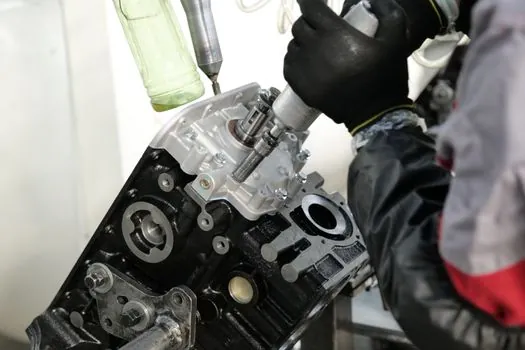
For pump and valve lines, the choice between standard, automatic, and double-head cold box core shooters is driven by core weight, cycle time, and labor availability. Standard machines cover regular core-making for small batch or job-shop work, automatic machines add controlled sequences for higher volume, and double-head units shoot two cores per cycle to roughly double throughput on small symmetrical cores like valve bonnets or pump impeller hubs [S2].
Selection discipline in 2026 favors matching the shooting head, clamping force, and core box size to the heaviest core in the family rather than the average. Pump bodies can run 5 to 50 kilograms per core depending on size class, and under-sizing the shooting head is the most common cause of uneven fill and scrap. A useful procurement filter is machines with accessible blow plates, automated diagnostic software, and tool-less maintenance features, because amine catalyst and polyurethane resin create harsh internal conditions that punish hard-to-reach service points [S4].
Maintenance Cost of Reactive Service
Reactive maintenance on a cold box core shooter destroys the two metrics that matter on a pump and valve line: Mean Time Between Failures (MTBF) and Mean Time To Repair (MTTR). Resin and sand mixtures harden rapidly on internal surfaces, causing uneven core density, elevated scrap, and accelerated core-box wear, and the hardened residue acts like sandpaper against expensive tooling [S4].
The published daily protocol is non-negotiable: clean the blow plate and sand magazine at end of every shift to prevent sand bridging, and inspect pneumatic hoses and hydraulic seals for micro-leaks that compromise shooting pressure [S4]. Weekly and annual protocols cover amine gas extraction system checks and core-box alignment. For foundries comparing cold box core machine quotes, the practical differentiator is service infrastructure and spare-parts continuity, not headline price, because an unplanned stop on the core shooter halts the entire molding line [S2][S4].
Comparison: Cold Box Versus Hot Box Versus Shell for Pump and Valve

On four decision criteria, the three processes separate cleanly. Cure method: cold box uses amine gas at room temperature, hot box uses heat-activated binder, shell uses heated resin-coated sand against a hot pattern [S1]. Cycle time: cold box is the fastest, with seconds-scale gas cure; hot box and shell require heating and cooling cycles that limit throughput. Internal geometry capability: cold box leads for complex thin-wall passages in pump and valve bodies; hot box and shell are preferred for simpler high-surface-finish cores. Sand compatibility: cold box accepts ceramsite with published 30 to 50 percent resin savings and sub 0.15 percent thermal expansion; silica works in all three processes but at higher resin dose and higher veining risk on hot spots [S5].
When Cold Box Is the Wrong Choice
Cold box is not the default for every pump and valve application. Very small cores below roughly 0.5 kilograms, simple solid cores without internal passages, and cores that demand near-mirror surface finish may be cheaper to produce on hot box core machine or shell lines, where heating cycles and resin-coated sand give a denser skin and shorter tooling lead time. Cold box is also the wrong fit for any plant without amine gas extraction and operator training, because tertiary amine catalyst is a regulated inhalation hazard and the gas system is a primary safety compliance item [S3][S4].
Buyers sourcing valve and pump cores should also weigh the related needle valve TCO question, since pressure-class and material choice downstream drive the internal-passage complexity that the cold box process must reproduce in sand. The two decisions, which casting process and which valve spec, are tightly coupled and should be reviewed together before locking in machine capacity.
Trackable signals for buyers over the next two quarters: amine gas system regulatory updates in EU OSHA equivalents, ceramsite sand pricing trends as Chinese supply expands, and resin system reformulations aimed at lower free-formaldehyde and lower amine odor at pour. These three nodes will reshape both operating cost and compliance scope for any new cold box line ordered before mid-2027.