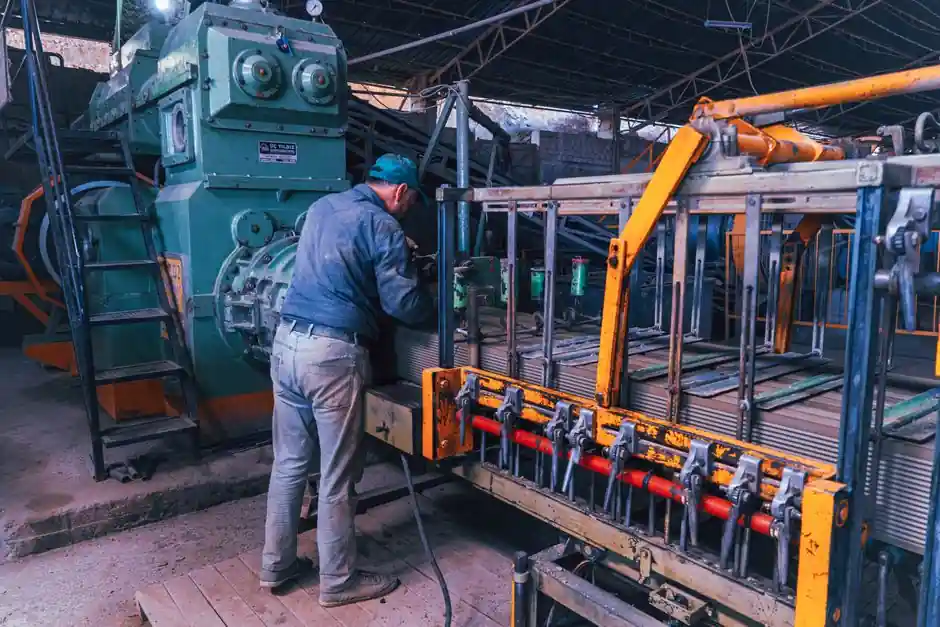
A phenolic urethane cold box core line, paired with a 4-6 bar horizontal core shooter, cuts core cycle time into single-digit seconds and is the dominant route for 5-20 kg sand cores feeding iron casting of tractor housings, plough points, and gearbox bodies [S3].
For agricultural-machinery foundries, the binding decision is not which brand of core shooter to buy, but whether the cold box amine-cured route matches the casting mix, the box size, and the available amine gas handling, which is what the rest of this guide lays out [S1][S3].
Why Cold Box, and Why It Fits Agricultural Castings
Cold box cores cure at room temperature when a tertiary-amine catalyst gas is passed through a phenolic resin Part 1 plus isocyanate Part 2 sand mix, producing a rigid urethane network in seconds without any external heating [S3]. The process is explicitly listed as a standard practice for agricultural-equipment castings alongside automotive, pump and valve, and engine block work, because it handles thin-wall, high-strength, and medium-to-large cores that agricultural machinery needs [S3]. A replacement cold box core shooter commissioned at INMASA in 2026 was justified on the same triad that agricultural buyers care about: higher productivity, better flexibility, and improved core quality versus the line it replaced [S1].
Two pieces of context frame the rest of the selection. First, the cold box process is a chemical route, so the machine has to integrate amine vapour piping, scrubber exhaust, and PLC interlock, not just a sand hopper and a blow head [S3]. Second, agricultural castings are dominated by grey and ductile iron poured at 1,300-1,450 °C, which means the core must survive aggressive thermal shock on a thin section without veining or gas defects, exactly the regime cold box was developed for [S3]. For readers who want the equipment-side reference, the cold box core machine entry covers the gas-generation and curing cabinet details these machines sit inside.
Core Shooter vs Shell Core Shooter: Selection Criteria Compared
Cold box and shell hot box are the two realistic options for 5-20 kg agricultural cores, and they should be selected on four hard criteria: cycle time per core, surface finish and dimensional accuracy, energy and gas handling, and capital plus tooling cost. A standard auto core shooter aimed at cold box typically runs horizontal box mounting with 12-20 kg shooting capacity at 4-6 bar blow pressure and 440 V 3-phase supply, matching the 5-10 kg and 10-20 kg core-weight bands published in current Indian OEM catalogues [S2][S4]. A shell core shooter in the same class uses the same 4-6 bar blow pressure but adds electric core-box heating and an individual temperature controller for each half of the box, which is what gives shell its surface finish advantage but also what makes its cycle longer and its energy bill heavier [S4].
On cycle time, cold box amine curing is seconds and beats shell hot box, which needs several minutes of heated dwell [S3][S4]. On surface finish, shell cores set the benchmark because the heated, resin-coated sand forms a smooth shell, while cold box cores typically need a coating (zircon, zircon-graphite, graphite, or alumino-silicate) to reach comparable casting finish [S3]. On gas handling, cold box requires amine vapour dosing plus a scrubber exhaust, which is regulatory plumbing that shell hot box avoids. On capital cost, current 2026 catalogue pricing for fully automatic shell core machines with Mitsubishi PLC sits around INR 6,90,000 to 7,90,000 per piece, while auto cold box shooters are quoted on application because the gas system is sized per line [S4]. For foundries weighing a shell core shooter against a cold box line, the deciding question is whether the casting is finish-limited (shell) or cycle-limited (cold box).
Key Specs to Lock In for a 5-20 kg Agricultural Core
Four specs carry most of the selection weight, and a buyer can reject a vendor outright if any of them is missing from the data sheet. First, shooting capacity must equal or exceed the largest single core weight: 12 kg shooting head for 5-10 kg cores and 20 kg shooting head for 10-20 kg cores, with horizontal core-box mounting for the standard auto configuration [S2][S4]. Second, blow pressure should sit in the 4-6 bar band; below 4 bar, the amine-catalysed sand does not pack tightly enough around thin-wall features, above 6 bar, the box seal and venting become the limiting factor [S4]. Third, control must be fully automatic PLC-based, with fault diagnosis, alarm system, and safety interlocks, because manual cold box operation cannot reliably meter amine catalyst to the seconds-window the chemistry needs [S3][S4]. Fourth, sand-level sensing, automatic core ejection, and individual temperature controllers for each core-box half are the features that actually keep a line running three-shift in an iron foundry, and they appear on current 2026 OEM data sheets rather than being aftermarket add-ons [S4].
Two more specs that look secondary but bite later: power supply should be 440 V 3-phase to match Indian and most export-agricultural plant standards, and machine mounting should be floor-mounted, not bench-top, once core weight exceeds 10 kg [S4]. Buyers sourcing through a construction machinery and equipment channel for tractor and implement castings should confirm these electrical and mounting numbers against their plant spec before issuing the PO, because retrofit is expensive on a 12-20 kg shooting head.
Who Should Buy Cold Box, and Who Should Not
Cold box is the right answer for foundries running grey or ductile iron for agricultural castings in the 5-20 kg core range with medium-to-high volume, where the per-core cycle cost dominates and the amine-scrubber infrastructure can be installed and permitted [S3]. It is also the right answer when the same line has to switch frequently between jobs, because replacing a cold box core box is a mechanical swap with no heated dwell reset, which is exactly the flexibility case INMASA cited when replacing its older system in 2026 [S1]. It is the wrong answer for job shops running fewer than 50 cores per shift, where the amine gas train cannot pay back its capital, and for foundries pouring non-ferrous alloys that do not need cold box strength and would be over-spending on a hot box that already meets the spec [S3].
The non-obvious failure mode is ventilation: cold box amine vapour is a respiratory and odour hazard, so any installation without a properly sized scrubber and a negative-pressure gassing chamber will fail on operator safety review even if the machine itself cycles perfectly [S3]. Foundries considering a manual retrofit of a hot box core machine to run cold box chemistry should not, because the gas-train integration, not the shooting head, is the harder problem and is what cold box machine builders engineer as a system.
Standards, Sourcing, and Lead-Time Signals

Two sourcing signals from 2026 are worth tracking. First, the Indian and South Asian OEM supply base for cold box and shell core shooters has stabilised around Mitsubishi-PLC-controlled, fully automatic 440 V 3-phase machines in the 12-20 kg class, with published lead-time quotations in the INR 6,90,000-7,90,000 per-piece range for shell and application-only pricing for cold box [S4]. Second, integrated buyers are consolidating on fewer vendors and demanding application engineering on the core box itself, not just the machine, mirroring the INMASA case where the value came from a customised solution rather than a stock catalogue item [S1]. A useful cross-check for buyers also looking at the wider process chain is the broader cold chamber machine reference, which covers the high-pressure die-casting cousin used for aluminium agricultural components, and the cold milling machine entry for foundries that also run their own pattern-shop machining.
For agricultural-machinery OEMs that already buy finished castings and are now considering forward integration, the trackable next node is whether the chosen cold box vendor offers application-engineered core boxes for the specific casting family (gearbox housing, differential case, plough mouldboard insert), since core-box design is what determines whether a 4-6 bar shooting head actually delivers the thin-wall accuracy the casting drawing calls for [S1][S2].
This topic is covered further in Total Station Spec Map for Masonry Layout: 2026 Selection Guide.