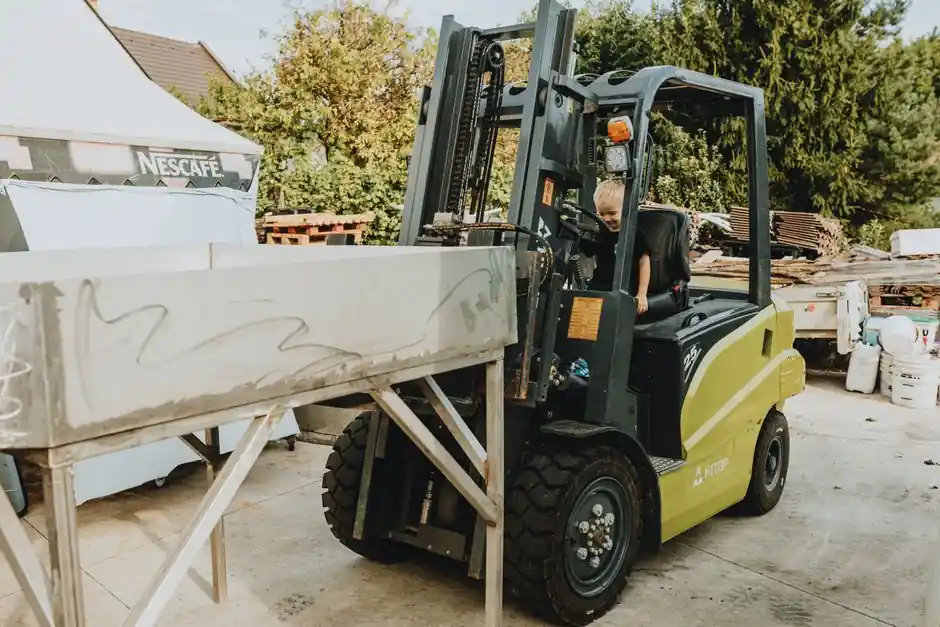
For North American GMA 48x40 inch pallets, 42 inch long x 4 inch wide ITA Class II forks remain the de facto warehouse default, with the next most common sizing running 48 inches long and 5-6 inches wide for Class III and IV carriages [S1][S4].
Across industrial spec sheets, fork dimensions follow a thickness x width x length convention; the 1.5 in x 4 in x 42 in geometry is the most frequently stocked replacement size, while specialty and longer-load work pushes lengths into a 48-72 in range with blade widths of 4-6 in [S1][S5][S8].
Pallet Footprint and Fork Length: How They Couple
Standard GMA pallets measure 48 x 40 in, with deck-boards and stringers oriented so forks enter the 40 in direction through openings that are typically 3-4 in tall and span the full 48 in depth; 42 in forks clear the back of the pallet by roughly 2-3 in and still leave 4-5 in of fork tip exposed beyond the front stringer, which is consistent with the rule of thumb that forks should reach at least two-thirds of the way into the load and extend 6 in beyond the load face for stability [S1][S7].
Euro pallets (1200 x 800 mm, roughly 47.2 x 31.5 in) and standard UK 1200 x 1000 mm pallets push operators toward 48-60 in blades, since 42 in forks leave the load with too little tip support and a poorly centred load centre on the carriage; PRO-Link's Class 2 catalogue lists 42, 48, 60, and 72 inch blade lengths as the four production-stocked options, and the 48 inch variant is widely cited as the second most common US spec after 42 in [S1][S5][S4].
For double-deep racking, drive-in rack bays, and two-pallet handling, 60 in and 72 in forks become the practical minimum, but each additional 6 in of blade length typically forces a re-rated load centre and a corresponding de-rate in allowable payload, a tradeoff that needs to be checked against the truck's data plate, not the marketing sheet [S5][S7].
Fork Width, Thickness, and ITA Class: Matching the Carriage
ITA fork classification governs the hook spacing on the carriage, and the width of the fork blade is tied to that class: Class II is most commonly a 4 in wide blade, Class III uses 5 in wide blades, and Class IV moves to 6 in wide blades, with thicknesses running 1.5, 1.75, 2.0, and 2.5 in depending on the lift's capacity rating [S1][S4][S5].
Selection logic is simple: heavier trucks and higher residual capacities need thicker and wider forks because section modulus scales with the square of thickness, so a 2 in thick blade has roughly 78% more bending capacity than a 1.5 in blade of the same width and steel grade; 1.5 in x 4 in is the typical Class II starter, 2 in x 5 in covers Class III workhorses, and 2.5 in x 6 in is the standard heavy-duty Class IV package for loads above 15,000 lb [S1][S4].
For specialty pallets (block pallets with 9-block footprints, wing pallets, or custom skids with non-standard bottom openings), wider blades (5-6 in) deliver more surface contact with each stringer, but the trade-off is that the fork no longer drops cleanly into narrow 3-4 in pallet openings, forcing operators to pry or tip the load, so the rule is to keep blade width at the lower end of the class range unless the load requires the larger section [S4][S7].
Outer Fork Spread: The Number That Catches Operators
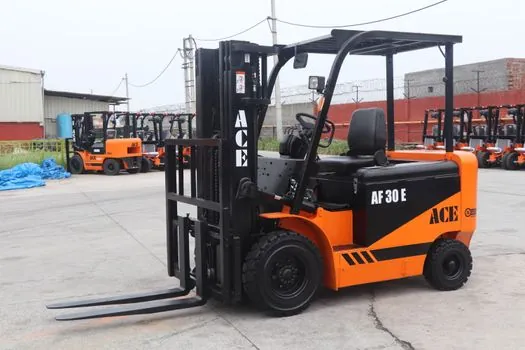
Pallet jack forks typically run 6-7 in wide each with a 20-27 in total outer spread, and a standard 27 in out-to-out dimension on a manual pallet jack is the practical lower limit for handling GMA 48 x 40 in pallets without overhanging the deckboards [S2][S3].
Field experience among warehouse operators suggests a 30 in out-to-out dimension covers the great majority of GMA pallet stock, while 32 in gives a margin that improves side-to-side stability on uneven floors; pushing to 42 in out-to-out is only practical when the load is centred, well-strapped, and lifted on level ground, and even then the wider spread lowers the effective lift truck capacity by moving the load centre [S2].
For rough-terrain forklifts, telehandlers, and wheel loader fork frames, the same spread rule applies but the mounting system is more often shaft-mounted or pin-type rather than ITA hook, so width adjustment is done by sliding the fork on a shaft or by re-pinning the carriage, not by sliding the fork across a hook-type carriage; the PRO-Link 2026 spec guide flags "machine brand alone never confirms fork fit" as the single most common procurement error on these machines [S5].
Length vs Pallet Type: Comparison by Application
Fork length selection is best framed as a function of pallet depth, load overhang, and rack bay depth: 36-42 in forks handle standard GMA 48 x 40 in pallets in single-deep selective rack, 48 in forks cover Euro pallets, 48-50 in stringer pallets, and most general warehouse work, 60 in forks are the practical minimum for drive-in or double-deep rack and for handling two GMA pallets end-to-end, and 72 in and longer forks are reserved for specialty lumber, masonry, or paper-roll handling [S1][S4][S5][S7].
The table below maps the most common fork sizes to the pallet and load types they actually fit:
36 in x 4 in x 1.5 in: short-cycle indoor work, single-faced display pallets, partial-load skids less than 36 in deep; limited to light Class II trucks and tight-aisle reach applications where the operator must keep the load inside the truck's wheelbase.
42 in x 4 in x 1.5 in: the US warehouse default for GMA 48 x 40 in pallets on Class II trucks; gives roughly 2-3 in of fork tip past the back stringer and 4-5 in past the front, meeting the 2/3-into-load and 6 in overhang rules [S1][S4][S7].
48 in x 5 in x 2 in: Class III workhorse spec, suitable for Euro 1200 x 800 mm pallets, UK 1200 x 1000 mm pallets, 48 in stringer pallets, and any load where the operator wants more tip support for higher-speed handling [S1][S4][S5].
60 in x 5 in x 2 in and 72 in x 6 in x 2.5 in: drive-in rack, double-deep rack, two-pallet handling, lumber, masonry, and block pallets; these lengths require a load-centre re-check because each 6 in of extra blade effectively moves the load centre forward on the carriage, reducing allowable payload [S5][S7].
Inspection, Wear Limits, and When to Replace
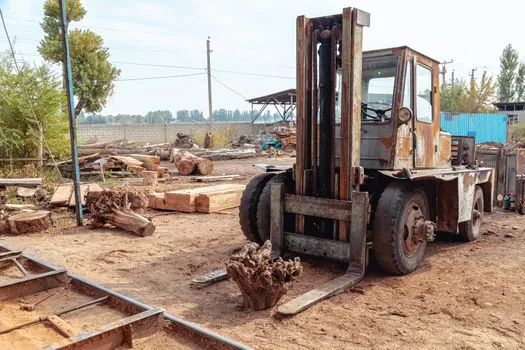
Heel wear is the failure mode that catches operators off-guard: dragging forks across concrete accelerates heel-section loss faster than any other wear pattern, and once the heel radius is worn flat, the stress concentration there drops by a factor of 3-4, which is enough to initiate a crack under rated load; re-tipping (rebuilding the heel) is allowed by some OEMs but only with documented weld procedure and post-repair magnetic-particle inspection [S1].
Specialty Forks and When Standard Forks Are the Wrong Tool
Standard ITA forks are the wrong tool for several common applications: drum handling requires drum forks with a clamping or cradle attachment, lumber and plywood handling needs wide thin blades that scoop off the floor, block and masonry pallets need long thin blades with high tip strength, and carpet or paper rolls need cylindrical carpet poles; specifying a standard 4 in x 42 in fork for any of these jobs is a fast way to damage product and forks [S4].
Fork extensions are a common field retrofit and are limited by the OEM to a maximum of 150% of the host fork's rated length, with a corresponding capacity reduction; a 42 in fork can carry a 21 in extension for a 63 in effective blade, but the extension's own capacity rating (and the 150% rule) governs the lifted load, not the host fork's original data plate [S4].
For explosion-hazard areas, spark-resistant forks made of brass, bronze, or beryllium-copper are specified where the application is rated for non-sparking tools; these forks have lower strength than alloy steel and require a capacity derate of typically 50-65% to maintain the same safety margin, which is a critical spec to verify with the manufacturer before putting them on a Class IV truck [S4].
Sourcing, Standards, and Procurement Discipline
For procurement in 2026, the three most common stocking SKUs in any distributor's warehouse are 1.5 in x 4 in x 42 in (Class II), 2 in x 5 in x 48 in (Class III), and 2.5 in x 6 in x 48 in (Class IV), and buying to one of these stock sizes keeps lead time at 1-3 days versus 4-6 weeks for a custom build, per the PRO-Link 2026 spec guide [S1][S5].
The minimum measurement set required before ordering is: blade length, blade width, blade thickness, hook type (ITA, shaft, pin), upper hook spacing, lower hook spacing, shank height, capacity stamp reading, and load centre rating; the spec guide is explicit that "machine brand alone never confirms fork fit," meaning a Caterpillar, Bobcat, John Deere, or Toyota truck of the same model year can carry different carriages depending on installed options [S5].
Standards alignment: ANSI/ITSDF B56.1 (the US safety standard for low and high lift trucks) governs inspection criteria, OSHA 1910.178 covers operator training and daily checks, and ISO 2328 defines ITA fork hook dimensions and carriage classes used outside North America; matching forks to the right class on the carriage is what makes the difference between a safe lift and a hook that walks out of the carriage under load [S1][S5].
Trackable signals to watch over the next quarter: distributor stocking expansions in the 48 in and 60 in Class II/III range to handle the shift toward Euro pallets in US import warehouses, and a continued move toward 2 in x 5 in x 48 in as a default "one-size-covers-most" spec for fleets running mixed Class II/III equipment [S5].
For readers comparing material handling equipment categories, the broader context of forklift carriage class and machine fit sets the baseline for which truck a given fork spec can ride on, and a forklift as a powered industrial truck entry point covers the carrier side of the equation. For lighter-duty or rough-ground handling, the related geometry of rough terrain forklift fork frames follows the same length and width logic but with shaft mounting instead of ITA hooks.
The underlying component specifications are covered under dry type transformer.