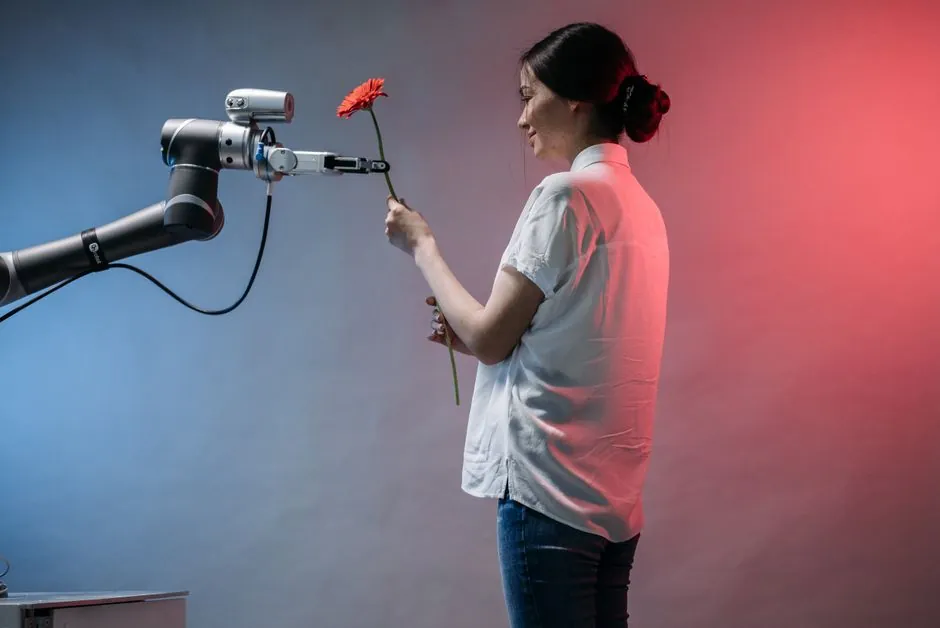
A collaborative robot typically handles 3–25 kg at speeds up to 1 m/s, enabling shared human-robot workstations with lower deployment cost than conventional industrial robot cells [S5].
The choice suits repetitive assembly, inspection, packaging and machine tending where flexibility matters, rather than heavy handling or the shortest possible cycle time [S3][S4].
What a Collaborative Robot Changes
A collaborative robot shares a workspace with people and is designed around force limitation, controlled speed and contact detection, unlike a conventional industrial robot that normally operates inside a segregated cell [S4][S5].
Many designs use joint torque sensors, rounded housings and lighter structures. When unexpected resistance is detected, the controller can stop the arm; external presence sensors can also slow or stop it before contact [S1][S4]. These features support collaborative operation, but they do not mean that every cobot application can be performed without guarding.
Programming can be handled through hand guiding. An operator moves the arm through a path with the teaching pendant, records the demonstration and refines the program through an interface; one basic teaching process can take as long as one hour [S1].
Cobots Versus Conventional Industrial Robots
The practical comparison is a trade between cycle performance and deployment simplicity: cobots generally provide easier programming, lower payload and lower speed, while conventional industrial robots provide higher speed, precision and repeatability [S1][S2].
Force sensors and limited speed allow cobots to work directly alongside people without a separating safety fence. Conventional industrial robots are faster, more precise and more powerful, but their cell hardware, guarding and installation generally cost more [S5].
This reflects the wider installation package, including fencing, hardware, labor and floor space, rather than the arm price alone [S1].
For high-volume lines, fixed articulated robots remain preferable when maximum speed and repeatability determine output. Cobots fit production environments with frequent changeovers, limited space and direct human interaction [S5].
Advantages for Flexible Manufacturing
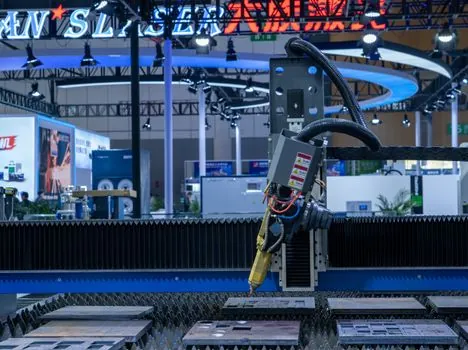
Cobots provide three measurable deployment benefits: smaller equipment footprint, simpler programming and potentially shorter payback than guarded robot cells [S1][S3]. Their portable form allows equipment to move between lines or facilities, while hand-guided teaching reduces dependence on specialist programmers [S2].
The lower infrastructure burden can be substantial because a suitable application may avoid a separate fence or light-curtain system, although the need for safety devices remains application-specific [S1][S3]. Cobots also require less floor space than a conventional work cell and can be introduced in small-batch operations [S2][S4].
Typical productive uses include material handling, assembly, inspection and packaging. Two-arm systems can support small-part assembly, screwdriving and parallel bin picking, although coordinating two arms increases control complexity and can reduce the simplicity advantage of a single collaborative arm [S1][S3].
Limitations and Failure Modes
Payload and speed are the primary constraints: collaborative robots generally carry less and move more slowly than larger industrial robots because safety functions limit impact energy and permit collision response [S2][S5]. Heavy lifting and rapid transfer operations therefore favor a dedicated industrial robot rather than a cobot.
Precision and repeatability are also generally below conventional industrial-robot levels [S1]. A task that depends on sub-millimetre placement, maximum uptime or minimum takt time may lose its economic advantage after cycle-time losses are included. The absence of guarding must be justified by the complete application, including payload, tool mass, process force, speed and human contact exposure.
Operational uptime can be extended through repeat work, but that does not remove process risk. A blocked tool, an unexpected obstacle, a dropped part or incorrect teaching path can stop the arm or create a quality failure. Two coordinated arms add further programming and interference-management complexity [S1].
Who Should Select a Cobot

A cobot is for manufacturers prioritizing safety in shared work, flexibility, low-cost deployment and fast return on investment, especially where operators can teach paths and applications change frequently [S4]. It also fits small and medium-sized businesses handling high product mixes in compact areas [S4].
It is not the best choice for heavy payloads, high-speed motion, maximum precision or a fixed high-throughput line where a guarded conventional robot has a clear cycle-time advantage [S1][S2][S5]. The collaborative robot should be evaluated as a production tool, not as an automatic substitute for every industrial arm.
End-effector selection must be treated as part of the risk assessment. A gripper, screwdriving tool or camera adds its own mass, reach and process forces, which can change the applicable payload and speed limits [S5]. For comparison with another compact architecture, the SCARA robot can be considered for applications centered on fast, planar motion rather than shared-workspace interaction.
Safety and Sourcing Requirements
Collaborative operation depends on the complete safety function, including force sensing, speed limitation, presence sensing, tooling and the process being performed, not on the collaborative label alone [S1][S5]. Suitable applications can permit a cobot to operate without a separating safety fence, but guarding may still be required where risk assessment identifies a hazardous condition [S5].
ISO/TS 15066 identifies four modes of human-robot collaboration: safety-rated monitored stop, hand guiding, speed and separation monitoring, and power and force limiting [S5]. This framework helps distinguish the operating method, but the selected mode must match the application and be supported by the cobot’s certified safety functions.
The procurement record should state payload, reach, repeatability, tool mass, maximum process force, operating speed and required safety functions. A valid business case also includes end-effector cost, guarding, validation and operator training. Trackable decision signals are the demonstrated cycle time, contact-stop behavior under the installed tool and the measured payback against the conventional robot-cell alternative.