
Articulated robots provide high flexibility and multi-axis movement, with multiple joints allowing them to adjust their posture, approach workpieces from different directions, and accommodate complex part geometries, confined access points, and changing tool orientations [S1][S3][S4].
The multi-jointed arm suits welding, painting, dispensing, assembly and material handling when the process needs changing tool orientation or access to complex geometry [S2][S3].
Working Envelope and Motion Flexibility
An articulated robot comprises a rotating base, connected arm links, rotary or revolute joints, an end effector and a motion controller. Industrial configurations commonly use four to six axes, although machines with two axes or more than ten are possible [S4].
The defining technical benefit is orientation control across a three-dimensional working space. Six-axis robots can adjust their posture and approach workpieces from different directions, which is useful for complex part geometries, confined access points, and changing tool orientations [S3]. Usable coverage still depends on arm reach, mounting arrangement, joint limits and nearby obstructions, so nominal reach alone does not establish available work volume [S3].
This motion flexibility distinguishes the articulated robot architecture from fixed-coordinate machines. Cartesian robots use linear X, Y and Z axes, SCARA robots use a compact horizontal configuration for high-speed assembly work, and delta robots use a parallel linkage for rapid picking and packaging [S5].
Payload, Reach and End-Effectors
Articulated robots are offered in different payload ratings, reaches, sizes and axis configurations. Articulated robots are available in different sizes and payload ratings, including models suited to confined-space work [S3][S4]. Reach and payload must therefore be matched rather than treated as independent marketing claims.
Changing the end effector and modifying the program allows one robot to move between material handling, machine tending and assembly, subject to payload, reach and process compatibility [S3][S4]. A welding torch, paint applicator or gripper changes the required accuracy, tooling mass, process data and guarding strategy, so robot selection cannot stop at the arm model.
Industrial robots generally exceed typical articulated robots in payload, but that higher capacity does not guarantee a better choice. A high-payload arm can cost more, occupy more floor space and require a larger safety envelope than the process actually needs [S1][S4].
Precision, Repeatability and Productivity

Calibrated articulated robots can deliver consistent positioning and repeatability for cutting, assembly, painting and welding, reducing variation associated with manual placement [S2][S3]. Repeatability and absolute positioning accuracy are separate measures: a robot can repeatedly return to one point without placing the tool exactly at the programmed target [S3].
Articulated robots can operate continuously without human fatigue, supporting repetitive and high-volume production. Their consistent cycle timing can improve throughput and make production schedules more predictable, but the robot must be integrated into a balanced process rather than evaluated independently of feeding, fixturing and downstream handling [S2][S3].
Programmed motion paths, joint coordinates and speed settings determine how consistently a route is executed [S1]. Payback depends on usable cycle time, downtime and the number of production tasks that can be consolidated onto one cell, not on operating hours alone [S4].
Where Articulated Robots Fit Best
Articulated robots fit processes requiring flexible posture, changing tool orientation, heavy handling or access to complex part geometry. Representative applications include arc welding, painting, dispensing, packaging, machine tending, part transfer and assembly [S1][S2][S4].
They also serve safety objectives by removing workers from repetitive handling, hazardous chemicals, extreme heat or exposure to heavy machinery. That benefit requires a designed risk-control system around the robot, process and operating mode, rather than treating robotic hardware as a complete safety solution [S2][S3].
A six-axis arm is a strong option when a task combines substantial reach with full orientation control. It is less compelling for a fixed linear transfer, a rapid repetitive pick where a simpler architecture may cycle faster, or a small assembly cell that can be served by a more compact SCARA robot [S4][S5].
Cost, Integration and Programming Constraints

The total acquisition cost includes the robot arm, controller, end effector, safety equipment, installation, programming and process integration, not the quoted robot price alone. These costs can be prohibitive for a small operation unless the application has a clear return path [S2][S3].
Programming is more complex than for many simpler robot types because multiple joints, coordinates, trajectories and application parameters must be configured. A skilled operator or programmer is needed for setup, troubleshooting and changes, and training can delay commissioning [S1][S2].
Articulated robots may also require more floor space than smaller machines, although overhead, wall or space-saving mounting arrangements can change that requirement [S1]. Mechanical interference, restricted joint travel and difficult tool access can reduce the effective envelope and complicate maintenance access.
Maintenance, Downtime and Reliability Limits
Regular inspection, part replacement and software updates are part of articulated-robot ownership. Maintenance access or replacement can interrupt production, while locating technicians able to service complex multi-axis systems remains an operational constraint [S2].
Common implementation limits also include process variation, sensor or end-effector failure, calibration drift, cable wear and collision risk. A six-axis system has more coordinated joints than a fixed-configuration machine, so motion planning must account for every arm segment and the installed tool rather than treating the tool centre point as the only occupied space [S1][S3].
Safety remains a design constraint during programming, testing and production. The collaborative robot category is a separate architecture and risk-control proposition, so an articulated robot should not be assumed to offer collaborative operating characteristics merely because personnel work near its cell [S4].
Decision Comparison Across Robot Types
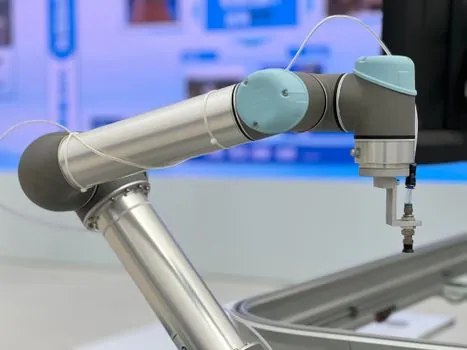
For selection, articulated robots score strongly on multi-axis orientation, heavy-payload options and task reprogrammability, but they demand more programming and maintenance resources than a straightforward fixed-axis alternative [S1][S2][S3]. Cartesian robots emphasize rectangular coordinate motion, delta robots emphasize rapid parallel handling, and SCARA robots emphasize compact horizontal assembly work [S5].
The comparison should use four criteria: required orientation freedom, payload, process cycle time and integration effort. A six-axis articulated robot earns its cost when the task needs several approach angles, complex paths or heavy handling. A delta, Cartesian or SCARA architecture is more rational when the motion pattern is simpler, the part is light and rapid repetitive placement matters more than full 3D articulation [S4][S5].
For welding, painting and dispensing, final validation must cover tool mass, process force, trajectory repeatability and workpiece access. For handling, it must cover payload, reach, floor space and transfer cycle time. These checks convert general advantages into a defensible equipment decision [S3].
A traceable next step is to document the required payload, reach, tool orientation, cycle time and safety zone, then compare those five inputs with an articulated model and at least one lower-complexity alternative before issuing a purchase specification [S1][S3].