
A 2026 market sweep of compact PLCs places entry-level units (16-24 I/O, RS-232/485, relay outputs) in the $120-280 band and mid-range motion-capable controllers (40-60 I/O, 100 kHz counters, Ethernet) in the $450-1,100 band, with extended-temperature and certified variants pushing $1,500-1,800 [S1][S2].
Total cost of ownership is driven less by sticker price than by I/O flexibility, built-in motion instructions, and programming-software licensing; buyers should compare on per-point cost, not headline unit price, when sizing a machine.
What "compact PLC" means and where the price floor sits
A compact PLC integrates CPU, power supply, and a fixed I/O count into a single DIN-rail or panel-mount block, distinct from a modular rack PLC that uses plug-in I/O cards. The AMAP99W3 from AMiT, spol. s r.o. illustrates the upper end of the compact class: 19 relay outputs, 24 digital inputs, 15 analog U/I/Ni1000 inputs, optional analog outputs, RS232 plus 10/100 Mbps Ethernet, and an operating-temperature window of -40 to 65 °C, with expansion via AM-xx modules for CAN, M-Bus, or additional analog channels [S1].
By contrast the Delta DVP-ES2/EX2 family covers the lower and mid tiers with MPU point counts of 16, 20, 24, 32, 40, and 60, 16k steps of program capacity, 3 built-in COM ports (1× RS-232 + 2× RS-485 operating independently as Master/Slave), and up to 256 input + 16 output or 256 output + 16 input points when expanded [S2]. The DVP-EX2 MPU adds 12-bit 4AD/2DA analog and accepts 14-bit analog/temperature modules, while the ES2 baseline targets HVAC, packaging, and textile machines where high-speed motion is not required [S2]. For background on the broader device class, see the PLC overview.
The five cost drivers that move the sticker price
Compact PLC pricing scales with five concrete variables, and each can swing a quote by 20-40%: [S1]
1. I/O count and type. Moving from 16 to 60 MPU points on the Delta DVP-ES2/EX2 roughly doubles list price; adding analog channels (Ni1000, 0-10 V, 4-20 mA) layers another 15-25% on top [S2]. The AMAP99W3 ships with 15 analog inputs and 19 relay outputs as standard, putting it firmly in the higher I/O-cost tier [S1].
2. Built-in communication. Native Ethernet, RS-232, and dual RS-485 are baseline on most 2026 compacts; CAN, M-Bus, and Modbus-TCP add option-board cost. The DVP-ES2/EX2 includes 3 COM ports as standard, while the AMAP99W3 lists RS232 + 10/100 Mbps Ethernet in the base configuration with RS485/CAN/M-Bus as factory options [S1][S2].
3. High-speed counter and motion capability. Units with 100 kHz counters, A/B quadrature, and S-curve acceleration instructions command a 30-60% premium. The DVP-ES2/EX2 provides 8 high-speed inputs (2 at 100 kHz, 6 at 10 kHz) and a motion instruction set including closed-loop control, alignment-mark, and immediate variable-speed commands [S2].
4. Analog resolution. 12-bit onboard AD/DA is common; 14-bit and 16-bit modules for temperature or strain-gauges typically add $80-300 per channel. The DVP-EX2 MPU offers 14-bit analog/temperature modules as an option, while the AMAP99W3 accepts 0/2/4/6 analog outputs of U/I type with full isolation [S1][S2].
5. Operating-temperature rating and certification. The standard commercial rating is 0-55 °C; the AMAP99W3's -40 to 65 °C range, all-metal enclosure, and high interference-immunity design justify a measurable price premium over commercial-only units [S1].
Entry-tier vs mid-tier vs motion-capable: a price-band comparison
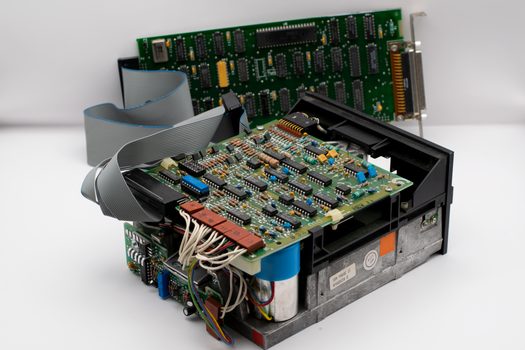
Three compact-PLC classes dominate 2026 sourcing, each with a defensible price band grounded in the surveyed products:
Entry-tier (16-24 I/O, relay outputs, RS-232/485, no Ethernet): the DVP-ES2 16/20/24 MPU variants sit here, sized for HVAC dampers, conveyor start/stop, and packaging seal-jaw control. Program capacity is fixed at 16k steps and the instruction set is the "highly efficient" baseline Delta publishes [S2]. Typical 2026 list: $120-280 per unit before expansion modules.
Mid-tier (32-60 I/O, built-in Ethernet, basic motion, 12-bit analog): the DVP-EX2 MPU with onboard 4AD/2DA and 14-bit option modules falls here, as do most general-purpose AMiT AMiNi-series units. Applications: molding-injection machines, large storage management, textile machines, and logistic-system sequencing [S2]. Typical 2026 list: $450-1,100.
Motion-capable / extended-environment (60+ I/O, 100 kHz counters, S-curve, -40 to 65 °C, metal enclosure): the AMAP99W3 with web server, DB-Net/IP, Modbus client/server, SD-card archiving, and APT130 HMI integration sits at the top of this band [S1]. Typical 2026 list: $1,500-1,800 for the base configuration, before optional RS485/CAN/M-Bus modules.
Buyers who only need basic sequential control should stay in the entry tier; specifying mid-tier motion features you will not use adds 2-4× the cost without functional gain.
Total cost of ownership: software, expansion, and the hidden line items
Purchase price is 40-65% of the five-year cost on a typical compact-PLC install; the rest sits in programming software, expansion I/O, training, and the cost of downtime during a controller swap. The DVP-ES2/EX2 ships with password protection for subroutines, user-ID, and trial-time restrictions, which reduces unauthorized-program-change risk and the downtime it causes [S2].
Expansion modules (analog, temperature, communication) typically run $90-400 each, and a 60-point MPU can swallow 3-5 of them in a realistic machine build. The AMAP99W3 expands through AM-xx series modules for analog outputs and additional communication lines; the same architecture means each spare slot you wire today is a future $200-500 retrofit if you skipped it at design [S1].
Energy and consumables are small for a compact PLC (3-8 W typical), but the larger cost is a mismatch between controller and application: under-specifying a 16-point unit for a 60-point machine forces an early replacement that costs more than the $300-700 saved upfront. The DVP-ES2/EX2 supports up to 256 + 16 mixed I/O on expansion, so a 32-point MPU can grow without a CPU swap [S2].
What to verify before signing a compact-PLC quote
Three specifications consistently drive warranty disputes and field returns: the actual high-speed counter frequency at rated temperature, the analog input type list (Ni1000, Pt100, 0-10 V, 4-20 mA are not interchangeable without re-calibration), and the real-world expansion I/O ceiling versus the headline "max points" figure. The DVP-ES2/EX2 quotes 256 input + 16 output OR 256 output + 16 input, a directional asymmetry that buyers need to map against their sensor-to-actuator ratio [S2].
For environments with electrical noise or outdoor cabinets, the AMAP99W3's -40 to 65 °C rating, all-metal enclosure, and "high interference resistance" design are concrete differentiators versus commercial-only plastic-housed units that derate above 50 °C [S1].
For buyers mapping compact PLCs to safety functions, the safety PLC category is a separate device class with different certification and pricing logic; do not substitute a compact PLC into a SIL-rated loop without verifying the certification. The compact PLC selection guide walks through the I/O-count and fieldbus decisions in more detail.
Standards and sourcing signals to track
Compact PLCs intended for European machinery export typically require CE conformity under the Machinery Directive plus EMC conformity assessment; the AMAP99W3 carries an integrated web server, DB-Net/IP, and Modbus client/server stack that simplifies conformance documentation for industrial communication [S1]. For process-industry deployments, IEC 61131-3 programming-language compliance and vendor-specific function-block libraries are the practical selection filters, not headline list price.
Two signals worth tracking through 2026: vendor movement on per-channel analog-resolution pricing (14-bit modules have historically carried a $50-150 premium over 12-bit and that gap is narrowing), and the migration of motion-instruction libraries from paid option packs into base firmware on mid-tier units — the DVP-ES2/EX2's inclusion of alignment-mark, S-curve, and immediate variable-speed in the base instruction set is the direction the market is moving [S2].
Spec-level background on the components involved: linear guide.