
A compact PLC integrates the power supply, CPU, and discrete I/O into a single box unit sized from 10 to 40 native points, and is the default controller class for stand-alone machines under roughly 100 I/O [S1][S2][S4].
Selection hinges on four numbers — local I/O count, scan time, supply voltage range, and the fieldbus used for expansion — and buyers typically compare Omron CPM1A, Mitsubishi MELSEC-F, and Allen-Bradley MicroLogix 1500/CompactLogix 1769 on those axes [S1][S3][S4].
What "compact PLC" actually means
A compact PLC is defined by form factor: power supply, CPU, and I/O live in one enclosure, as opposed to modular rack PLCs with separate backplanes [S1]. The MELSEC-F series is the canonical example — "incorporates power supply, CPU and I/Os into a single compact unit" and has accumulated over 17 million installations worldwide since Mitsubishi entered the European market more than 30 years ago [S1].
Common compact form factors include box-style bricks (CPM1A 10/20/30/40 I/O), modular-but-still-compact (CompactLogix 1769 I/O used as MicroLogix 1500 expansion), and DIN-rail all-in-ones (Horner XL4 Prime OCS, Saia PCD1 E-Line) [S2][S3][S4]. The Horner HE-RCC1410 Remote Compact Controller, for example, ships as a screen-less 128 KB-logic unit with a 0.013 ms/kB scan rate and onboard Ethernet [S2]. For a general primer on programmable logic controller class boundaries, the integrated form factor is the only defining criterion.
Native I/O count and supply voltage: the first filter
The Omron CPM1A series comes in four native sizes — 10, 20, 30, and 40 I/O — and accepts either 100–240 V AC or 24 V DC power, with DC operating range of 20.4 to 26.4 V DC and AC operating range of 85 to 264 V AC [S4]. Inrush current on the 10-point AC variant is specified at 30 A max, rising to 60 A max on the 40-point unit, which directly affects the upstream breaker or fused-circuit sizing [S4].
For the 40-point AC unit Omron publishes an external 24 V DC sensor supply rated at 300 mA — enough to power a small bank of photoeyes or proximity switches without an auxiliary PSU [S4]. When a build outgrows 40 native points, the path is fieldbus expansion: 1769 Compact I/O drops onto a CompactLogix controller, or onto a MicroLogix 1500 base, or onto a 1769-ADN DeviceNet adapter node [S3]. Each I/O bank needs its own dedicated power supply unless it sits on a MicroLogix 1500 base [S3].
Fieldbus and network expansion: HART, PROFIBUS, Ethernet
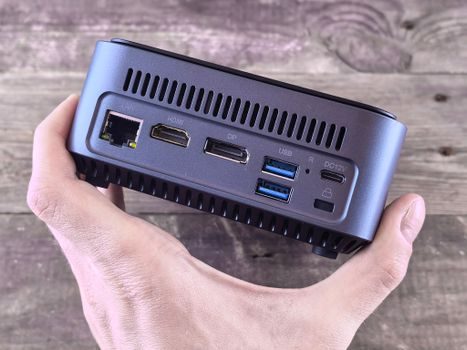
Compact PLCs differ sharply in how they reach field devices. The MELSEC-F FX3U line supports open network expansion plus analog and positioning options on top of its native I/O [S1]. The Rockwell CompactLogix 1769 platform extends I/O through 1769 Compact I/O modules and integrates DeviceNet via the 1769-ADN adapter [S3].
CompactLogix has also been demonstrated as a PROFIBUS-DP slave against a Siemens S7 master, which matters for brownfield retrofits where a Siemens line PLC must hand off a sub-machine to an Allen-Bradley controller without rewiring [S5]. On the Ethernet side, the Horner XL4 Prime OCS provides a built-in 10/100 Ethernet port, RS-232/485, CAN, and a ¼-DIN cutout plus DIN-rail mount, with USB-A and Micro-SD for program and data storage [S2]. For shop-floor networks a related buy is a safety PLC — required wherever the compact PLC closes an ESTOP or guard-door circuit, since most compact brick PLCs are not safety-rated.
Scan time, memory, and program size
Scan rate separates low-end bricks from higher-end compact controllers. The Horner HE-RCC1410 hits 0.013 ms/kB with 128 KB of ladder logic, while the larger HE-RCC6512 trades scan rate (0.7 ms/kB) for more I/O and 16 KB of logic [S2]. ODOT's C-3351 runs CODESYS V3.5 and supports up to 32 expansion I/O modules — between the two extremes in capacity and price [S2].
CompactLogix 1769 and MELSEC-F FX3U are positioned above the small-brick tier: FX3U is described as "delivering performance that was formerly the exclusive domain of larger control systems in a compact package" [S1]. A useful analogy: the FX3U behaves like a modular mid-range PLC in scan performance but keeps the box-form factor. Buyers who need motion — even simple two-axis positioning — should look at the MELSEC iQ-F line, since plain FX-series compact PLCs are not optimised for multi-axis coordination [S1].
Selection criteria: matching duty to model
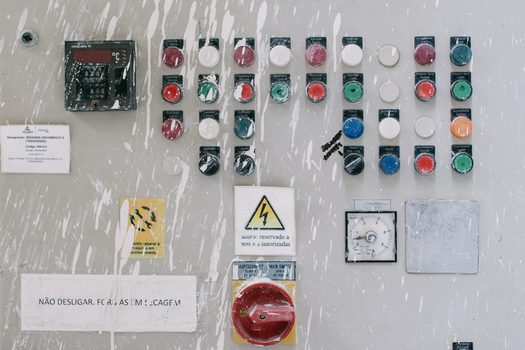
Pick the controller by answering four questions in order: native I/O count needed, supply type (AC mains vs 24 V DC panel), required fieldbus, and scan budget in ms/kB. For a 10–20 I/O standalone machine on 24 V DC with no network, an Omron CPM1A 10-point or 20-point unit covers the duty; for 30–40 I/O the 30-point or 40-point CPM1A is the direct fit, and the 40-point AC variant supplies 300 mA at 24 V DC for sensors [S4].
For 50–200 I/O with DeviceNet, MicroLogix 1500 plus 1769 Compact I/O (or a CompactLogix 5370) is the standard Rockwell path [S3]. For high-density or high-speed machines the FX3U or MELSEC iQ-F is the correct compact tier [S1]. For all-in-one HMI + control in one panel cutout, Horner XL4 Prime OCS combines a ¼-DIN touch screen, two serial ports, Ethernet, and CAN [S2]. For distributed sub-panel automation in electrical subdistributors, the Saia PCD1 E-Line CPU is purpose-built to fit on DIN rail inside a cabinet [S2]. A useful side-by-side pass: Omron CPM1A 40 I/O (AC, 24 V DC at 300 mA sensor supply) vs MicroLogix 1500 + 1769 I/O (modular, 24 V DC bank) vs MELSEC FX3U (high scan, open network expansion) — on the axes of native points, supply, and scan class, the three split cleanly into low-end brick, mid modular, and high-scan compact. If the work cell shares cabinet space with linear motion, the same spec-first logic used for the linear guide selection applies: fix the duty envelope first, then pick the controller to match.
Who compact PLCs are NOT for
Compact PLCs are the wrong class for safety-rated functions (ESTOP, guard interlock to Cat 3/PL d or above) — most brick controllers lack the dual-channel architecture, diagnostic coverage, and certified safety firmware required by ISO 13849-1 PL d/e. For those loops, specify a dedicated safety PLC or a safety I/O slice, and keep the compact PLC out of the safety chain. [S1]
They are also the wrong class for plants that need high-availability redundant CPUs (no compact brick supports dual redundant processors) and for very high-axis motion (the FX3U handles simple positioning but is not a multi-axis coordinated-motion controller). For those duties, step up to a modular mid-range PLC with servo axes. When pairing a compact PLC with field measurement, a pressure transmitter or flow meter on the process side should be checked for the same fieldbus — a PROFIBUS-PA flow meter, for example, will not drop onto a MELSEC-F CC-Link network without a gateway.
Certifications, sourcing, and procurement signals

Mitsubishi states that MELSEC FX controllers "conform to all major international industrial standards and maritime classifications" and operate over a wide power supply range that lets the same hardware ship globally [S1]. Omron publishes a full AC/DC spec table for CPM1A by I/O size, including the 200 mA and 300 mA external 24 V DC sensor supplies that differ by unit size [S4]. The DirectIndustry compact-PLC directory listed 69 manufacturers and 143 products in mid-July 2026, with active entries from Allen-Bradley, ABB, B&R, Bosch Rexroth, Beijer, Crouzet, Delta, Eaton, and Schneider, indicating sustained supply-side breadth [S2].
Track three signals over the next buying cycle: (1) MELSEC-F and iQ-F lead times from authorised distributors, since the FX3U generation is mature; (2) CompactLogix 5380 / 5480 firmware revisions for the CompactLogix 1769 I/O platform, since MicroLogix 1500 phase-out dates are still being published by Rockwell; (3) additions to the DirectIndustry compact-PLC index above 143 products, which marks new entrants and refreshed product lines. Buyers can also use the existing programmable logic controller reference to cross-check the compact class against modular and rack PLC boundaries before issuing an RFQ.
For related coverage, see Needle Valve Sizing and Selection: Cv, DN, and Duty Map.