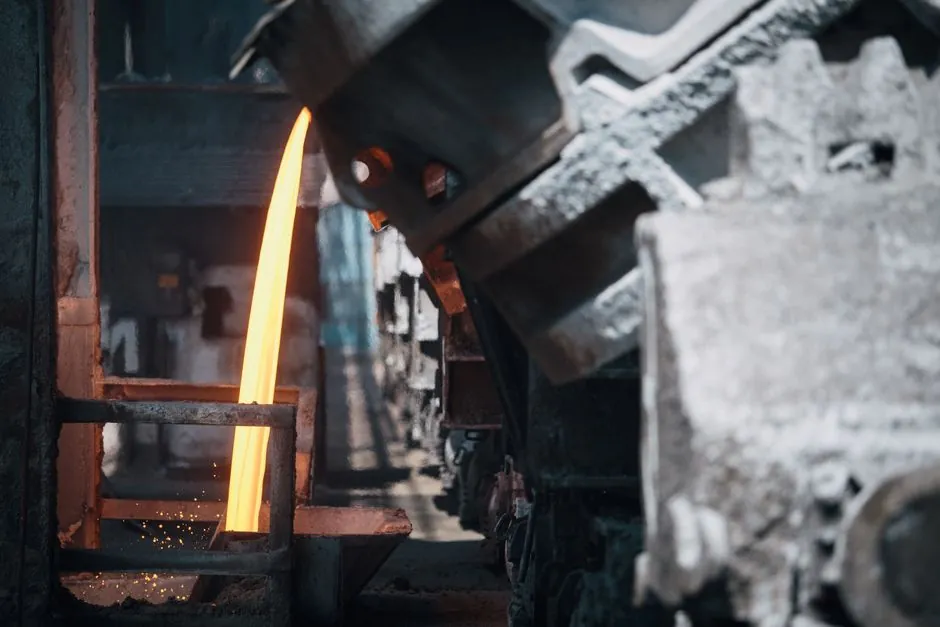
A coke-fired cupola operates in a reducing, carbon-saturated environment, so any low-carbon steel charged into the bed picks up carbon from the fuel until its melting point drops to the ~1147°C eutectic of cast iron at about 4.3% carbon [S4].
The thermal window matters as much as the chemistry: pure iron melts near 1536°C, and typical cupola tap temperatures sit in the 1450–1550°C range, leaving no headroom to superheat steel for clean pouring once carbon has been absorbed [S2][S3].
What a cupola actually is, and what it was built to melt
A cupola furnace is a vertical, cylindrical shaft furnace lined with refractory brick, charged from the top with alternating layers of metal, coke, and limestone, and blown with air through tuyeres near the bottom; shell diameters span roughly 0.5–4.0 m and overall heights commonly reach 9–24 m, with melt rates in production installations measured in tons per hour [S2][S5]. Reference sources describe the cupola as a melting device "used to melt cast iron, Ni-resist iron and some bronzes", and historically that roster has been the limit of what the process is designed to deliver [S2]. The cupola depends on coke as both fuel and reductant, and the coke bed is the source of the carbon that defines the final alloy, which is the root cause of the incompatibility with carbon steel targets.
Carbon pickup: the thermodynamic trap
When low-carbon iron or steel scrap is charged into a coke-fired cupola, the descending metal makes prolonged contact with incandescent coke at 1400–1600°C; under those conditions the metal's carbon content rises until the local Fe-C phase diagram dictates a liquid at the operating temperature, so the tap stream exits as cast iron rather than the steel that went in [S4]. Practical demonstrations in small furnace setups confirm the same physics: a steel rod dipped into a 4.3% carbon iron bath saturates toward cast-iron composition, because the bath, not the operator, sets the final carbon level [S3]. For foundries whose goal is a 0.15–0.30% carbon steel melt, this continuous carbon transfer is disqualifying, since no normal cupola operating practice reverses it once the metal has passed the melt zone.
Why the melt temperature ceiling is the second blocker
Cast iron at ~4.3% carbon melts just above 1147°C on the Fe-C eutectic, well within cupola capability, but carbon steel grades need 1490–1530°C to become fully fluid, and pouring temperatures for thin-section steel castings sit 50–100°C above the liquidus to keep the stream from freezing in the runner system [S3]. Cupola hot-blast designs with oxygen enrichment can push the combustion zone higher, yet the iron-carbon bath itself self-limits at cast-iron composition: a higher flame temperature cannot change the carbon content already dissolved in the melt, and excess coke contact only drives carbon higher toward the 4.3% eutectic [S2][S4]. The result is a furnace that is correctly sized to melt cast iron but lacks both the temperature margin and the chemical isolation required for routine carbon steel production.
What the cupola CAN melt, and where the line is drawn
The compatibility list is narrow by design: gray iron, ductile iron, Ni-resist iron, malleable iron base, and a handful of high-copper alloys or bronzes with melting points under roughly 1200°C all sit inside the cupola's natural envelope [S2]. Compacted graphite iron and high-chrome white irons are also routine because their carbon and chromium levels match the reducing atmosphere. Outside that band, the practical rule is simple: any alloy whose specification demands less than about 2% carbon, or whose liquidus sits above the cupola's stable superheat range, needs a different furnace. EAFs and induction furnaces handle that territory because they use electric energy for heat, not carbon for both heat and chemistry, and therefore leave the melt composition under operator control rather than under the fuel's control [S1][S5]. A plain comparison makes the selection logic visible: - Cupola: 1147–1300°C typical tap range for cast iron; carbon source is the fuel; tolerates dirty, oily, painted, zinc-coated scrap; ~32% of U.S. foundry iron tonnage in 2025 [S1][S2]. - EAF: 1600–1700°C typical for carbon steel; carbon is an alloy addition; requires clean, dense, homogeneous scrap; widely used for steel foundries and mini-mills [S5]. - Induction (coreless): precise composition control; no carbon pickup from electrodes; common in ductile iron and small-batch specialty melts [S1][S5].
Real consequences of getting the choice wrong
Specifying a cupola for a carbon-steel pour does not just produce off-chemistry iron; it produces iron that fails the customer's spec at the lab, and the failure mode is systematic rather than statistical. The same goes for alloys sensitive to nitrogen or sulfur pickup from the coke, since both elements enter the metal through the same gas phase that delivers the carbon. Foundries that have tried to stretch the cupola into low-carbon territory generally end up running a separate crucible furnace or channel-style holding unit to refine a small batch, which negates the cupola's scale advantage and brings the question back to why the EAF or induction route was not selected up front. [S5]
Verdict and what to verify before specifying
Use a cupola for cast iron, Ni-resist, and compatible bronze grades; choose an electric arc or induction furnace when the specification calls for carbon steel, low-carbon alloy steel, or any grade where carbon must stay under roughly 2% and be held within tight limits [S1][S2][S4]. Before locking in the equipment list, confirm three numbers from the melt supplier: target carbon range and tolerance, minimum pouring temperature at the runner, and the maximum allowable tramp element pickup (Cu, Sn, Zn, Cr) from the scrap stream, since these together decide whether a coke-bearing furnace can stay inside the spec at all. Track the cupola's TPK efficiency (tons per hour per 1000 scfm Equivalent Blast Rate) where the foundry still runs one, because U.S. operations span 2.3 to over 3.5 TPK and that spread is a leading indicator of carbon and temperature stability in the tap stream [S1]. For shops that do need both cast iron and carbon steel on the same site, plan a dedicated holding furnace and ladle metallurgy station, not a converted cupola, to keep the two alloy families from contaminating each other between campaigns.
Next verifiable signal: the 2025 Modern Casting feature on cupola sustainability, which restates the ~32% U.S. iron-tonnage share and frames induction and cupola as complementary rather than competing routes, is the cleanest public benchmark for tracking how the equipment split evolves through 2026 [S1].
Background reading: ASTM D1418 FKM Type 1 dipolymer: composition, cure, and where it actually fits.