The global air compressor market is projected to grow from $20.01 billion in 2026 to $33.82 billion by 2034 at a 6.80% CAGR [S3].
For process engineers sizing a new plant or retrofit, the 2026-2030 window is defined by three forces: variable speed drive (VSD) penetration in the 7-500 kW bracket, IIoT-enabled predictive monitoring, and reshoring-driven demand for redundant compressed-air capacity in North American discrete and process manufacturing [S4][S5].
Sizing baseline: CFM, kW, and pressure class for 2026 specs
A correctly sized industrial compressor package starts with three numbers: required CFM at the working pressure (typically 100-150 psig for general manufacturing, 150-200 psig for PET blowing, 200-250 psig for heavy-pneumatic actuator duty), full-load kW input, and specific power in kW per 100 CFM delivered [S5]. VSD units that match motor speed to trim-band demand cut unloaded running hours, a critical metric because U.S. DOE estimates indicate compressed air routinely accounts for roughly 10% of industrial electricity use in discrete plants, with the U.S. DOE's Industrial Technologies Office publishing training and assessment software for that exact reason [S1].
For 2026 procurement, the practical baseline for a 100 hp (75 kW) shop is 400-450 CFM at 125 psig with a VSD drive, a refrigerated or desiccant dryer sized to the lowest expected dew point, and a 120-240 gallon receiver to buffer pulsation from reciprocating trim compressors [S5]. Engineers evaluating reciprocating versus rotary screw versus centrifugal types should anchor the decision on duty cycle, not list price: oil-flooded rotary screw dominates the 25-250 kW band for continuous duty, while two-stage reciprocating still wins on capital cost for intermittent low-CFM shop air [S4][S5].
VSD versus fixed-speed: where the 2026 savings actually land
Advanced VSD and VSD+ compressors dynamically trim motor speed against real-time CFM demand, eliminating the unloaded blow-off penalty of fixed-speed units and typically delivering the fastest ROI available in compressed air today, per AirCompressors.com's 2026 outlook [S5]. Fluid-Aire Dynamics separately notes lead times for VFD-class machines stretched to as long as 18 weeks during the 2022-2023 supply shock, a number worth carrying into 2026 project schedules even as supply chains normalize [S4].
The trade is electrical infrastructure: a VSD in the 100-200 hp range draws high inrush harmonics that may require a line reactor or active harmonic filter on the same bus as sensitive VFD-driven machine tools, a coordination point that fixed-speed units avoid. For a deeper look at how rotary-screw trim pairs with pneumatic downstream hardware, the pneumatic actuator 2026 spec map walks through the matching CFM-and-pressure window for the same duty bands.
IIoT monitoring and predictive maintenance: spec what to log
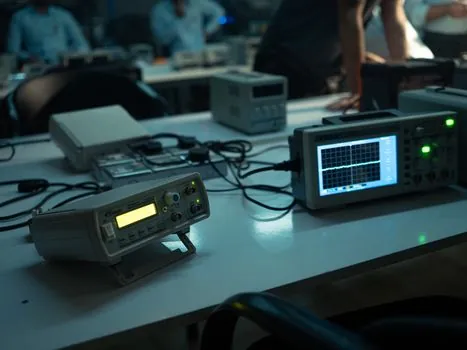
Cloud-connected monitoring platforms and IIoT pressure, flow, and vibration sensors are now baseline on new builds, enabling predictive maintenance that prevents unplanned downtime and extends bearing, separator, and filter element life [S5]. The U.S. DOE's compressed-air systems program page lists assessment and training tools explicitly so plant teams can benchmark specific power and leakage rates against peer facilities [S1].
When specifying a 2026 monitoring stack, the minimum data set should include: live CFM and kW per compressor, dew point at the dryer outlet, receiver pressure trend, and a leak-rate percentage calculated overnight when no production load is scheduled. Leak rates above 10-15% of nominal CFM are the most common energy-audit finding, and IIoT metering turns that into a trackable KPI rather than a periodic walkdown guess. Pairing flow data with the right downstream tooling matters, and our reference on air impact wrench selection covers the CFM-per-cycle demand that drives shop-air consumption peaks on assembly lines.
Compressed air treatment and piping: dryer, filter, and receiver choices
2026 treatment trains pair refrigerated cycling dryers (typically +3 deg C pressure dew point) for general shop air with desiccant dryers (-40 deg C PDP) for instrumentation and pharmaceutical-grade lines, plus coalescing and particulate filtration staged to ISO 8573-1 cleanliness classes [S5]. Modular aluminum or stainless piping with grooved couplings has largely replaced threaded black-iron for new plant builds because leak rates on threaded systems can run several times higher than on flanged or push-to-connect networks [S5].
Receiver sizing should target roughly 1-2 gallons of storage per CFM of trim compressor capacity for variable-demand shops, with a separate satellite receiver near high-pulsation loads such as sandblasting cabinets or PET blow molders. The downstream control devices that gate flow into these receivers are covered in the air solenoid valve reference, including response time and Cv ratings that influence whether a fixed receiver is even needed. End-of-arm tooling on pick-and-place cells drives another branch of shop-air demand, mapped in the air pick encyclopedia entry alongside the vacuum-versus-blow-off decision.
Lead times, steel supply, and 2026 procurement windows

Standard compressors that historically shipped in 2-4 weeks ran 6-8 weeks through the supply shock, and VFD-class units stretched to roughly 18 weeks at the worst point, driven primarily by steel shortages affecting receiver tanks, castings, and oil-filter housings, plus semiconductor allocation for VSD control boards [S4]. Steel-heavy piston and reciprocating packages were hit hardest, while oil-injected rotary screw lead times normalized faster thanks to lighter fabricated assemblies [S4].
For 2026 capital projects, the working assumption should be 8-12 weeks for a standard 50-100 hp rotary-screw VSD package, with VFD+ models running 12-18 weeks from PO to commissioning, and any unit specified with non-stock motors or NEMA 4 enclosures carrying an additional 4-6 week tail. Buyers who can flex on color, controller brand, or receiver orientation usually recover 2-3 weeks. Allocation of structural steel in heavy-industry buyers also affects downstream fit-out, and the belt tensioner selection for steel mills spec map covers the matching drive-side reliability questions for adjacent process equipment.
Where this lands: tracking the 2026-2030 build signal
DOE quarterly industrial electricity use allocated to compressed air, paired with compressor OEM quarterly order book commentary [S1]. Next nodes: the November 2026 DOE Industrial Efficiency update, Q1 2027 OEM earnings calls, and the next ISO 8573-1 revision cadence, all of which will confirm whether the VSD-plus-IIoT build cycle is still on a 6%-plus trajectory or settling into the lower CAGR band [S1][S3].