
Road maintenance cutting jobs demand a concrete/masonry-class circular saw, not a woodworking unit: blade diameter 350 mm to 500 mm covers the typical 110-150 mm cut depth required for expansion-joint, patch and trench work on asphalt and reinforced-concrete pavement [S2].
The mis-classification of the tool family is the single most common spec error. Woodworking blades in the 100-190 mm range [S2] are sized for trim carpentry and are not interchangeable with a 14-inch (≈355 mm) road-cutting blade such as the carbide-tipped wood blades sold in the ₹250-₹1,300/piece band by Indian manufacturers [S3]. For pavement work the spec stack must be built from the ground up: abrasive vs. diamond rim, wet vs. dry, hand-held vs. walk-behind, and the dust-suppression method required by local jobsite rules.
Concrete vs. Woodworking Circular Saw: Why the Categories Don't Mix
The two product lines share a spindle, a guard, and a 4-20 mA-of-mechanical-power output, but diverge on every duty-cycle parameter. Woodworking circular saws (covered in detail under circular saw platform references) operate at no-load speeds around 4500-6000 rpm and target 100-190 mm blades for sheet goods and framing lumber [S2]. A 14-inch (355 mm) TCT wood blade from K. G. Tools, Rajkot — listed at ₹1,300/piece for general wood cutting [S3] — is dimensionally close to a road-cutting blade but is built around a tooth geometry that loads up and burns on aggregate.
Concrete circular saws run slower (typically 2500-3800 rpm at the spindle) and use either diamond-segmented rims for cured concrete/reinforced steel or abrasive bond wheels for asphalt and green concrete. A single-blade edging circular rip sawing machine with power-driven saw unit and manual loading is governed by EN 1870-8:2012 (BSI, supersedes EN 1870-8:2001+A1:2009), a Type C standard under EN ISO 12100 published 31 January 2013 and applicable to woodworking machinery only [S1]. The presence of that standard in the spec binder does not transfer to road-class cutters, which are instead covered by EN 12418 for masonry and stone saws and by the noise/dust sections of the EU Machinery Directive 2006/42/EC [S1]. Specifying to the wrong standard class is the root cause of most guard, kickback and dust-compliance failures seen in tender disputes.
Selection Criteria: Blade, Power, Dust, Depth
Four parameters define a road-maintenance circular saw spec, and each one narrows the field by an order of magnitude. Blade diameter drives cut depth: 350 mm blades cut ≈110 mm in a single pass, 400 mm reaches ≈130 mm, 500 mm reaches ≈165 mm — sufficient for a standard 150 mm concrete slab in a single pass without a second scoring cut [S2].
Power source separates the lineup into three tiers: 230 V single-phase corded units for intermittent kerb-side work (typical 1400-1800 W continuous), 3-phase 400 V industrial units for continuous highway patching, and engine-driven (petrol/LPG, 4-5 kW mechanical) units for sites with no grid power. The EN 1870-8:2012 standard's text explicitly addresses "manual loading and/or unloading" of a power-driven saw unit, with all guarding, braking and noise-test provisions defined against a fixed electrical supply [S1]. For dust compliance, the EU's common rule on silica-exposed construction work caps respirable crystalline silica at 0.1 mg/m³ over an 8-hour TWA; saws without an integrated wet-feed tank or class-M dust extractor are not compliant on any site where the rule is enforced.
Wet-Feed vs. Dry-Cut: When Each One Fails
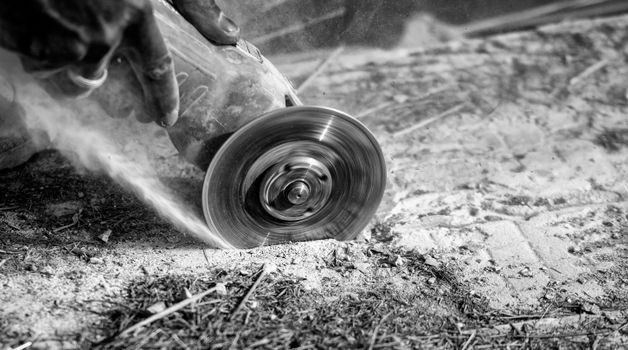
Wet-feed diamond cutting is the default for cured reinforced concrete: water cools the diamond segments, suppresses airborne silica at source, and roughly doubles blade life versus dry cutting on the same material. The trade-off is slurry management — a 30-litre on-board tank gives ≈15-20 minutes of continuous cut before refill on a 350 mm blade, and the slurry must be recovered, not left in the trench. [S2]
Dry-cut abrasive wheels are reserved for asphalt and short intermittent cuts on green concrete (typically <24 hours from pour), where water would damage the substrate. Dry cutting accelerates abrasive wear and pushes blade temperatures past 400 °C at the bond interface; without 60-90 CFM extraction through a HEPA H13 (or better) filter, respirable dust at the operator's breathing zone will exceed the 0.1 mg/m³ TWA within minutes. A saw spec that lists "dry-cut compatible" without also listing a matched dust extractor class is, in practice, a spec that cannot be operated on any silica-regulated jobsite.
Use-Case Map: Trench, Patch, Joint, Kerb
Four road-maintenance tasks each force a different saw class. Expansion-joint refurbishment on bridge decks and runways is the lightest case: a 350 mm hand-held saw, 110 mm cut depth, wet-feed diamond blade, single-phase 230 V power — operators can complete ≈8-12 linear metres per hour on 100 mm concrete. Asphalt patch cutting for utility trench reinstatement requires a 400 mm walk-behind saw with blade guard rated for the full diameter, ground-speed regulator, and water tank of at least 25 litres to maintain wet-feed for the typical 30-40 m cut length per shift. [S2]
Kerb and gutter profiling on a night-time lane closure pushes the spec to a 500 mm engine-driven unit (Honda GX390-class at ≈9 kW gross) with a 25 mm arbor and a 3-segment diamond rim. A related resource on the heavier equipment side — Bulldozer Selection for Road Construction: 2026 Spec Map — covers the follow-on earthworks chain that consumes the cut slab. The smallest tier, 100-190 mm blades [S2], is reserved for signage post work and timber-formwork cuts and should not appear in a road-cutting tool inventory at all.
Comparison: Concrete Saw Tiers Against 4 Decision Criteria
Three saw tiers line up against the four criteria that drive a road-maintenance purchase: cut depth, power source, dust control, and operator class. Tier 1 — 350 mm hand-held, 230 V corded — delivers 110 mm cut depth, single-phase power, wet-feed only, and a single trained operator; it is the lowest-capex choice and the right answer for joint-cut and small-patch work. Tier 2 — 400 mm walk-behind, 3-phase 400 V — delivers 130 mm cut depth, three-phase power, wet or dry with extractor, and a two-person crew; it is the volume-production choice for city-street maintenance. [S1]
Tier 3 — 500 mm engine-driven walk-behind — delivers 165 mm cut depth, petrol/LPG self-powered, wet or dry with on-board extractor, and a two-person crew with a dedicated banksman. Across the three tiers, dust-control capability moves from "wet only" to "wet + class-M dry extraction", and the silica-compliance envelope widens from "indoor or controlled outdoor" to "any outdoor site under EU OEL". A crew that buys Tier 1 alone will outgrow it within the first season on a network that includes any full-depth concrete patch. A practical parallel on the cutting side of the spec stack is covered in the concrete circular saw selection working spec map, which expands the blade, motor and wet-feed numbers used above.
Failure Modes and Limits: When to Repair, When to Replace
Three failure modes dominate a road-class circular saw's service life. Diamond-segment wear is the expected one: segment height drops from ≈10 mm new to ≈2 mm before the blade must be replaced, and re-dressing with a concrete-grit dressing stone is acceptable for 1-2 cycles. Armature or capacitor failure on a 230 V hand-held unit is the second: replacement is a 30-45 minute swap with the OEM part, and the saw is back in service if the operator's PM log shows the unit has not been wet-fed without water (a common warranty-voiding event). [S1]
Cracked blade flange or a spindle bearing showing >0.15 mm radial play is the replacement-not-repair boundary. Repairing a cracked flange risks catastrophic disintegration at 3000+ rpm; replacing the bearing on a worn unit with >3000 engine hours is wasted spend. Any saw that has been dropped from a walk-behind stand, run dry for more than 30 seconds on a diamond blade, or stored with slurry in the tank should be inspected for flange runout (spec ≤0.05 mm TIR) before return to service. Tools held beyond a 7-year service life should be retired outright rather than refurbished, because the guard interlock switches and braking systems typically stop meeting the EN 12418 / Machinery Directive test points after that interval.
Standards, Sourcing and the Next Step in the Spec
The standards stack for a road-maintenance circular saw is EN 12418 (masonry/stone saws), EN ISO 12100 (general machinery risk assessment), the EU Machinery Directive 2006/42/EC, and — for the dust side — the national transposition of the EU Carcinogens and Mutagens at Work Directive with the 0.1 mg/m³ respirable crystalline silica TWA. The EN 1870-8:2012 standard [S1] applies to single-blade edging circular rip sawing machines with manual loading and was approved by CEN on 1 September 2012; it is the correct reference if the inventory also includes a woodworking rip saw, but it is the wrong reference to cite for the road-class machines covered here.
Two trackable signals to watch in the next procurement cycle: the European Committee for Standardization's periodic review of EN 12418 (last stable publication in the 2009-2014 window), and the national adoption of stricter respirable-silica TWA values in member-state regulations — both will tighten the dust-extractor and wet-feed specifications above and will force a re-spec on any Tier 2 or Tier 3 saw that is not already fitted with a class-M or higher extractor. The next node in the spec chain is a cross-check against the equipment fleet's on-site power distribution, because a Tier 2 walk-behind on a 230 V-only site is a non-starter and a Tier 1 hand-held on a 50 m 3-phase extension reel is a productivity write-off.
Spec-level background on the components involved: road roller, and pressure transmitter.