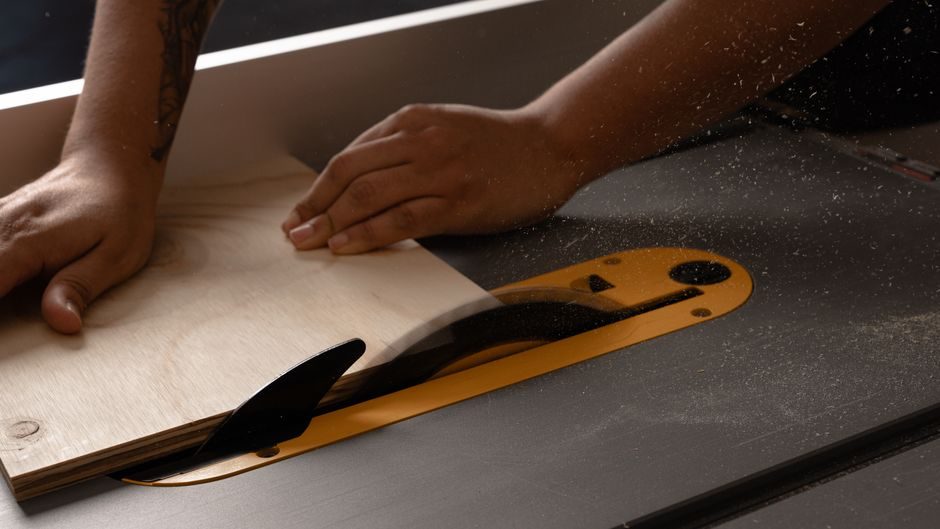
A circular saw for steel cutting is defined as a power saw with a steel disk blade carrying peripheral teeth, rotating on a spindle [S1]. In structural-steel fabrication the same definition holds, but the saw, the blade, and the peripheral equipment must be chosen against material grade, section size, tolerance, and production volume rather than a generic wood-cutting duty cycle [S2].
Steel-construction buyers in 2026 typically compare three machine families: portable handheld circular saws in the 1400 W / 5500 r/min class (e.g. CS185A-2, 220-240 V, 50/60 Hz, with a saw blade included and 500-piece MOQ) for site and light-fab work [S3]; industrial cold-saw benches such as ExactCut's T-series, M-series and L-series for steel and non-ferrous metals in automated production [S2]; and dedicated tube-processing lines from builders such as SOCO/World Machinery & Saw, whose FM-series end-finishing cells handle tubes up to 7500 mm in working length [S5]. Selection is driven by what you actually cut, not by what the catalogue headline says.
Three Saw Families and Where Each One Fits
Portable handheld circular saws in the CS185A-2 class deliver 1400 W at 5500 r/min no-load speed on 220-240 V / 50-60 Hz supply, with the blade shipped in the package and a 500-piece MOQ at the manufacturer level [S3]. They are sized for decking, purlin, and thin-plate trimming on site, not for sustained structural-section cutting where a cold saw pays back. ExactCut's T-series is the company's dedicated platform for round-bar and solid-section steel cutting, while the M-series is positioned as the flexible line for profiles and mixed production, and the L-series covers the heavier/larger cross-sections in the programme [S2]. World Machinery & Saw's SOCO line extends the envelope to tube end-finishing, where the FM-series chamfers both ends of a tube while measuring length, with some models reaching 7500 mm working length [S5]. ExactCut is part of the BOMAR group and manufactures in Brno, CZ, with in-house design, testing and production [S2].
Blade Material and Tooth Geometry
Three blade families dominate structural-steel circular sawing. TCT (tungsten-carbide-tipped) teeth are the workhorse for mild and structural carbon steel sections, hollow structural sections, and rebar, and they tolerate the interrupted cuts and surface scale typical of a yard environment. HSS (high-speed steel) and segmental HSS blades are specified for thinner-wall tube, stainless, and non-ferrous work where a finer tooth pitch and lower tooth load reduce burring; HSS circular saw blades have been benchmarked on nickel-based superalloys (Cupro 107, Inconel 600L, Nimonic PK31) for high-speed machining stability [S1]. Abrasive wheels (Al₂O₃ or SiC) are still used for cut-off work on thin-wall tube and rebar where a clean, low-burr edge matters more than cycle time. The relevant blade and saw-body material is usually an alloy steel or stainless steel body, with silicon steel laminations appearing in the motor and armature stacks driving the spindle.
Selection Criteria for Steel Construction

Selection starts with the workpiece, not the machine. Six parameters decide the build: (1) material grade, e.g. mild carbon steel S235/S275 vs quenched-and-tempered alloy steel vs austenitic stainless steel; (2) section type — solid round, square, rectangular hollow section, channel, I-beam, plate, sheet; (3) wall thickness and diameter, which set minimum blade diameter and minimum kerf; (4) tolerance and surface-finish requirement, where a cold saw beats abrasive on burr and squareness; (5) production volume, where a 500-piece MOQ-class portable saw is wrong for a 50 000-cut-per-month line; and (6) duty cycle, which drives the choice between a handheld 1400 W / 5500 r/min unit and a stationary T/M/L-series cold saw with automatic feeding and unloading [S2][S3].
A practical comparison: a portable saw like the CS185A-2 (1400 W, 5500 r/min, 220-240 V, 50/60 Hz, blade included, 500-piece MOQ) suits site trim and low-volume fab [S3]; an ExactCut T-series is the right pick when the line is mostly round or solid bar in mild/structural steel and cycle time dominates [S2]; the M-series wins on mixed profiles and small-batch flexibility [S2]; the L-series is the choice for large cross-sections and heavy steel fiber / structural members; and a SOCO FM-series cell is the right call when tube end-finishing up to 7500 mm in length has to be done in one pass [S5]. Buyers should match the saw to the circular saw duty class, not the other way round.
Standards, Speeds, and Operating Limits
For a portable circular saw, the CS185A-2 rating of 1400 W input at 5500 r/min no-load speed on 220-240 V / 50-60 Hz defines the envelope within which the blade diameter and the workpiece feed rate must be chosen; exceeding the rated no-load speed by stacking an oversize blade is the classic route to lateral-vibration failure modes documented in the research literature on guided and slotted circular saw blades [S1]. Saw-stability research has covered roll-tensioning methods, slot effects on lateral vibration, and the critical rotational speed of thin circular saws — all directly applicable to choosing safe operating RPM and blade-body design [S1]. Industrial cold-saw lines (T/M/L-series) are designed for automatic feeding, length-stopping, and chip evacuation, and ExactCut sells the full periphery (feeders, conveyors, post-processing stations) as one integrated chain [S2]. For a complete tube cell, SOCO offers chamfering and length-measuring in the same station up to 7500 mm [S5].
Limitations and Failure Modes

Circular saws are not the right tool for every steel-construction cut. Thin, high-silicon electrical laminations and other silicon steel grades chip and burr badly on TCT and are normally nibbled or laser-cut instead. Hardened alloy steel above ~40 HRC and most stainless steel grades cut slowly on cold saws and burn on abrasive wheels — bandsaw or plasma is the usual workaround. Handheld saws in the 1400 W class do not have the torque or the rigidity to hold squareness on heavy I-beam flanges; a stationary T/M/L-series cold saw with a proper vice and feed is the correct tool there [S2]. Documented failure modes in the research literature include cutting-induced vibration, lateral vibration amplified by blade slots, and roll-tensioning errors that lower the critical rotational speed — all of which are reasons to stay inside the OEM blade-diameter and speed envelope [S1].
Use Cases, Sourcing Signals, and What to Watch Next
For a fabricator weighing portable vs stationary purchase in 2026, three signals are worth tracking. First, ExactCut is exhibiting at MSV 2026 in Brno (International Engineering Fair), stand location to be announced [S2]. Second, ExactCut's AMB 2026 presence in Stuttgart (a leading metalworking trade fair) was confirmed 15 May 2026, and the company's Partner Days on 5 June 2026 in Brno were used to brief international sales and service partners [S2]. Third, supply of portable units like the CS185A-2 is available at 500-piece MOQ with blade included from Chinese OEM listings, useful for site-kit sourcing [S3]. For a fuller saw-vs-saw comparison, see the side-by-side impact drill selection for tunnel construction spec map; for material context on the workpiece side, the alloy steel selection for general fabrication and stainless steel selection for electronics maps are the matching references.