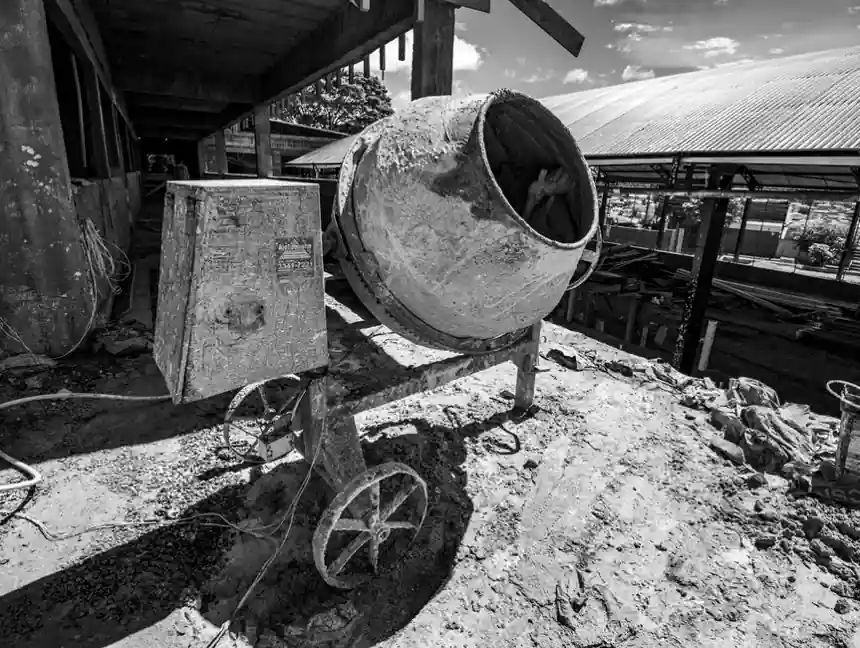
A demolition project rarely needs the same concrete concrete mixer truck a paving crew does, because the pour volumes are small, the haul distances are short, and the mix design is often lean, flowable fill or fiber-reinforced rather than structural slab concrete [S3]. The most common rear-discharge transit mixer carries 6 to 12 cubic yards (4.5 to 9 m³) per load and rotates the drum at 2 to 6 RPM during transit to keep the mix from setting [S4][S5]. Demolition haul windows also tend to fall under the 90-minute "shelf life" benchmark commonly cited for ready-mix concrete, which keeps standard transit mixers in the running [S4].
For demolition crews, the operating envelope is narrow: a truck has to enter a tight site, churn a low-slump or high-slump mix for backfill or grade beams, and discharge without a long chute run. A typical transit mixer runs at 8 to 12 L/km under load and discharges from the rear, which limits maneuverability on congested sites [S5]. That constraint is the main reason some demolition contractors move to front-discharge or volumetric units [S3][S5].
Demolition Site Demands vs. Paving or Commercial Pours
Demolition pours are usually subbase, lean concrete backfill, mud slabs, or pile-cap infill, not 4000+ psi structural slabs, so the truck does not need the same batching precision a high-rise pour does [S3]. Standard transit mixers handle the majority of demolition work because they match the 4.5 to 9 m³ pour sizes that fit one- or two-pump cycles on a typical interior gut or slab-on-grade replacement [S5]. The 90-minute workability window from batching to discharge is the binding constraint, since demolition traffic, debris haul-off, and on-site crusher work frequently stall the truck more than a green-field pour [S4]. Retarders can extend workability, but they cannot fix a truck that is stuck behind a dump truck for 40 minutes at a gate [S4].
Site access is the second binding constraint: rear-discharge units need clearance behind the truck for the chute, which is hard to find on a partial floor demo where the slab edge is gone. Front-discharge transit mixers (8 to 10 cubic yards, 6 to 7.6 m³) solve that visibility and clearance problem but carry a higher purchase cost and remain less common outside North America [S5]. For deeper pours, contractors typically pair a transit mixer with a separate concrete pump truck rather than upgrading the mixer itself, because a boom pump reaches over demo debris and rebar stacks that a chute cannot [S2].
Standard Transit Mixer (Rear-Discharge): The Default for Most Demo Work
Rear-discharge transit mixers are the most widely available units, typically carrying 6 to 12 cubic yards (4.5 to 9 m³) and rotating the drum at 2 to 6 RPM to keep the mix homogeneous in transit [S4][S5]. The drum is double-cone or pear-shaped with internal spiral blades driven by a hydraulic pump and motor off the truck engine, and the chassis is a multi-axle heavy-duty truck frame [S2]. On demolition sites, this is the workhorse: the unit can deliver a single 8 to 12 m³ load per trip, cutting labor input by roughly 30% compared to on-site mixing and avoiding 5 to 8% cement waste from manual batching [S5].
Fuel economy runs 8 to 12 L/km depending on load, so a demolition contractor running three trucks across a 20 km urban radius will see measurable diesel burn before the first pour finishes [S5]. The unit can hold a usable mix for up to about 4 hours if the drum is kept turning and the mix is retarded, which extends the effective service radius of a single batch plant to roughly 50 km [S5]. For a demolition job, the practical limitation is not the truck, it is whether the site has a place to put the chute and a place to wash out the drum after the last pour [S2][S4].
Front-Discharge Transit Mixer: Tight Sites and Operator Visibility
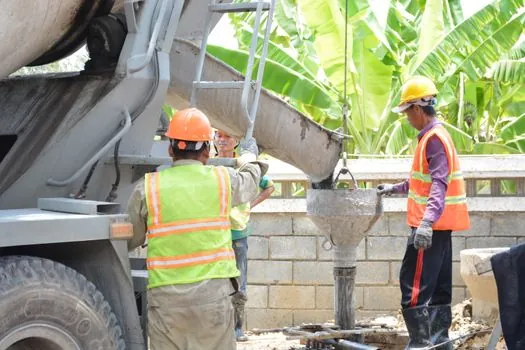
Front-discharge transit mixers carry 8 to 10 cubic yards (6 to 7.6 m³), discharge from the cab end of the truck, and let the driver control the chute from the cab, which cuts a spotter out of the loop on congested demo floors [S5]. Visibility is the headline advantage: the driver can see the chute, the pour target, and any rebar or shoring post in the same line of sight, which matters when the work zone has open shafts or partially demolished walls. Fuel economy is slightly lower than rear-discharge because of the added front-end hardware, and these units are uncommon outside North America, so spare parts and trained operators can be a constraint on European or Middle East projects [S5].
Where the front-discharge unit earns its premium on demolition is interior gut work where rear access does not exist, and on phased slab replacements where the truck has to pull forward, pour, and pull out without a backing maneuver. For taller pours or vertical element work in a partially demolished structure, a truck-mounted concrete pump attached to a separate boom is still the right answer, since even a front-discharge chute is limited to the same arc as a rear-discharge unit. Crews running front-discharge mixers also tend to spec automatic drum cleaning and anti-drip sealing, which reduces site washout water and concrete slurry on the demo floor, both of which are EPA or local-authority concerns on urban demo projects [S5].
Volumetric Mixer: On-Site Mix Control for Variable Demo Loads
Volumetric mixers carry cement, aggregate, and water in separate bins and mix on-site, which lets the crew change the mix design pour by pour without returning to the batch plant [S3][S4]. This is the right tool for demolition jobs where the pour schedule changes daily: a subbase pour in the morning, a flowable fill in the afternoon, and a high-strength patch by the end of the week, all from the same truck. The trade-off is throughput, since on-site mixing is slower than discharging a pre-batched drum, and the metering system needs calibration each shift [S3].
Volumetric units also reduce over-ordering and under-ordering on small pours, which is a real cost on demo work where the final pour size is rarely known until the slab is stripped and the subbase is recompacted [S4]. Rough-terrain variants are self-loading and built for off-road sites, which fits remote or brownfield demolition where the batch plant is far and the access road is crushed concrete rather than asphalt. The mobile batch mixer sits between the standard transit and the volumetric: it carries enough dry material to mix small structural pours on remote sites, useful when a tower crane selection for demolition: jib type, capacity, and site fit study has already limited what heavy plant can reach the pour zone [S3].
Decision Criteria: Matching Truck Type to Demo Scope
Pick by pour size first, then by access. A demolition contractor pouring more than 6 m³ per shift with rear access should default to a 9 to 11 cubic yard standard rear-discharge transit mixer, which is the size the National Ready Mix Concrete Association calls the typical North American unit [S4]. If rear access is blocked or visibility is poor, the 8 to 10 cubic yard front-discharge unit is the right upgrade, at a higher capital cost and limited geographic availability [S5]. For variable daily mix designs, partial pours, or remote sites, the volumetric or mobile batch mixer is the correct choice, with the understanding that throughput per shift will be lower [S3][S4].
Standard transit mixers (6 to 12 yd³) cost less and are widely available, but they need rear clearance, run 8 to 12 L/km, and discharge at a fixed chute arc. Front-discharge units (8 to 10 yd³) trade higher cost and lower fuel economy for cab-end visibility and tighter-site access. Volumetric and mobile batch mixers trade throughput for mix-design flexibility and zero waste on partial pours, which is decisive on phased demo work where the pour size is uncertain [S3][S4][S5].
Operating Limits and Failure Modes on Demo Sites
The drum is the most maintenance-sensitive component, and on demo work it sees more washout cycles than on paving work because slurry, mud, and demolition grit stick to the spiral blades. Routine checks should cover drum rotation, blade wear, the hydraulic pump and motor, the water system for both mix adjustment and drum cleaning, and the tires and brakes, since top-heavy loaded trucks tip on tight turns and on sloped demo floors [S2][S4]. Hydraulics run hot on slow-speed mixing in summer, and the retarder dosage that extends the 4-hour plastic window also raises the risk of late setting if the pour is delayed again [S5].
Weather is the second failure mode: high temperatures accelerate curing and shrink the workability window, while rain on an open demo deck changes the water-cement ratio at the chute and weakens the pour [S4]. Traffic is the third: a 40-minute backup at the demo gate costs more concrete than a 40-minute backup on a highway job, because the urban detour rarely has a place to keep the drum turning at the right speed. Crews that run automatic drum cleaning and anti-drip sealing, and that spec a National VI or equivalent emission engine, cut dust by roughly 60% and noise by 40%, which matters on LEED-certified adaptive-reuse demo projects in dense urban cores [S5].
For deeper structural pours, pair the mixer selection with a demolition hammer sizing review and a pump selection, since the truck that delivers the mix and the boom that places it have to be sized to the same hourly throughput, otherwise the truck queues or the pump starves. The next signals to watch are batch-plant retarder stock in summer metro areas, and any tightening of diesel-idle rules on urban demo sites, both of which will reshape the rear-discharge vs. volumetric mix over the next 12 to 24 months.