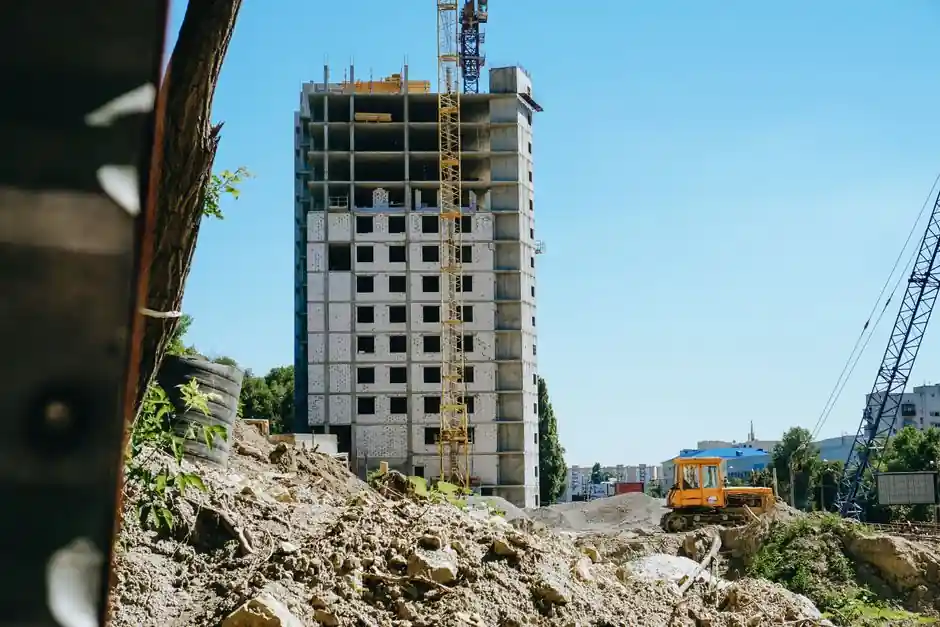
On demolition work, the tower crane is rarely the primary breaking tool, but it is the workhorse for lowering cut steel, precast panels, and debris hoppers, and that role dictates a different selection path than for new-build high-rise lifts [S1].
For demolitions inside a 30-50 m working radius, luffing-jib and flat-top configurations dominate the spec sheet, with lift capacity typically 5-100 t, jib length 40-80 m, and hook height commonly reaching 250 m+ when climbing a neighbouring structure [S3].
Why the demolition brief changes the selection logic
Demolition lifts are characterised by high cycle counts, asymmetric loads (a slab section weighs differently from a rebar bundle), and a working envelope that is shrinking as the structure comes down, which is why a demolition spec weighs site geometry over headline capacity [S1][S3]. Operators must plan for conflicting swing-radius interference where multiple cranes work, and overcapacity simply inflates the dismantle cycle at the end of the job [S3]. A tower crane selection for demolition therefore starts with three numbers: maximum piece weight to be lowered, maximum radius needed to reach the cut face, and clearance above any adjacent occupied structure.
Four jib architectures and where each one fits
The four common types, hammerhead, flat-top, luffing-jib, and mobile self-erecting, behave very differently once the working radius is no longer free air but is bordered by standing walls or overhead lines [S4]. Hammerhead towers offer full 360-degree rotation and the longest fixed jibs, which suit open plots where reach matters more than footprint; flat-top designs drop the A-frame cat-head for a shorter tip, making them quicker to erect and safer when several cranes must share air space; luffing-jib units raise and lower the jib to vary the working envelope, which is the dominant choice where the crane sits inside a tight urban footprint and the jib must clear adjacent roofs; mobile self-erecting cranes are smaller, lower-capacity units used on short, relocatable demolition tasks [S4][S3]. A simple decision matrix used on demolition tenders: open ground and long reach = hammerhead; multiple cranes on a congested site = flat-top; jib must fly over a neighbouring occupied building = luffing-jib; short-duration interior strip-out = mobile self-erecting.
Selection criteria that drive the spec sheet

Sany's 2025 selection guide breaks the decision into three phases: define core requirements, evaluate site conditions, and select the structural configuration, and demolition planners largely follow the same sequence with one extra step, a load survey of every piece to be lowered [S5]. Concrete criteria that appear on every demolition spec sheet: maximum single-piece weight (often drives the 5-100 t range cited above), maximum radius to the cut face (drives the 40-80 m jib length range), slewing restrictions (drives the luffing vs flat-top choice), and hook height above ground or above the tie-in floor (drives whether a climbing or static base is used) [S3][S5]. Counterweight arm length, set symmetrically opposite the jib, balances the lift and constrains the rear swing envelope, a detail that matters when a street or occupied building sits behind the crane [S5]. Speed ratings of 36-100 m/min on the hoist, and SLI/ACD load-moment indicator compatibility, are the next-tier checks that prevent mid-lift cut-outs on a heavily cycled demolition [S3].
Comparison matrix: which crane for which demolition
Lining the four jib types against the criteria that actually drive a demolition tender gives a clean decision grid: hammerhead wins on radius and lift capacity but loses on rear-swing clearance and multi-crane air-share; flat-top wins on fast erect/dismantle and air-share with neighbouring cranes, but offers no variable geometry; luffing-jib wins on confined urban footprints and variable working radius, at the cost of a more complex hoist and luffing winch; mobile self-erecting wins on short-duration jobs under about 6-12 months, with reduced foundation work but lower maximum capacity [S4][S3][S5]. For demolitions where pieces heavier than 50 t must be lowered, the spec sheet typically demands a hammerhead with extended jib or a high-capacity luffing-jib, both of which need a stronger base and longer dismantle planning [S3][S4].
Site, foundation, and adjacent-structure constraints

Tower cranes are anchored to a concrete foundation when static, and tied back to the host structure with an attachment frame once free-standing height is exceeded, which on demolition means tying to the building being taken down, an unusual loading case that needs explicit engineer sign-off [S5]. Urban congestion, overhead restrictions from adjacent buildings, and ground-bearing capacity for the base are the three site constraints that most often force a switch from hammerhead to luffing-jib or flat-top [S3][S4]. Where foundation limits are tight, climbing-type or internal tower cranes allow the base footprint to be reduced while keeping hook height, a configuration that recurs on inner-city demolitions where the slab being removed cannot accept a heavy pad foundation [S3][S5].
Cost, duration, and the rent-vs-buy threshold
Tipton Crane's rental guidance groups cost drivers into four buckets: crane size, project duration, site conditions, and service requirements, with duration as the single biggest swing factor on total cost [S6]. Industry rule of thumb: a project under about 12 months favours rental because the dismantle, transport, and certification costs of a purchased unit are not absorbed; multi-year or multi-site programmes tip the economics toward ownership, especially when the same crane can be relocated between phases [S3][S6]. For demolitions, the duration skew is amplified: setup and dismantle windows are short, the cycle count is high, and the residual value of a demolition-rated machine is lower than a new-build machine, which pushes most contractors toward the rental column [S3].
Failure modes and safety controls specific to demolition lifts
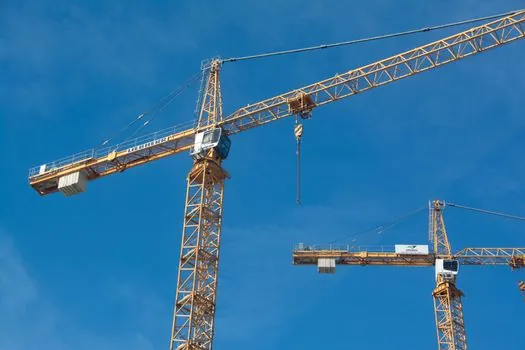
Three failure modes dominate demolition tower-crane work: swing-radius collision with the host structure as it is being cut, load-moment trips caused by asymmetric debris loads, and base or tie-in overload as the host building loses stiffness [S1][S3]. SLI/ACD anti-two-block and load-moment indicators are standard on modern machines and are usually mandated by the lift plan, but the demolition-specific addition is a controlled-lowering protocol for large pieces, typically using a second hoist or a hydraulic skid to keep line shock inside the crane's dynamic rating [S3]. Adjacent-structure monitoring, including vibration and crack-width limits on neighbouring occupied buildings, is increasingly written into the lift plan and constrains the slewing speed, which in turn feeds back into the crane selection [S1][S4].
Standards, sourcing, and what to verify on the data sheet
CE marking and a manufacturer declaration of conformity to the relevant machinery directive are the baseline gate on any machine deployed on a European or EU-adjacent site, and operators should request the certificate file, not just the plate [S3]. For demolitions adjacent to live traffic or occupied buildings, the lift plan should reference a recognised crane planning method; the Marzouk and Aboushogur 2016 framework remains widely cited in planning literature for type selection, fleet sizing, and site-positioning, although it was developed for new-build high-rise and is adapted, not directly applied, on demolition work [S2]. The most common spec values to verify on the data sheet before sign-off: maximum capacity at the maximum radius to be used on the cut face, hoist speed in m/min, slew speed in rpm, and the minimum radius at which full capacity is still available [S3][S5].
Trackable signals for the next planning cycle: watch for tighter adjacent-structure vibration limits being written into municipal demolition permits in dense European cities, and for modular climbing-base kits to broaden the luffing-jib offer into inner-city contracts where foundation footprint is the binding constraint [S1][S5]. Two practical follow-ups for any spec under preparation: a cold milling machine class, power, and drum match review for the horizontal cutting fleet that feeds the crane, and a shield machine pros, cons, and selection criteria check where basement or tunnel demolition runs alongside the above-grade takedown.
Spec-level background on the components involved: demolition hammer, and signal tower light.