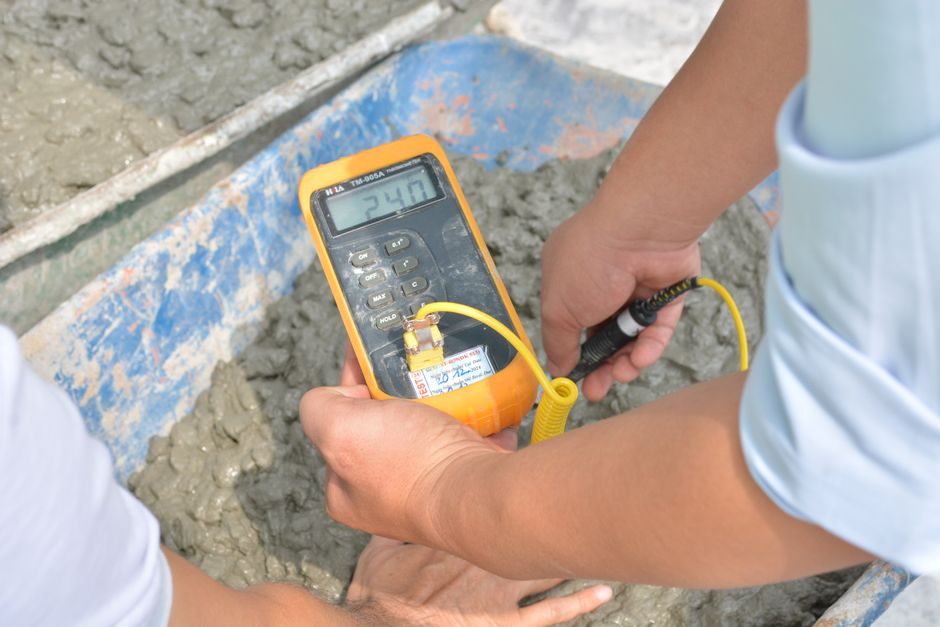
Ready-mix concrete trucks operate on a hard 60-90 minute discharge window after batching [S3]; concrete vibrators, by contrast, are placed-batch tools whose frequency, amplitude, and head diameter determine in-place density, not mix age.
The two products solve adjacent, not competing, problems: ready-mix is a delivery format governed by ASTM C94 (standard specification) or ASTM C685 (volumetric), while a concrete vibrator is a consolidation tool applied after the mix hits the form. Comparing them head-to-head on cost, rating, lifetime, or integration effort is therefore a process question, not a product question — pick ready-mix vs site-mix delivery, then pick the vibrator class that matches the slump and rebar congestion of the chosen mix.
Scope and Definitions: Delivery Format vs Consolidation Tool
Ready-mix concrete is centrally batched at a concrete batching plant, agitated in a drum truck, and discharged at the job. The supplier's certification scope — typically NRMCA Quality Certification or an equivalent national scheme such as NSAI's ready-mix certification in Ireland [S4] — controls mix design traceability, batch-ticket data, and constituent tolerances.
A concrete vibrator is an engine- or motor-driven eccentric that injects oscillatory energy into fresh concrete, liquefying the paste temporarily so entrapped air rises and aggregate nests tightly. Immersion (stick) vibrators dominate in-situ work; form vibrators attach to the form face; surface vibrators (screeds) suit slabs and pavements. Power sources span 120/230 V single-phase electric, 3-phase electric, and Honda GX-series gasoline, with head diameters commonly between 25 mm and 75 mm and frequencies from ~200 Hz (12,000 vpm) down to ~150 Hz (9,000 vpm) for high-power units.
Selection Criteria: Match Mix to Delivery Format, Match Slump to Vibrator
Ready-mix selection turns on volume, travel time, certification, and mix-adjustment needs. Site-mixed volumetric batching — described by one Colorado operator as "each volumetric mixer is a mobile batch plant" carrying separate bins for sand, cement, aggregate, water, fiber, color, and admixtures [S3] — suits small loads, remote sites, color or fiber additions, and continuous pours where discharge time pressure is severe.
Vibrator selection turns on member geometry, rebar congestion, and slump. ACI 309R-style guidance — widely cited but not quoted here verbatim — ties vibrator head diameter to member depth (rule-of-thumb: head diameter ≤ 1/3 of the narrowest form dimension) and amplitude to concrete stiffness; this is the engineering basis for matching a 25-35 mm head to thin walls and columns, and 50-75 mm heads to deep footings and mass pours. For stiff mixes with low slump, high-amplitude eccentric weights (~2-3 mm peak) outperform high-frequency small-amplitude units.
Comparison: Ready-Mix vs Site-Mixed vs Vibrator-Consolidated Outcomes
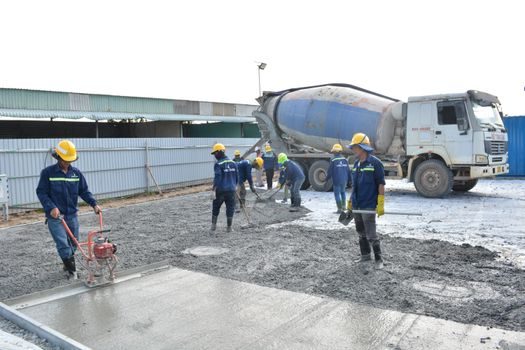
Three options lined up against four decision criteria: (1) discharge-window pressure, (2) minimum order quantity, (3) on-site mix adjustability, (4) in-place density achievable. [S3]
Central-plant ready-mix scores: high pressure (60-90 min from plant to pour [S3]); minimum order typically 1 yd³ and priced by full load; mix fixed at batch; density dependent on vibrator chosen. Site-mixed volumetric scores: minimal time pressure (ingredients stored separately and mixed at the pour point [S3]); no minimum load — half-yard DIY to hundreds of yards commercial per the same operator; mix adjustable on the truck including fiber, color, retarders, and accelerators; density again dependent on vibrator chosen. Dry-cast or no-vibrator placement scores: no time pressure (factory-controlled); no field minimum; no field adjustability; density dependent on press/compaction, not vibration.
The fresh-PSI claim that "fresh concrete maximizes early strength" applies to both ready-mix placed immediately and site-mix placed on demand [S3]; what kills early strength is delayed placement or under-vibration, not the delivery format itself.
Use Cases: Who Each Option Is For — And Who It Is Not
Central-plant ready-mix is the right call for: high-rise decks, post-tensioned slabs, DOT work, and any pour where a printed batch ticket with mix code, w/c ratio, and admixture doses is required for spec compliance. It is the wrong call for: a 0.5 yd³ patio repair, a remote ranch site more than 90 minutes from the nearest plant, or any colored-concrete pour where the exact shade needs to be dialed in truck-side. [S3]
Site-mixed volumetric is the right call for: CDOT-approved mixes on rural Colorado roads (ASTM C685-compliant batching is explicitly cited by the operator [S3]), small DIY batches, and decorative pours requiring truck-side color tweaking. It is the wrong call for: pours that demand a third-party-certified batch ticket for the engineer of record, or work in jurisdictions that have not approved ASTM C685 volumetric mixers on the qualified products list.
A concrete vibrator is required for any poured-in-place wall, column, footing, or slab where the design strength is 25 MPa (3,625 psi) or higher. It is not needed for: roller-compacted concrete, dry-pressed masonry units, or zero-slump bedding layers consolidated by dead weight.
Limitations, Failure Modes, and Real Numbers

Ready-mix failure modes center on the discharge clock: hot-weather pours, traffic delays, and jobsite backup can render a load unusable, and the buyer pays for the full ordered quantity regardless of what is poured [S3]. Short-load fees and returned-load surcharges on partial deliveries are common industry practice, though specific dollar figures vary by region and supplier.
Vibrator failure modes center on under-use or over-use. Under-vibration leaves bug-holes, sand streaks, and voids at rebar interfaces; over-vibration segregates aggregate, drives paste to the form face, and can fracture lightweight aggregate. Practical field numbers: a 50 mm-head electric vibrator consolidating 0.5 m of wall should be inserted on ~450 mm centers for 5-15 seconds per insertion, withdrawn at ~75 mm/s to close the insertion hole.
Admixture interactions matter on both sides of the question. A mix dosed with a concrete admixture such as a high-range water reducer (ASTM C494 Type F/G) at 600-900 ml/100 kg cementitious typically arrives at the site at 180-230 mm slump, which demands immediate vibration before the slump loss curve bites; site-mixed volumetric can delay ad dosing until the truck is on the pad, recovering workability for that exact placement.
Standards, Sourcing, and Certification Trail
Central-plant ready-mix in the U.S. is produced under ASTM C94; volumetric site-mixed under ASTM C685, which the Colorado operator cites verbatim as "ASTM C685-compliant batching" [S3]. NRMCA Quality Certification is the U.S. industry scheme; in Ireland, NSAI runs a comparable product-certification track for ready-mix [S4]. UK supply is delivered under BS 8500, with suppliers such as the London operator referencing commercial "ready mix concrete" delivery lines [S5].
Vibrator-side standards are thinner: IEC 60745 covers handheld electric vibrator safety in many markets; engine-driven units fall under ISO 1940 balance grades for the rotating eccentric. Manufacturer literature, not a single harmonized standard, sets the rated frequency (vpm), amplitude (mm), and head diameter (mm) on every nameplate.
For the supplier side, the page on ready-mix concrete consolidates the delivery-format options, while concrete fiber and concrete curing compound cover the in-mix and post-pour variables that interact with the vibrator's consolidation job.
For a broader process-engineering cross-reference that pairs equipment-selection maps with industrial control logic — useful when a batch plant's vibrator feeders tie into the same PLC scope — see this articulated robot arm vs AGV spec map. If the pour is part of a plant upgrade that includes crane work, this overhead bridge crane spec map lines up duty cycle, span, and capacity against the same kind of decision matrix. For facility-side lifecycle math on hardware and coatings that interface with concrete pours, the architectural hardware TCO 10-year buy breakdown is a parallel reference.
Trackable next signals: whether CDOT (or an equivalent state DOT) adds a new ASTM C685 volumetric-mixer line to its approved-products list in the next 12 months, and whether any of the three regional ready-mix suppliers cited here [S1][S2][S6] publish updated mix-design libraries that include high-range water reducers and shrinkage-reducing admixtures as standard line items rather than special-order add-ons.