
For confined urban lots, compact equipment can be a practical starting point because restricted space, limited access, and structural obstacles make traditional machines less efficient and increase maneuvering risks.
On open sites, equipment selection can prioritize excavation capacity, lift height, material volume, and sustained production rather than the smallest possible footprint; the correct choice depends on the work package, ground condition, access route, and operating budget [S2][S5].
Confined-lot selection by access footprint
Restricted access, existing structures, narrow streets, and temporary obstructions make working space a primary equipment constraint on urban sites [S1]. Mini excavators are compact and well suited to smaller sites with limited space, while equipment selection should be matched to the specific task and project scale.
A skid steer’s compact frame and ability to pivot within a tight radius make it suitable for urban work where a larger machine cannot maneuver efficiently [S3]. Tracked skid steers are the better choice where wheeled machines would disturb soft ground, although their load capacity remains below that of larger loaders [S3].
Measure the complete access path, not only the machine width: consider gate openings, street restrictions, turning radius, tail swing, delivery route, and the area needed to unload attachments. Compact machines should also be checked for visibility and stability on uneven ground, since reduced maneuverability in restricted areas increases accident risk [S1].
Open-site selection by production capacity
Open sites permit larger equipment when the work package requires greater digging depth, bucket capacity, lift performance, or material-hauling volume. Large excavators, loaders, and bulldozers are not automatically inefficient on open ground; their advantage is throughput when adequate space and stable terrain allow full operating cycles. [S3]
Equipment should be matched to the task rather than selected by physical size alone: excavation, lifting, and grading have different requirements, and the project scale determines whether a larger machine is justified [S5]. A bulldozer suited to broad grading is a poor substitute for a confined-lot excavator, while a long-reach excavator can address deep or hard-to-reach excavation where long reach matters more than compactness [S3].
Cost comparison must include purchase or rental, fuel, maintenance, operator time, transport, and repair downtime [S5]. Open-site machinery can consume more fuel and carry higher operating costs, but it may finish more work per shift. The defensible selection is the machine with the lowest total cost per completed task, not simply the lowest acquisition price.
Compact machines versus full-size equipment
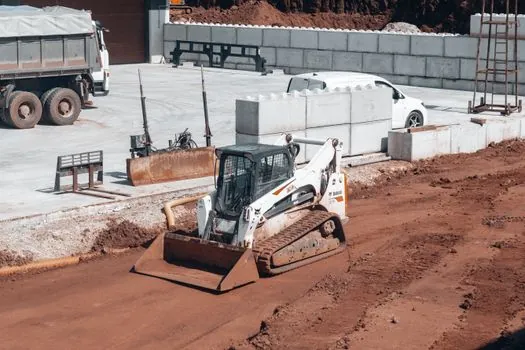
The comparison below uses four decision criteria: access, task capacity, operating cost, and site flexibility. Machine weights for mini excavators and skid steers are available, but model-specific dimensions, rated loads, reach, and lifting capacities must be checked against the actual machine [S5].
Compact telehandlers combine a reduced footprint with lifting capacity and reach, allowing material handling and load positioning where conventional machines are inefficient [S1]. Their suitability still depends on machine dimensions, rated capacity, load stability, and available floor or ground area.
Vertical work and temporary access
Scissor lifts provide vertical access without the horizontal reach of a boom lift, using either electric or diesel power, with rough-terrain versions available for outdoor work. Their platform includes safety rails and accommodates workers and tools, but operation requires level ground and their horizontal outreach is limited [S3].
On confined lots, choose a scissor lift that fits the access route and work platform, then verify the stated operating surface. On open sites with uneven terrain, a rough-terrain scissor lift may be appropriate only if its manufacturer permits the intended ground conditions. Full-size telehandlers and cranes should not be substituted for a compact lift solely because they offer greater height.
Lifting selection also interacts with examination and control requirements. Where tower crane type selection by site constraints and lift requirements is being considered for a confined plot, the crane decision depends on the available base radius, obstruction geometry, and required lift envelope rather than maximum capacity alone.
Attachments, underground work, and ground limits

Attachment compatibility can improve utilization on small urban projects. Skid steers can use buckets, augers, trenchers, grapplers, forks, and hydraulic breakers, allowing one carrier to cover material movement, clearing, small excavation, and utility work [S3][S5]. Compact telehandlers similarly support material handling, lifting, loading, and unloading when approved for the relevant task [S1].
Excavation type drives the attachment and machine requirement. Common excavation categories include topsoil stripping, trenching, rock removal, foundation or basement excavation, and muck excavation [S4].
Rock excavation costs approximately 3–5 times more than ordinary earth removal, so hydraulic breakers and rock-specialist equipment should be evaluated before assigning a general-purpose machine [S4]. For trenches 1.5 m, or 5 ft, and deeper, the cited excavation guidance calls for protective systems and competent-person inspections under OSHA requirements [S4].
Fuel, control systems, and emissions
GPS-guided excavation can reduce grading errors and fuel consumption by 20–30% [S4]. That range makes machine-control systems worth evaluating on open sites with repetitive grading, provided the project can use the guidance effectively and the equipment supplier supports implementation.
Electric excavators are presented as an emerging option, but power availability, duty cycles, charging arrangements, and emissions requirements must be assessed before substitution [S4]. A compact electric machine may suit indoor or tightly controlled work, while remote fueling infrastructure can be a decisive constraint on an open site.
For broader equipment context, review construction machinery and equipment when comparing operating principles, carrier formats, attachments, and power options. The selection should close with a site-specific utilization model covering fuel, maintenance, transport, attachment changes, and expected downtime, because these factors determine whether a smaller confined-site machine or a higher-capacity open-site machine delivers the lower cost per completed operation [S2][S5].