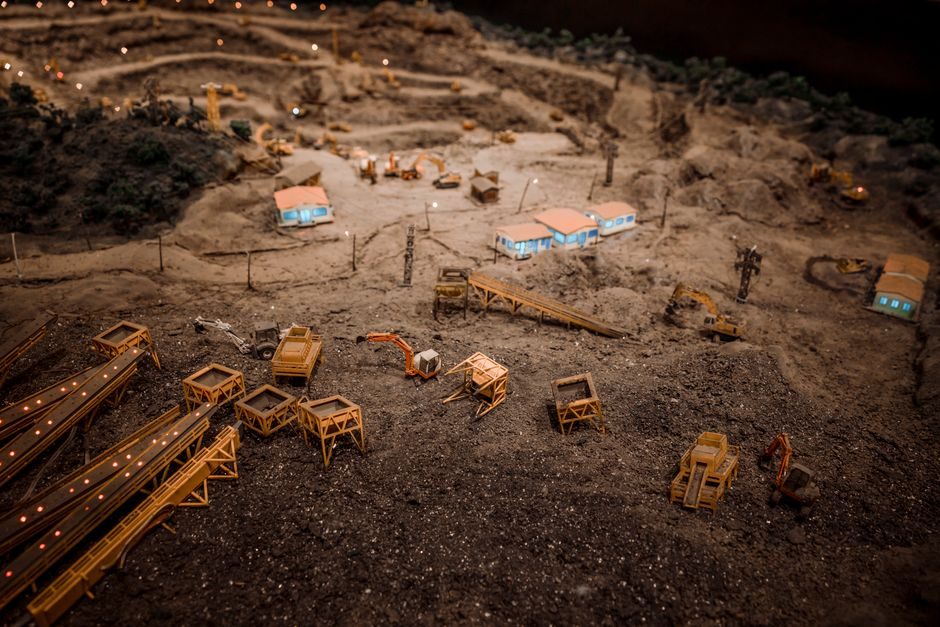
The shortest path to a defensible conveyor chain purchase is to lock four engineering gates first: chain family, pitch and breaking load, environment-driven material upgrade, and the supplier's quality-system evidence, in that order [S1][S3].
Conveyor chain sits in the material-handling equipment class alongside hoists, stackers, and warehouse vehicles, and is generally excluded from over-the-road transport and pipeline categories [S4]. A 2025-2026 supplier scan shows three dominant vendor patterns: ISO 9001-certified Indian export mills (ESBEE Machinery Pvt. Ltd., serving manufacturers and exporters of standard, slat, and roller chain) [S1], Chinese transmission-chain specialists (Changzhou Dongchuan Chain Transmission Technology Co., Ltd., listing forged, roller, and conveyor chain lines) [S3], and integrated engineering-class chain groups (Shinelink Group) [S2].
Chain family determines load path, not just appearance
Standard roller chain is the most widely stocked conveyor chain family and is appropriate for medium-duty, parallel-shaft drives where the chain engages a sprocket and the conveyor is essentially a powered shaft line [S1].
Conveyor chain is a broader category that includes attachments, slats, deep-link, and heavy-pitch variants built to carry pallets, plates, or scrapers — selection starts from the carried product, not from the sprocket [S1]. Where the conveyed product is bulky, hot, or corrosive, attachments and pin diameters are upgraded; ESBEEs product line lists slat chain and standard chain as distinct categories, confirming that attachment geometry is a first-order selection variable [S1].
Where the line runs long, is exposed to debris, or needs silent operation, silent chain (inverted-tooth) and cable drag chain (also written drag chain cable) enter the candidate set; silent chain is preferred where low-noise, high-speed, and minimum slip are required, while cable drag chain is suited to long-distance, low-speed horizontal conveying of bulk or scrap [S2][S3]. Drag chain cable configurations are typically specified with engineered flights or discs and are selected when the conveyor trough geometry dictates the chain envelope rather than the sprocket pitch.
Pitch, breaking load and the service-factor arithmetic
Manufacturer datasheets list pitch in inches or millimetres (common industrial pitches 50.8 mm / 63.5 mm / 76.6 mm / 101.6 mm and ANSI 40/50/60/80/100 equivalents) and a minimum breaking load in kN or lbf; both numbers must appear on the datasheet before a quote is comparable [S1][S3].
Operating load is derived by dividing minimum breaking load by an aggregate service factor that bundles shock load, ambient temperature, lubrication cadence, and multi-strand drive layout. ESBEE explicitly markets itself as an "ISO 9001 Certified Company" — that certification is the most common baseline filter Indian and Chinese mills present in headers and is a useful first-pass acceptance gate [S1].
Chain width (number of strands) and pin diameter interact with sprocket hardness; induction-hardened sprockets (typically 45-55 HRC at the tooth flank) are the usual pairing for a heavy-pitch conveyor chain, and Changzhou Dongchuan lists forged chain as a distinct product family, signalling that drop-forged link plates are the upgrade path for shock-loaded applications [S3].
Material and environment — where stainless, coated and case-hardened diverge
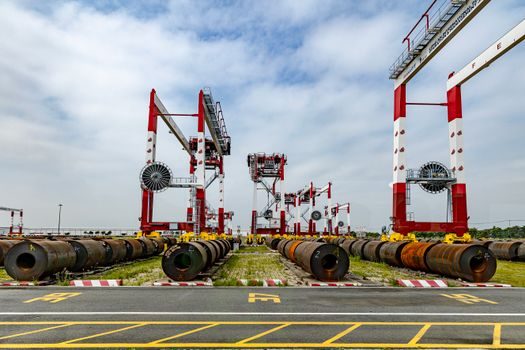
Environment gates the material decision more than the chain family does. For dry, ambient, indoor lines, carbon-steel roller chain with case-hardened pins and bushings is the cost baseline and matches most stock items from both Indian and Chinese export catalogues [S1][S3].
For washdown, food-grade, or mildly corrosive lines, 304 stainless pins and bushings with nickel-plated or stainless link plates extend service life; for chloride-bearing or chemical-exposure lines, 316 stainless or specialty alloy upgrades are common, and the selection criteria shift toward material traceability documentation (mill certificates) rather than dimensional fit [S1].
For high-temperature lines (above ~200 °C) or abrasive bulk handling, heat-treated alloy-steel link plates and through-hardened pins are specified; Shinelink's positioning as an "engineering class chain" group reflects the same product tier — heavy-duty, attachment-rich, environment-hardened lines sold on documented mechanical properties [S2].
Supplier evidence: what separates a manufacturer from a trader
Three supplier-data points are worth checking on every conveyor-chain RFQ: ISO 9001 certification scope (manufacturing vs. trading) [S1]; presence of a mill test certificate or material traceability document per lot [S3]; and a written hardness statement for pins, bushings, and link plates (HRC range) on the datasheet [S3].
ESBEE's public page states "An ISO ISO 9001 Certified Company — ESBEE Machinery Pvt. Ltd." and identifies the firm as a "Manufacturers, Exporters and Supplier of Conveyor Chains", which on its own is necessary but not sufficient evidence of in-house forging versus assembly [S1]. Changzhou Dongchuan lists roller, forged, and conveyor chain categories with a named contact (Mr. Kai Wu, GM) and a fixed address in Yaoguan Town, Wujin District, Changzhou, Jiangsu — exactly the kind of footprint that supports a mill audit if a buyer wants to escalate from datasheet to factory inspection [S3].
Shinelink Group's "Enterprise outlets" and "Enterprise Atlas" navigation, combined with a dedicated "Product Management" and "News" tab, is consistent with a multi-factory group and gives a buyer a longer conversation track for volume contracts [S2].
Comparison — chain families against four decision criteria
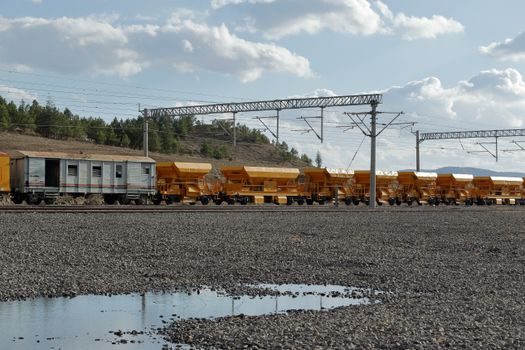
Roller chain versus slat conveyor chain versus silent chain versus cable drag chain, scored against four typical selection criteria: load path (carrying capacity), running speed range, environmental hardening, and noise/slip behaviour. [S1]
Roller chain: highest running speed of the four, modest carrying capacity, modest environmental hardening (case-hardened as standard), moderate noise — best fit for powered-shaft conveyor drives [S1]. Slat conveyor chain: moderate running speed, high carrying capacity (slat-attached pallets or plates), good environmental hardening with material upgrade, moderate noise — best fit for assembly, paint, or pallet lines [S1]. Silent chain (inverted-tooth): moderate running speed, moderate-to-high load capacity, good environmental hardening, low noise and minimal slip — best fit for high-speed, low-noise enclosed drives [S2]. Cable drag chain: low running speed, moderate load capacity, very good environmental hardening (enclosed in trough), low noise — best fit for long-distance horizontal bulk conveying [S3].
Failure modes and limit-state checks before sign-off
Three failure modes dominate conveyor chain in service: elongation from pin-bushing wear (measured as a percentage over a pitch span — typically rejected above ~3% elongation), link-plate fatigue cracking at the hole, and attachment loosening. None of the three can be specified out of a product photo; they require the supplier's stated material grade, hardness range, and recommended re-tensioning interval on the datasheet [S1][S3].
Lubrication cadence is a selection criterion as much as a maintenance one: for high-temperature or food-grade lines, food-grade or high-temperature grease is specified up front, and supplier recommendations should be matched to the operating envelope rather than chosen after the line is installed [S2].
Sprocket alignment and shaft parallelism are not on the chain datasheet but are the leading root cause of premature elongation; the chain selection memo should always record the alignment tolerance accepted by the supplier's warranty terms.
Standards, sourcing and where this lands for a 2026 buyer
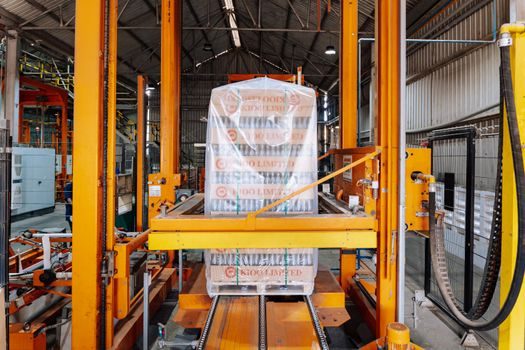
The relevant dimensional standards governing industrial conveyor chain are the ISO 606 (short-pitch transmission) and ISO 1275 (conveyor chain, attachments, and chain attachments) series; ISO 9001 is the most common quality-management baseline cited by Indian and Chinese exporters in their public headers [S1][S3]. Buyers should ask for the specific ISO 606 / ISO 1275 designation(s) and breaking-load class on every quote — generic "conveyor chain" line items without these references are difficult to compare across vendors [S1].
For deeper comparison against neighbouring drive-chain categories, the Silent Chain Buying Guide 2026: Pitch, Profile, Lubrication and Sourcing Gates breaks down pitch, profile, and lubrication, while the Silent Chain 2026 Price & Cost Guide gives the cost-lever view of the same family when the selection lands on inverted-tooth rather than roller. Where the conveyor decision also touches upstream material-handling equipment like hoists and stackers, the Industrial Shock Absorber Buying Guide 2026 covers the energy-absorption gates that pair with high-inertia chain-driven lines.
Trackable signals for the next buying cycle: confirmation of ISO 606 / ISO 1275 designation on every quote [S1][S3]; mill test certificate (material traceability) per lot in the supplier's standard documentation pack [S3]; and a written pin-and-bushing HRC range on the datasheet rather than a generic "hardened" claim [S1][S3].