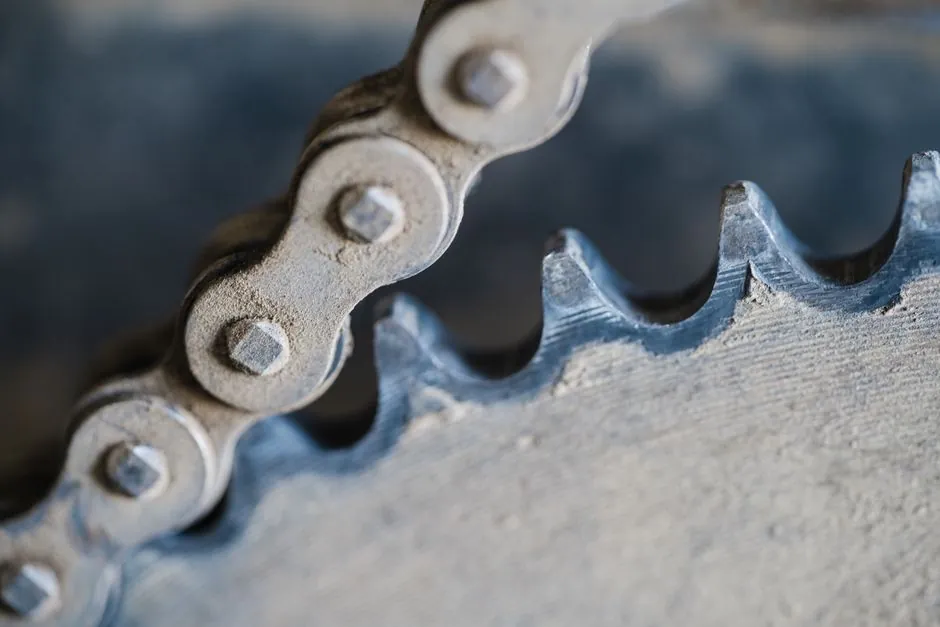
Conveyor chain choice on hay balers, harvesters, grain elevators, and manure spreaders is dominated by a small set of double-pitch and pintle topologies: A-series (figure-8 side plate), C-series (straight sidebar, e.g. C2060H, C2080H), agricultural roller CA550/CA557, and pintle 667XH/88K, all dimensioned against ASME/ANSI chain requirements [S1][S3].
For field work where dust, chaff, fertilizer, and moisture are constant, the decision rarely hinges on tensile strength alone; it pivots on debris shedding, elongation rate, attachment interface, and whether the supplier can ship a non-standard pitch or a custom attachment within one season's downtime window [S2][S4][S5].
Match Chain Topology to the Implement Function
A-series double-pitch conveyor chain is built with an extended figure-8 side plate, which gives the link more flex and a larger clearance window for trash to fall away, and is the common fit for grain conveyors, fertilizer spreaders, and the lighter gathering sections of planting machinery [S3]. C-series double-pitch chain, by contrast, uses a straight sidebar (the C2060H and C2080H being the workhorse sizes carried by major US distributors) and is specified where higher shock load and side impact from crop residue are routine, such as the draper and feeder sections of combine harvesters [S3].
Where the drive is a true power-transmission rather than a pure conveying function (round baler chain drives, forage blowers, some manure spreader aprons), agricultural roller chain in the CA550 and CA557 series is the historical fit, valued for its articulated link geometry that tolerates misalignment on irregular shafts and confined frames [S3]. Pintle chain (667XH, 88K) is reserved for the dirtiest, most abrasive slugs: open-barrel links shed soil, stover, and lime residue that would pack inside a closed roller chain, which is why it stays specified on salt spreaders, sugar beet handling, and lower-speed apron conveyors [S3][S6].
Series Comparison Against Four Selection Criteria
A criteria-based read of the four dominant topologies, drawn from the product lines catalogued by Diamond-Drives, Jeremywell, PEER Chain, and Nitro, looks like this: A-series double-pitch scores high on debris shedding and low cost per foot but is the weakest of the four on shock tolerance; C-series double-pitch (C2060H/C2080H) buys higher tensile capacity and better side-impact survival at a modest cost premium; CA550/CA557 agricultural roller chain is the most compact and most precise on pitch, but is the most sensitive to grit ingress and demands the shortest lube interval; pintle 667XH/88K is the most forgiving in dirty service and the easiest to field-repair with hand tools, but runs slower, louder, and at lower efficiency than enclosed roller chain [S1][S3][S5][S6].
For procurement, the rule of thumb is straightforward: a baler that hammers through wet hay is a C-series or CA-series problem, a combine header is a C-series problem, a grain leg or gentle incline elevator is an A-series or CA-series problem, and a lime/manure spreader apron is a pintle problem, and the right call depends less on catalogue and more on matching the link to the contamination and shock profile actually seen in the field [S3][S4][S6].
Material, Coatings, and Corrosion Logic
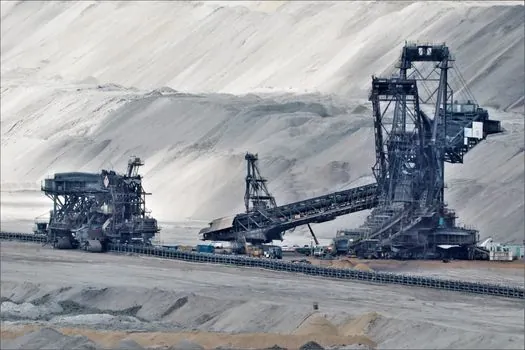
All four of the surveyed vendors frame their agricultural chain as high-tensile steel with heat-treated plates, pins, and bushings, and pair that base with a coating or material upgrade when the service is wet or chemically aggressive: zinc plating, nickel plating, ProCoat, and full stainless steel are the four tiers PEER Chain publishes for corrosion-resistant roller chain, with the same logic carried into agricultural variants by the other suppliers [S5]. Diamond-Drives positions its Sapphire line and corrosion-resistant chain specifically against fertilizer and produce-handling exposure, where plain carbon steel would pit through a season [S1].
For operations that handle sugar beets, citrus, or stored grain in damp silos, the cost delta of stepping up to stainless or heavy nickel plate is recovered inside one to two seasons through fewer chain stretch-induced re-tensions and reduced unscheduled downtime, which is the same conclusion Can-Am Chains Europe draws when it lists corrosion resistance and long service intervals among the top four buyer criteria for agricultural chain [S2]. The "no-coating" base spec is acceptable only on enclosed drivelines where the chain is shielded from direct spray and the relube interval is enforced, anything left open to the weather should at minimum carry a zinc or zinc-aluminium finish, and that finish decision is the single biggest controllable variable in wear life, per the marketing engineers quoted across the [S2][S4][S5] literature.
Attachments, Custom Pitch, and the "Drop-In" Problem
Most agricultural chain is not bought as a bare strand; it is bought with K-1, K-2, bent, or extended pins, with gripper attachments, with cross-rod every other pitch, or with a custom sidebar geometry that matches the OEM's existing sprocket pocket. Diamond-Drives explicitly calls out "specialized attachment roller chain to size and sort fruit and vegetables" as a category, and PEER Chain breaks out a separate "Agricultural Chain with Attachment" line alongside its base "Agricultural Roller and Engineering Chain" line, which is the cleanest signal that attachment hardware is its own specification path, not an accessory [S1][S5].
Jeremywell, Can-Am, and Dixie Industrial all highlight custom-fit chain for specific balers, harvesters, and elevators as a routine request, with turnaround driven by whether the OEM's sprocket pattern can be matched from a catalogue family or whether a true one-off has to be cut [S2][S3][S4]. From a sourcing standpoint, the practical answer for a buyer is to send the worn chain back to the vendor with the original pitch count and any bent or welded attachments identified, because off-the-shelf "will-fit" chain in this market is often close but not identical on sidebar width, pin diameter, or attachment hole pattern, and a 1-2 mm mismatch is the classic cause of premature sprocket wear even when the chain itself is correctly rated [S2][S4].
Standards, Sizing, and What to Verify on the Datasheet
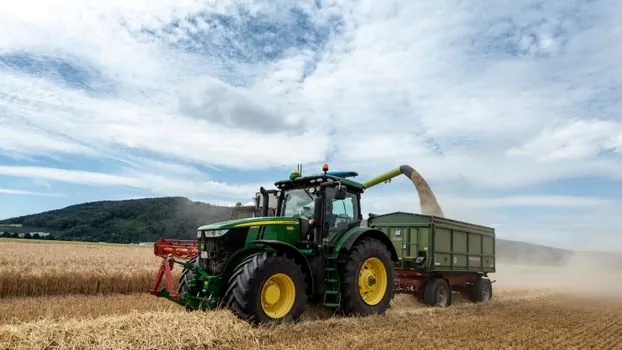
The baseline dimensional and strength frame across the surveyed suppliers is ASME/ANSI chain, with Diamond-Drives stating its Diamond and Drives product lines "meet or exceed ASME/ANSI chain requirements for maximum strength and wear life", and PEER Chain organising its catalogue explicitly into ANSI Standard, ANSI Heavy, ANSI Double-Pitch A-Type, and ANSI Double-Pitch C-Type families [S1][S5]. A buyer should treat the ANSI designation (e.g. C2060H, CA557, 667XH) as a shorthand for pitch and roller diameter, but should still confirm on the cut sheet the actual working load limit, the recommended maximum speed in feet per minute, the minimum pin shear, and whether the chain is rated for the specific shock cycle of the implement.
A useful sizing pass for a new agricultural conveyor chain is to compute the equivalent tension from peak crop throughput, apply a service factor of 1.4-1.7 for dusty field conditions and 1.7-2.0 for high-shock applications like square balers, then select the next pitch up from the calculated minimum, which is the same logic the vendor applications engineers apply and is more robust than copying the OEM's old part number without checking the operating conditions have not drifted [S2][S3][S4]. The reference page on roller chain sizes and the one on conveyor chain topology are useful cross-checks for buyers verifying the ANSI nomenclature against what arrives on the pallet.
Failure Modes Most Often Seen in the Field
The three most common field failures are pitch elongation from wear at the pin-bushing joint, plate fatigue cracking at the sidebar hole from shock overload, and corrosion pitting that initiates a fatigue crack long before the chain reaches its rated wear life; all three are accelerated by running the chain dry past its relube interval, which the suppliers uniformly flag as the controllable variable [S2][S3][S5].
A second failure pattern, specific to enclosed roller chain on combines and planters, is debris packing between the sidebars and the sprocket, which lifts the chain off the tooth root and ratchets the hardened pins across the bushing, and is the technical reason pintle chain keeps its place on the dirtiest auger and spreader drives despite being heavier and less efficient [S3][S6]. Buyers should treat any sign of side wear on the sprocket teeth, or of the chain climbing the sprocket under load, as a flag that the wrong topology was specified, not that the chain was under-rated, and that the next replacement is the right moment to switch topology, for example from an enclosed CA-series to an open pintle on a lime spreader apron. For a deeper read on the link-and-sidebar architecture that all four topologies share, the silent chain and chain belt reference pages lay out the alternative architectures worth ruling out before committing to a roller or pintle path.
Track the next buying cycle: confirm whether the chosen vendor will publish an updated 2026 catalogue for the CA, C, A, and pintle families (PEER Chain, Diamond-Drives, and Nitro all rev their ag sections on roughly an annual cadence), and watch for any move to higher-pin-shear stainless options as the agricultural market gradually shifts away from greasing-intensive maintenance toward sealed-for-life agricultural chain [S1][S5][S6].
For related coverage, see In-Cycle Automatic Pattern Change for Flaskless Molding Lines.