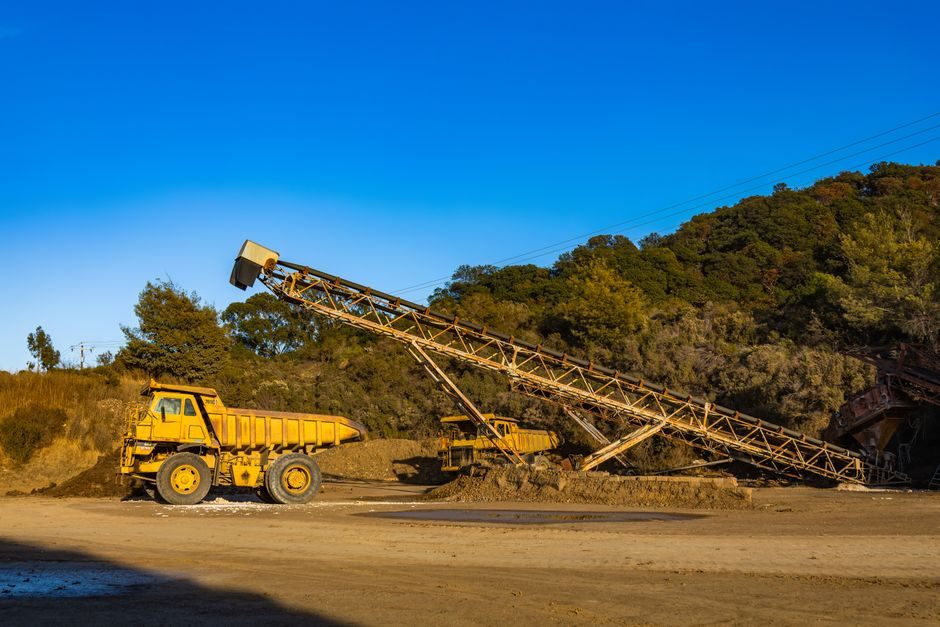
The conveyor chain market in mid-2026 segments into at least seven functional families, with X-series drop-forged, WH/WR welded steel, and 40/50/60-series double-pitch roller chains accounting for the majority of OEM catalogue listings across the surveyed manufacturers [S2][S3].
Pitch is the master variable: 76.2 mm X348, 102.4 mm X458, and 152.4 mm X678 are the three most-listed drop-forged trolley chains on Shinelink's catalog at unit price $8.50-30 per set, while welded steel covers 66.27 mm WR78 through 152.4 mm WR106 and heavy drag chain WDH118 / WD-120XHD at $78-116 per metre [S2].
Drop-Forged Rivetless Chain (X348 / X458 / X678) for Overhead Trolley Conveyers
Drop-forged rivetless chain uses forged offset-link sidebars that lock together without pins, giving the chain the tensile capacity to pull trolley hangers around horizontal and vertical track bends [S3]. The X-series pitch ladder — 76.2 mm, 102.4 mm, 152.4 mm — is the British/ISO norm for overhead conveyors in automotive paint shops, appliance assembly, and slaughterhouse dressing lines, where the chain doubles as the trolley rail [S2].
Working-load ratings scale roughly with pitch: X348 is typically specified up to about 1,000 N per trolley for light parts carrier duty, while X678 at 152.4 mm pitch moves heavier stampings, white-goods casings, or engine blocks at 3,000-4,000 N per trolley [S2]. Attachment options K1 (one bent-tab), K2 (two bent-tabs), and A/M-style brackets bolt directly to the offset sidebar; mismatched tabs and bracket gauge is the single most common cause of premature trolley hang-up on the track.
For paint-shop or food-grade lines, manufacturers offer zinc-plated, nickel-plated, or full stainless-steel rivetless chain; FB Chain's 2025 King's Award for International Trade recognises its export volume of industrial chain including this family [S7]. Compared with welded steel of the same pitch, drop-forged rivetless runs quieter and absorbs shock better, but costs 2-3x more per metre and is harder to field-repair.
Welded Steel Chain (WR / WH / WHC / WRC / WD Series) for Heavy-Duty Bulk Handling
Welded steel conveyor chain is the workhorse for sugar mills, cement kilns, bagasse handling, and drag conveyors running hot, abrasive, or corrosive bulk product [S2][S3]. Shinelink lists WR78 at 66.27 mm pitch and 55 mm width ($16-21/m MOQ 50 m), WR106 at 152.4 mm pitch ($31-33/m MOQ 50 m), WHC150 ($78-82/m), and WRC132 ($68-70/m) [S2].
The 304.8 series — 304.8 mm pitch — is the de-facto standard for sugar-mill bagasse and cane-carrier conveyors, with 304.8 steel bagasse conveyor chain listed at $92-95 per metre MOQ 50 m for new-condition mill installations [S2]. Palm-oil and cement plants order the 856 cement-plant bucket-elevator chain and palm-oil conveyor chain 4501 from the same vendor family, both designed to operate at slower speeds (typically 0.3-0.6 m/s) under continuous abrasive load [S2].
Drag chain extensions — WDH118 and WD-120XHD at $90-116/m — are rated for en-masse conveyors where flights push product through a trough; the XHD suffix denotes heavy-sidebar, heat-treated construction for slag or clinker service [S2]. Compared with cast chain, welded steel tolerates misalignment and shock load better, but requires periodic weld inspection at the sidebar/pin interface per the manufacturer's maintenance schedule; FB Chain supplies a chain wear gauge to standardise that measurement across sites [S7].
Roller-Type Conveyor Chain (40/50/60 Series and Double-Pitch) for Accumulation Lines
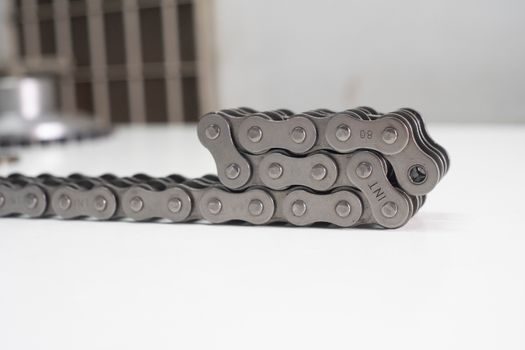
Roller conveyor chain — also called table-top or bushed-roller chain — uses freely rotating rollers between the inner and outer link plates, so the chain engages sprocket teeth on the rollers themselves, giving low-friction running on long accumulation conveyors [S3]. The 40/50/60 single-pitch series and C2040/C2050/C2060/C2080 double-pitch series map to ANSI B29.1 dimensions; metric M-series (M40/M50/M63/M80) covers the ISO equivalent listed under Shinelink's metric conveyor chain family [S3].
Standard double-pitch chain (40-2x, 50-2x, 60-2x) runs at conveyor speeds up to 60 m/min with a working load of roughly 1.3-2.5 kN per strand depending on the series, and is the default for packaged-goods, bottling, and warehouse accumulation lines [S3]. The inherent rolling contact cuts drive-motor power draw by 30-50% versus sliding-bushed chain of the same pitch, which matters on long, continuously-running lines.
Limit: roller chain cannot carry heavy point loads perpendicular to the strand; for cartons up to ~50 kg unit mass it is ideal, beyond that engineers move to straight-sideplate or drop-forged rivetless. Stainless-steel construction extends the same envelope to washdown food lines and pharmaceutical conveyors [S3].
Cast, Pintle, and Combination Chain for Low-Speed Bulk Service
Cast chain — malleable iron links with integrally cast sidebars — is the cheapest conveyor chain per metre and is widely used on slow-speed agricultural elevators, low-profile conveyor beds, and feeder applications where the chain does not need to bend around tight radii [S2][S3]. Pintle chain is a close relative with detachable pin links, used in round-bale handling, grain elevator buckets, and light-duty packaging lines.
Cast combination chain interleaves cast sidebars with through-hardened pin links to add tensile capacity while keeping material cost low, and is the standard bucket-elevator chain for grain, fertiliser, and wood-chip legs at speeds typically below 1.2 m/s [S3]. Working temperature ceiling is the binding constraint: malleable cast iron loses impact strength above 300 °C, so any service above that — clinker coolers, hot ash conveyors — forces a move to welded steel or alloy drop-forged [S2].
FB Chain's "ash conveyor" product line is targeted specifically at the bottom-ash handling segment where the chain runs submerged in water-ash slurry; the manufacturer specifies stainless or special-alloy pin materials for that duty [S7].
Specialised Sub-Families: Scraper, FV, Steel-Bushed, Leaf, and Hollow-Pin
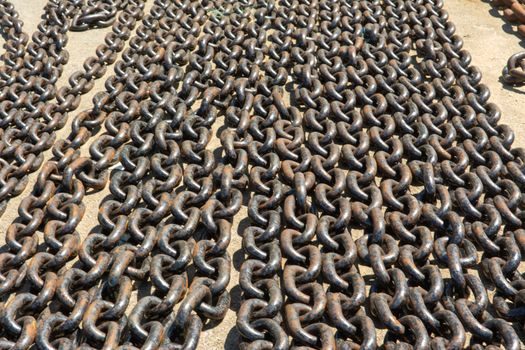
Scraper chain (e.g. 142H, 14226) adds flights at fixed pitches to drag material along a trough; Shinelink lists alloy 142H at $55-100/m MOQ 1 m with attachments [S2]. Hollow-pin conveyor chain accepts threaded pins at any link, allowing cross-bars, flights, or custom attachments to be bolted on without disassembling the chain — a common spec for bakery, can-handling, and special-machinery conveyors [S3].
FV-series conveyor chain is the British FV-standard chain originally developed for motorcycle drive but widely reused for light conveyor service; steel-block chain uses cast-steel block links for higher impact resistance; steel-bushed chain is the sliding-bushed (non-roller) low-cost conveyor chain where the bushing — not a roller — bears against the sprocket tooth [S3]. Leaf chain (AL/BL/LH/LL series) is the high-tensile, low-flexibility chain used in lifting counterweights and forklift masts, not in powered conveyors in the strict sense, but it appears in every chain-maker's catalog because the manufacturing process overlaps [S3].
For reference on the basic chain architecture shared across these families, the conveyor chain encyclopedia entry covers the link plate, pin, bushing, and roller geometry that defines the entire class.
Standards, Sourcing, and What to Verify Before Specifying
BS 4116-4:1992 "Conveyor chains, their attachments and associated chain wheels — Specification for chains and attachments (British series)" remains the active reference for the British-series attachment geometry and chain-wheel interface, and is sold as the controlling document for X348/X458/X678-style drop-forged conveyor chain in Commonwealth and EU markets [S5]. Manufacturers exporting to those markets either hold an ISO 9001-accredited test facility (Yuh Chern cites UKAS & ISO 9001 accreditation) or carry equivalent national certification [S1][S4][S9].
Pre-spec verification should cover: pitch and roller diameter match sprocket stock; sidebar thickness and hole pattern match the chosen K1/K2/A/M attachment; working-load envelope versus trolley spacing; material specification (alloy grade, stainless grade, surface finish) versus the corrosive or washdown environment; and lubricant interval versus the duty cycle. For more on how conveyor selection intersects with broader line-engineering decisions, see the roller conveyor spec map for warehouse automation and the roller conveyor spec map for food and beverage lines — the chain type chosen locks in the sprocket, drive, and guard layout the rest of the line has to follow.
Trackable signal: monitor the conveyor chain section of [S2] for new X-series pitch introductions beyond X678, and watch FB Chain's 2025 King's Award follow-on capacity expansion for European export pricing on drop-forged and rivetless families [S7]. A second signal is the next BS 4116 revision cycle; BS 4116-4:1992 is the current live document and any superseding edition will reset the British-series attachment-drawing templates used across the X-family [S5].
Spec-level background on the components involved: chain conveyor, and roller chain.