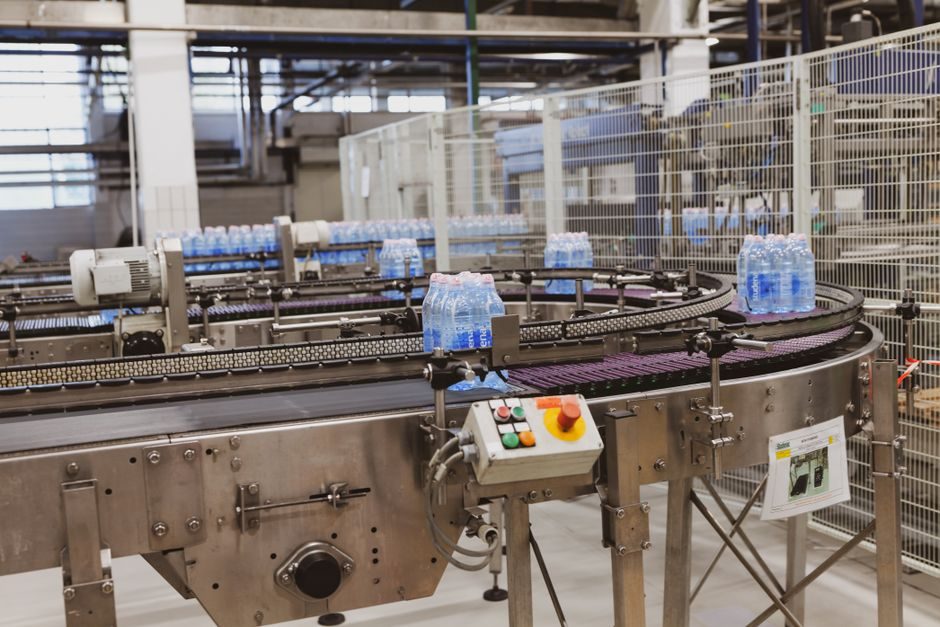
A 1800/800 mm chain-driven grooved-roller inspection conveyor from TENRIT Foodtec Maschinenbau GmbH is rated at 2,000 kg/h (4,409 lb/h) bulk throughput, with two parallel chains driving continuous roller rotation so the product itself tumbles for visual inspection [S1].
Food and beverage lines move thousands of items per shift, and a roller conveyor in this duty is specified first on material/hygiene, then on throughput, then on drive topology — gravity-roller for accumulation, chain-driven (or belt-driven) for inspection, motorized driven-roller for high-speed sortation. Control and recording equipment that sits beside the conveyor must keep time and temperature within a programmed band and retain traceable batch records, since food regulators care about safe product and the ability to reconstruct a fault, not about the specific device chosen [S2].
Roller Conveyor Type vs. Function on a Food Line
Three roller-conveyor topologies dominate food and beverage plants, and each maps cleanly to a process zone. Gravity roller conveyors are unpowered, low-cost, and used for accumulation and buffering of cartons, trays, and cases between washdown zones; they rely on a 2–5° decline and have no electrical signature, which simplifies sanitation. Chain-driven roller conveyors, the family the TENRIT 1800/800 unit belongs to, are specified when the product itself must rotate for inspection — peeled potatoes, carrots, similar root vegetables — because two parallel chains drive every roller and a grooved surface forces axial product rotation [S1]. Motorized driven-roller (MDR) conveyors, using 24 V or 48 V DC rollers with internal card or poly-V belts, handle end-of-line sortation and case handling where variable speed and zero-pressure accumulation matter.
For a complete spec walkthrough of how a belt conveyor compares to a roller conveyor on a distribution-center floor, see the Belt Conveyor Selection for Retail Distribution: 2026 Spec Map — the side-by-side cost and sanitation tradeoffs translate directly to food-line buffer zones. Within this encyclopedia, the baseline definition and component anatomy of a roller conveyor is covered in roller conveyor.
Material, Surface Finish, and Hygiene Specs
Sanitary roller materials for direct food contact default to 304 stainless, with 316 stainless specified when chloride-bearing cleaners (sodium hypochlorite, chlorinated foam) are routine; shaft and bearing hardware follow the same upgrade path. Roller surface finish on inspection conveyors is deliberately textured or grooved — the TENRIT 1800/800 uses a "special grooved roller surface" to force the product to rotate, not just translate [S1]. Polymer rollers in HDPE or UHMW are common in dry zones (bakery, snack) where impact noise and carton scuff matter more than chemical resistance.
Frame materials follow a parallel logic: 304/316 stainless tube or sheet for wet and washdown zones, powder-coated mild steel acceptable in dry-pack areas sealed from the washdown envelope. Fasteners should be captured (welded studs, hex-flange bolts with nylock nuts) to eliminate crevices that harbor biofilms — this is a direct response to food-safety audit findings rather than a marketing preference.
Washdown Rating, IP Code, and Zone Layout
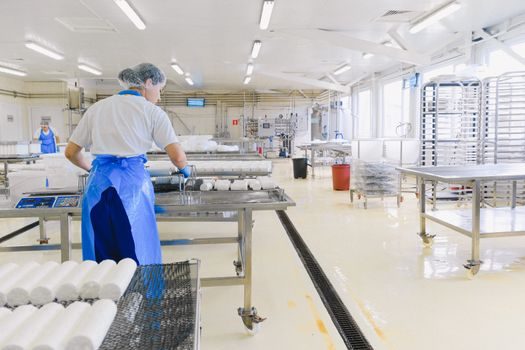
Washdown rating is the second spec gate. IP65 (dust-tight, protected against low-pressure water jets) is the entry floor for any conveyor that lives inside a washdown envelope. IP66 (powerful jets) covers most daily-clean spray patterns. IP69K (high-temperature, high-pressure close-range cleaning) is required for conveyors in direct product-path zones where 80 °C / 100 bar rotating spray lances are used to sanitize between batches. Electrical enclosures, photo-eyes, and motor controls must match the roller assembly's IP code — mismatched ratings on a single conveyor are a common audit finding. [S2]
Zone layout also drives roller spec. A typical line splits into dry zone (pre-pack, case handling, IP54 sufficient), wet zone (primary processing, IP65/IP66), and high-care/high-risk zone (post-pasteurization, ready-to-eat, IP66 or IP69K). Cross-zone conveyors must use a sanitary transition (lift-up section, removable roller section, or pass-through window) so the dry-zone conveyor never enters a washdown zone.
Throughput, Load, and Roller Spacing Math
Throughput is set by the slowest upstream or downstream machine, not by the conveyor itself. Inspection conveyors sized for vegetable lines typically run 1,000–5,000 kg/h; the TENRIT 1800/800 is rated at 2,000 kg/h (4,409 lb/h) for a 1800 mm-long, 800 mm-wide inspection belt — a typical footprint for a 2–4 operator visual-inspection station [S1]. For case and tray handling, throughput is usually expressed in cartons per minute (cpm) and falls in the 10–60 cpm band, driven by roller diameter, roller spacing, and belt or chain pitch.
Roller spacing is a hard spec, not a preference: it must be less than 1/3 of the smallest product's longest dimension to prevent tip-over, and for round products, less than 1/2 of the product diameter. Roller diameter (typically 50 mm, 60 mm, 76 mm, 89 mm) follows load: a 50 mm roller with a 1,000 N point load is normal for packaged goods; 76 mm and above for raw produce and heavy tote loads. For background on how roller geometry, bearing selection, and shaft fit interact, the roller bearing entry covers the bearing side of the same calculation.
Drive Topology and Control Integration
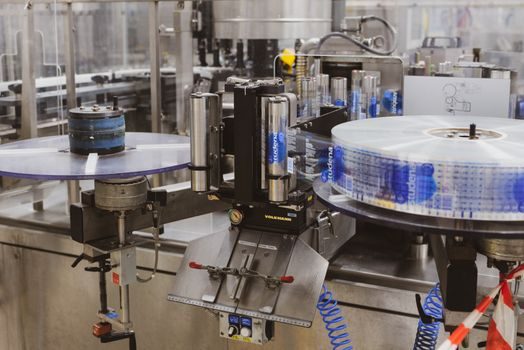
Three drive options are common on food-grade roller conveyors, and the choice cascades into the control architecture. Fixed-speed AC gearmotors paired with VFDs are the workhorse for chain-driven inspection conveyors — simple, sealed (IP66/IP69K stainless gearmotors are available), and easy to integrate with the line PLC. MDR conveyors use 24 V or 48 V DC roller cards inside each roller, controlled by a zone controller; they shine in zero-pressure accumulation but require a separate logic controller. Belt-driven roller conveyors (a flat belt under the rollers driving them by friction) are a quiet alternative for lightweight packaged goods and are easier to clean than chain-driven units in some geometries. [S1]
Control integration should follow a batch-tracking discipline: every conveyor should be tagged with a unique equipment ID in the line PLC, and start/stop events should write to the same batch record as the cooking or pasteurization steps. Multi-recipe controllers manage per-product time and temperature bands, and pre-programmed recovery routines (stop, alarm, restart at step N, or full restart) remove operator judgment from fault handling — the right outcome for repeatable quality [S2].
Common Failure Modes and Selection Pitfalls
Three failure modes dominate food-line roller conveyor service. First, bearing failure from water ingress when IP rating is undersized or seal material is wrong (NBR vs. Viton vs. EPDM — chlorinated cleaners attack NBR). Second, chain and sprocket wear on chain-driven units when lubrication is incompatible with the food zone — food-grade H1 grease is mandatory in product-path zones, and oil-mist lubrication is typically prohibited in open food areas. Third, frame and roller corrosion from chloride cleaners on 304 stainless; specifying 316 stainless or upgrading to a polymer roller in known high-chloride washdown zones is cheaper than replacing the conveyor after 3 years. [S1]
A selection pitfall worth flagging: do not specify a chain-driven inspection conveyor for sticky or oily products — chain lubrication will contaminate the product path. For those applications, a belt-driven or MDR conveyor is the correct choice, with the trade-off being less aggressive product rotation and a different inspection geometry. For a deeper dive on how temperature-zone selection plays out for cold-chain applications, the Cold Chain Roller Conveyor Spec Map: Materials, Temperature, and Load Ratings lays out the material and load deltas in detail.
Selection Checklist and Sourcing
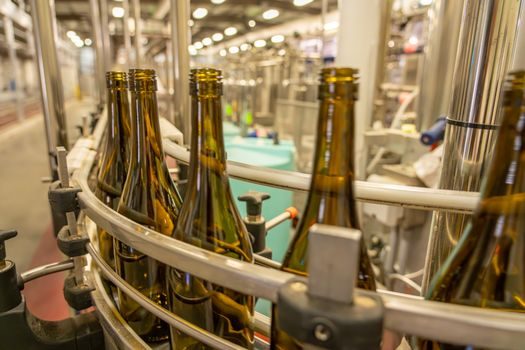
A defensible roller conveyor selection for a food or beverage line should answer five questions in writing: (1) roller material and surface finish tied to product and washdown chemistry; (2) IP rating tied to zone classification; (3) throughput in kg/h or cpm tied to upstream/downstream machine capacity — the TENRIT 1800/800 at 2,000 kg/h is a reasonable midpoint for vegetable inspection [S1]; (4) drive topology and control integration tied to the line PLC and batch-recording system; (5) lubrication strategy and bearing seal material tied to the washdown chemistry. Vendor selection should be evidence-based: confirmed hygienic design (3-A, EHEDG, or equivalent documentation), documented IP test reports, and reference installations in the same product category.
Trackable signals for 2026: a rising number of stainless MDR 24 V/48 V roller platforms with IP66/IP69K ratings entering the food-and-beverage catalog, driven by the need for flexible zero-pressure accumulation in washdown envelopes; continued migration from 304 to 316 stainless in chloride-heavy plants; and tighter integration of conveyor start/stop events with multi-recipe batch records for traceability audits [S2].
Spec-level background on the components involved: road roller.