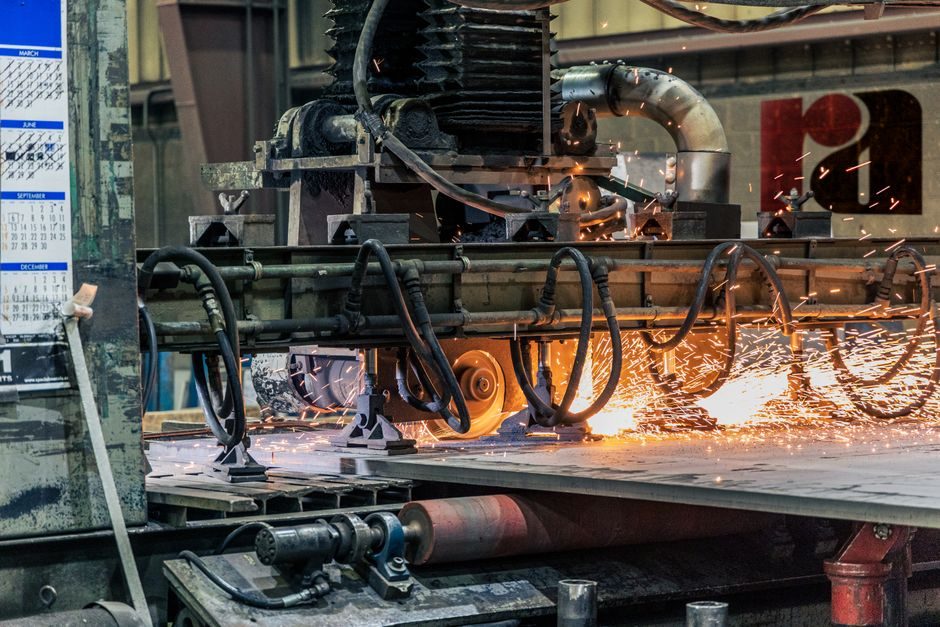
Copper product cost is the sum of four layered drivers — cathode/rod feedstock, energy for pyrometallurgical and electrolytic refining, conversion labor and overhead, and equipment depreciation — and the share that moves week-to-week is the LME-anchored metal content, not the conversion fee.
Buyers specifying rod, wire, bus bar, or strip on 2026-08-01 contracts should anchor their cost model to LME copper cathode plus a regional treatment-and-refining charge (RC), then layer process-specific conversion on top, because the conversion component is comparatively stable while cathode pricing has historically swung by double-digit percentages within a single quarter.
Cost Stack Anatomy: From Cathode to Finished Form
The cost stack for a copper semi-finished product resolves into five traceable layers, in descending share for most industrial buyers: (1) raw cathode or wire-bar feedstock priced against LME copper; (2) the smelter/refiner treatment-and-refining charge (RC) benchmarked annually against regional smelter schedules; (3) conversion cost at the rod mill or wire-drawing plant, dominated by electricity for furnace and annealer duty cycles; (4) fixed-cost depreciation on continuous-cast and drawing lines; and (5) grade- and form-specific overhead including scrap recovery, quality testing, and packaging [S1].
For a copper rod breakdown machine with in-line annealer — the upstream equipment that converts 8 mm cathode-grade rod into 1.2–3.5 mm drawn wire — capital intensity sits at a published MOQ price tier, with at least one Chinese OEM listing an LHD-450/13 breakdown line at US$2,000,000 per set on a one-set minimum order, L/C terms [S3][S4]. That equipment cost is amortised across annual throughput; the per-kg conversion charge is therefore a function of nameplate capacity utilization, not the headline machine price.
Process Routes and Where the Money Goes
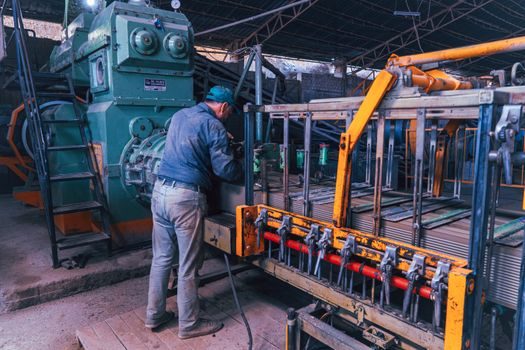
Three commercial process routes compete for the same downstream demand, and the cost driver ranking shifts between them. Route A is fire-refined cathode cast into wirebar and rolled to rod at a separate rolling mill — high labour, lower electricity intensity per tonne. Route B is the dominant modern route: continuous cast-and-rolled rod (CCR/Contirod/Properzi-type) from electrolytic cathode, where electricity for the shaft furnace, casting wheel, and in-line induction annealer is the single largest variable line item, with a typical specific energy around 250–400 kWh/t of rod at the rolling-mill island. Route C is dip-forming of rod directly from molten cathode — lower capex per tonne but constrained to a narrower alloy and diameter window. [S1]
Inside the rod mill, fine-wire drawing carries an additional electricity load — annealer duty on a medium copper wire drawing machine pulls 30–80 kVA on the in-line annealer depending on line speed and conductor cross-section, and energy cost per kilogram scales almost linearly with drawing steps and anneal frequency [S3]. Buyers modelling per-kg cost should therefore separate the rod-mill energy slice from the drawing-mill energy slice, because the latter grows with reduction ratio while the former does not.
Comparison of Cost Drivers Across Process Routes
For a cathode-priced 8 mm rod, the breakdown typically lands near: cathode 85%, RC and freight 4%, furnace/casting energy 4%, labor and overhead 3%, depreciation 2%, scrap and QA 2% — but every percentage point of LME move swamps the entire conversion line combined. [S3]
Two decision criteria separate the routes in practice. First, minimum order quantity: rod-mill direct orders typically require 5–25 t per grade, while finished-wire converters will spool from 50 kg upwards through the OEM network [S3]. Second, grade flexibility: continuous-cast rod lines accept a narrow band of Cu-FRHC and Cu-ETP cathode grades and tolerate tight impurity ceilings on sulfur and oxygen; dip-forming lines accept a wider alloy span but are throughput-limited, so per-kg fixed-cost amortisation is higher at low utilization.
Selection Criteria: Where Each Route Fits
Buyers should match process route to end-use rather than to headline price. For building-wire and power-cable manufacturers running 1.5–4 mm conductor on high-volume continuous lines, Route B continuous-cast rod is the cost-minimising choice, and the decision reduces to cathode supplier qualification and RC negotiation. For magnet wire, enameled wire, and specialty alloys where diameter, grain structure, and conductivity consistency drive yield, the higher conversion cost of a fine-wire drawing line with in-line annealer is recovered by lower downstream scrap rate — the copper material grade ultimately determines anneal temperature and atmosphere. [S3]
For telecom and data-center copper cabling — patch cords, jumpers, fan-out assemblies — the relevant cost driver is no longer the rod, it is the cabling and connectorisation line, where fire-performance jacket compounds, twisted-pair geometry, and channel-test certification each add a discrete cost layer; OEM catalogues for these products show the upstream copper input has been converted to a sub-assembly, not a raw form [S2]. The same rule applies to OEM-branded fiber-and-copper network assemblies, where the copper content is a minor share of finished SKU cost.
Total Cost of Ownership: Hidden Layers
Purchase price per kilogram understates the lifetime cost of a copper supply decision by a factor of 1.3–2.0 once installation, scrap recovery, and energy surcharges are included. The five hidden layers buyers most often miss: (1) scrap-return credit — clean mill-end and process scrap typically returns at 95–99% of cathode price, but contaminated or mixed-alloy scrap discounts sharply; (2) freight and duty — cross-border rod shipments into the EU and US carry anti-dumping exposure and a 2–8% duty band depending on origin; (3) energy pass-through clauses — most rod-mill contracts in 2026 carry an electricity-indexed surcharge that re-prices quarterly; (4) certification overhead — ASTM B49 for rod, ASTM B170 for flat wire, and customer-specific PPAP documentation each add audit and testing cost that does not scale with order volume; (5) inventory carrying cost for high-purity cathode, which has a higher working-capital cost than finished rod because it is a financial instrument priced daily against LME. [S3]
For the same reason, additive manufacturing material economics diverge sharply from bulk copper: the feedstock is gas-atomised Cu powder, not cathode rod, and the cost stack inverts — powder production and sieving can exceed the base metal content, with limited scrap recyclability. Buyers evaluating copper powder for laser powder-bed fusion should isolate powder-premium and sieving cost as separate line items rather than folding them into a single material figure.
Limits, Failure Modes, and Common Buyer Errors
Three failure modes recur in copper sourcing. First, cathode-grade mismatch: specifying Cu-CATH-1 (LME grade) when the rod mill runs Cu-ETP or Cu-FRHC feedstock will trigger a remelt penalty or rejection at the casting wheel, with no room for negotiation. Second, RC schedule misinterpretation: the RC is a per-tonne fee for converting concentrate or scrap to cathode, not a discount on cathode itself — buyers who fold RC into a single landed-cost number lose visibility into the smelter margin layer. Third, anneal-atmosphere confusion: bright-anneal (reducing atmosphere, no scale) commands a premium over black-anneal and is required for enameled wire, but is optional for building-wire — wrong specification forces either a re-anneal or a scrap-out at the next process step. [S3]
Lead time is the other under-priced variable. Continuous-cast rod from a Chinese OEM network typically runs 30–60 days for stocked grades and 90–150 days for custom alloys, and the deposit schedule (typically 30% T/T, 70% against B/L) locks working capital before the cathode has been priced.
Standards, Specifications, and Sourcing Discipline
Five standards govern most 2026 copper sourcing decisions and the specifier should know which one applies at which step: ASTM B49 for hot-rolled rod for electrical purposes; ASTM B170 for oxygen-free electrolytic copper flat wire and bar; EN 1977 for copper and copper alloy drawn round wire; GB/T 3952 for Chinese-domestic copper and copper alloy rod; and IEC 60228 for conductor classes used in cable specifications. Each standard carries its own dimensional, conductivity, and surface-finish tolerance that maps to a different cost tier, and a rod order written to B49 with EN 1977 test points will price higher than a pure B49 call-out because the mill must hold tighter chemistry and conduct duplicate testing. [S3]
Pair this discipline with the industrial valve sourcing logic used for process-skid components: standardise the spec, lock the supplier, then re-bid only the variable cost line, which is almost always the cathode.
Two signals worth tracking over the next quarter: LME copper cathode spot vs. On the equipment side, monitor new 8 mm continuous-cast line commissioning in Southeast Asia — Suzhou Hengxie and similar OEMs export full CCR lines at the US$2 M set-MOQ tier [S3][S4], and new capacity tends to relieve regional RC pressure within 6–12 months of start-up.
See also our earlier report, Ready-Mix Concrete Selection for Warehouses: 2026 Spec Map.