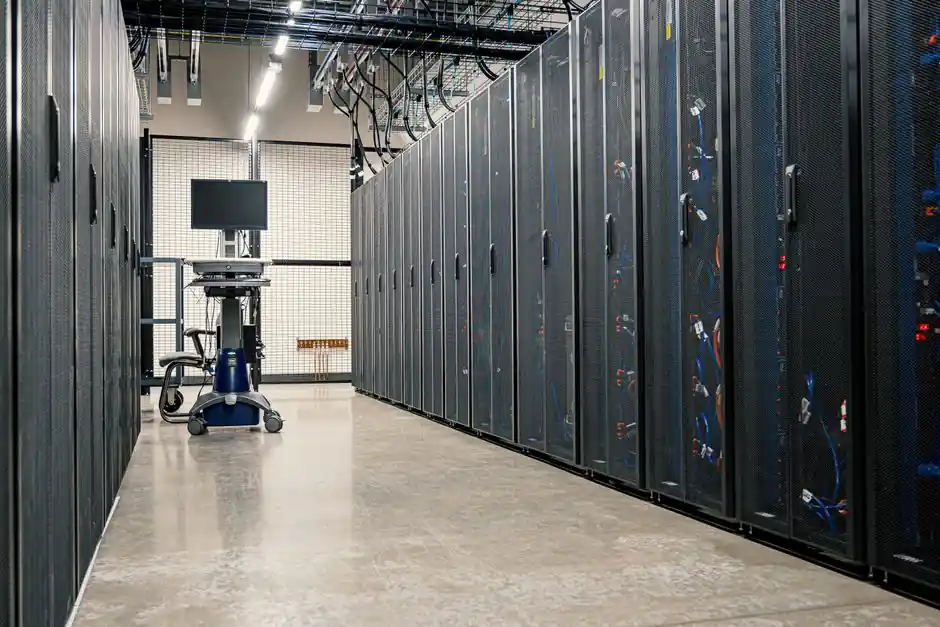
Standard CRAH and CRAC units on the data-center market ship in roughly 12-week lead times for catalogue builds, while specialised high-density and liquid-cooling skids are now pulling project schedules forward by quarters, not weeks [S2][S3].
For 2026, the practical reality is that any data-hall cooling scope above 30 kW per rack must be procured as early as transformers and switchgear, because rack density, equipment availability, and project sequencing are now the binding constraints on schedule [S3].
What separates a CRAC from a CRAH on a 2026 spec sheet
A CRAC (Computer Room Air Conditioner) uses a direct-expansion refrigerant cycle, the same basic refrigeration loop as a packaged DX unit, with the compressor, condenser, and evaporator coil packaged inside the data-hall cabinet [S1][S6]. A CRAH (Computer Room Air Handler) has no refrigerant circuit; it moves return air over a chilled-water coil and rejects the heat to a remote chiller plant [S1][S7]. That single architectural split drives almost every downstream decision on capacity, efficiency, redundancy, and lead time, and is the reason CRAH units dominate mid-to-large data centres while CRAC units remain common in smaller and edge deployments [S5][S8].
On controls and monitoring, both unit types are typically tied into the building management system and rely on sensor calibration discipline; predictive monitoring flags a 3 to 5% compressor current rise or a 1 to 2 °C discharge-temperature creep weeks before a thermal event, which matters because the ASHRAE TC 9.9 Class A1 recommended inlet envelope sits at 18 to 27 °C for IT equipment [S4]. A CRAH side-steps the compressor and refrigerant charge, which is one of the reasons it scales more cleanly into 30 to 100 kW-per-rack AI halls [S3][S5].
Why lead times matter more in 2026 than they did three years ago
Rack power density has migrated from a 1 to 3 kW baseline two decades ago, to 30 kW and above in many current facilities, and is now exceeding 40 kW per rack with AI workloads pushing toward 100 kW and beyond, so the cooling scope per hall has more than doubled in nominal capacity [S3]. Traditional air cooling starts losing efficiency above roughly 15 kW per rack, which is exactly the band where CRAC and CRAH lead times start to be measured against chillers, cooling towers, and pumps rather than against each other [S3].
The operational consequence is that equipment availability is now driving project sequencing, with teams prioritising what can be procured rather than what was originally specified, and CRAC, CRAH, pumps, and specialised liquid-cooling skids are being ordered alongside transformers and switchgear instead of after them [S3]. For standard catalogue units, a 12-week lead time is still realistic, but that figure is anchored to standard build SKUs with frozen options; any non-standard coil, fan array, or controls package typically pushes the schedule past 20 weeks [S2].
CRAC vs CRAH: a procurement-side decision matrix
On a 2026 spec, the four selection criteria that actually drive lead time and total cost are cooling medium, scalability, maintenance burden, and fit with the chiller plant, and a clear pattern emerges once they are lined up side by side [S1][S5][S7].
Cooling medium: CRAC uses DX refrigerant in a self-contained loop, so the lead-time driver is the compressor and refrigerant charging line; CRAH uses chilled water from a remote plant, so the lead-time driver is the coil bundle, control valve, and the upstream chiller schedule, which can be longer or shorter depending on plant room [S1][S7]. Scalability: CRAC scales by adding refrigerant-based units, each with its own compressor and condenser, which becomes both a capex and a maintenance drag above mid-size halls; CRAH scales by adding air-handler cabinets fed from a common water loop, which is the standard architecture for hyperscale and colocation builds [S5][S8]. Maintenance: CRAC demands compressor service, refrigerant leak checks, oil monitoring, and EPA 608 compliance items; CRAH demands coil cleaning, valve calibration, and chilled-water chemistry, but no refrigerant circuit at the air handler [S4][S5]. Fit with high-density AI: above 30 kW per rack, CRAH plus rear-door heat exchangers, direct-to-chip, or immersion tends to be the default because it shares the heat-rejection path with liquid-cooling infrastructure already being procured for the same hall [S3].
Where a 12-week lead time still holds, and where it does not
The 12-week figure published for standard data-hall products is real, but it only covers catalogue SKUs with the vendor's default options, controls, and coil sizes, and the same vendor typically reserves the right to extend that for non-standard fan arrays, custom filtration, or unusual supply voltages [S2]. Once a project moves to a 60,000 CFM-class vertical water-cooled DX or a split-system DX/chilled-water hybrid, the lead-time conversation shifts from the air-handler cabinet to the upstream chiller, pump skid, and cooling tower, where extended procurement timelines are now reported across major US markets including Northern Virginia, Phoenix, Dallas, and parts of the Midwest [S2][S3].
For predictive maintenance, the practical lead-time protection on the operations side is to keep standby units on an identical PM frequency as the primary unit, because low refrigerant, drifted sensors, or aged belts on a standby unit typically trace back to deferred maintenance, and that gap is what converts a routine swap into a tier-level thermal event [S4]. Engineers comparing CRAC and CRAH air-distribution paths should also remember that both unit types depend on the same containment logic: hot-aisle/cold-aisle containment, slab or raised-floor supply, and overhead ducted supply all change the cabinet selection and the CFM-per-kW ratio, and that ratio feeds straight back into how many cabinets the project has to procure, which feeds straight back into the lead-time exposure [S1][S8]. For projects that pair precision cooling with packaged mechanical rooms, the same supply-chain pressure shows up in construction machinery and equipment lead times on the build side, and in the longer electrical-equipment queues that now gate the commissioning window [S3].
What contractors and estimators should pin down before issuing a PO
On a CRAC scope, the three items that most often move the lead-time needle are refrigerant type and EPA 608 compliance paperwork, compressor model and frame size, and whether the unit ships with a factory-installed BMS card or needs field integration; each of those can add weeks if it is left to the submittal phase [S1][S4]. On a CRAH scope, the equivalent items are chilled-water coil connection size and pressure class, control-valve selection, and whether the unit is being delivered as a stand-alone air handler or as part of a packaged mechanical-room solution; mismatch on any of those is a common source of field rework and schedule slip [S2][S7].
For projects still choosing between architectures, the rough rule of thumb from the field is that CRAC remains a sensible pick for small and low-density halls where the underfloor air distribution can carry the load, while CRAH plus a central chiller plant becomes the more efficient and more scalable answer once the hall is mid-size or the rack density is climbing past 15 to 30 kW [S3][S5]. Pairing the cooling decision with a generator sizing review is sensible at this density step, since the standby-power budget for the same hall changes materially; the diesel genset pricing bands for 2026 and the skid-steer framing choices both feed the same site logistics envelope that the cooling cabinets have to land inside.
Failure modes that turn a lead-time question into an outage
The three most common CRAC and CRAH failures in data halls are a compressor whose current rose 3 to 5% over four weeks without being flagged, a CRAH control valve that drifted after an unlogged BMS software update, and a standby unit that failed when called upon because it had been running on low refrigerant for months; every one of these was predictable from data the BMS already had, which is why predictive monitoring is increasingly specified alongside the cooling cabinet itself [S4].
The thermal consequence of any of those failures falls outside the ASHRAE TC 9.9 Class A1 envelope of 18 to 27 °C inlet air, and a unit that stops delivering within that envelope is treated as a tier-level incident rather than a maintenance event, so the operational rule is to verify discharge temperature, alarm acknowledgement, and unit ID on every shift, not just on the active unit [S4]. For facilities that already have a building automation layer, the next sensible node is to confirm that the construction machinery and equipment commissioning plan and the cooling commissioning plan share a single point of truth, because most 2026 delays are sequencing failures between trades rather than failures of any single piece of equipment [S3].
Trackable signals for the next procurement cycle: published Q4 2026 lead-time updates from the major CRAC and CRAH vendors, and any new ASHRAE TC 9.9 guidance on inlet envelope limits above 40 kW per rack, both of which will re-baseline the 12-week catalogue figure that this article is anchored to [S2][S4].
Component reference pages worth checking: data logger, and lead screw.