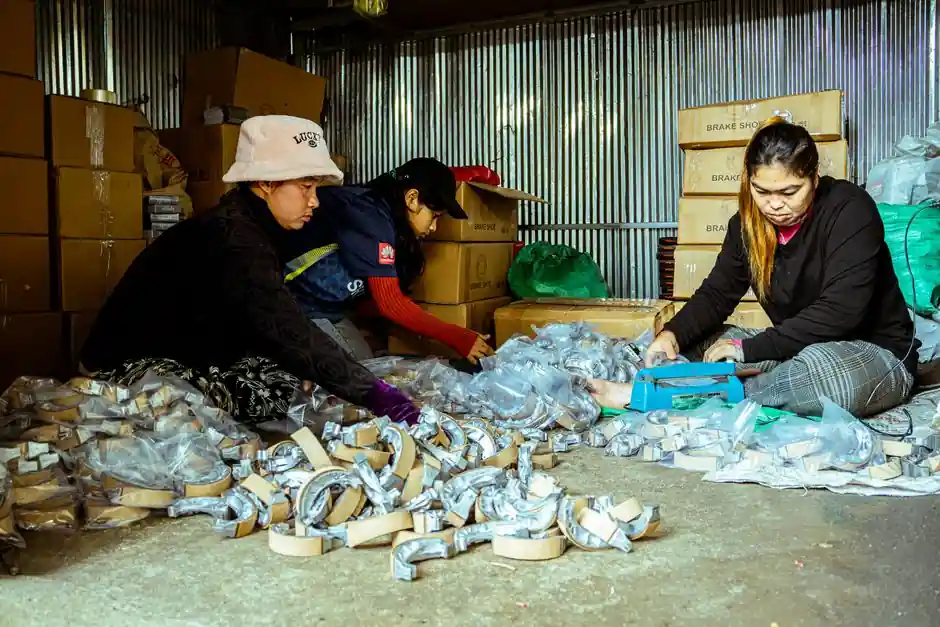
Counterfeit bearings remain a structural supply-chain problem, not a transient one: EUIPO recorded €3.4 billion in counterfeit goods seized in the EU during 2023, a 68% year-on-year jump, and the OECD puts global counterfeit trade at roughly USD 464 billion, or about 2.5% of world trade [S2]. The World Bearing Association cites a 4.2 trillion USD drain on the global economy and 5.4 million jobs at risk, with 39% of seized counterfeits rated dangerous to life or limb [S3].
Bearings are a high-value target for counterfeiters because the components are small, dense, expensive per kilogram, and used in every rotating machine from pumps and motors to gearboxes and spindles. A 2015 presentation by SKF's then-general counsel Timothy Gifford, citing U.S.
What "Counterfeit" and "Gray Market" Actually Cover
The industry distinguishes three failure modes that engineers must screen for: outright fakes (no-name or off-brand product laser-marked with a premium brand), badly refurbished originals relabeled and resold as new, and genuine parts diverted through unauthorized intermediaries, the so-called gray channel, which still voids the manufacturer's warranty and traceability chain [S3][S6]. Counterfeit bearings typically use sub-specification alloys, inconsistent heat treatment, and unstable metallurgy, which raise the probability of early fatigue, surface cracking, or sudden collapse under load, with common failure modes including spalling, cage fracture, and raceway cracking [S2].
Seal quality is another quiet giveaway: low-grade seals in counterfeit bearings commonly fail in washdown, chemical, or moisture-rich service, and the internal lubricant may be unclassified or wholly unsuitable, a critical risk in food, beverage, and hygienic process lines [S2]. For buyers, the practical consequence is that a counterfeit offers no verified origin, no batch traceability, and no manufacturer-backed warranty, and accountability for any downstream failure rests with the distributor or trading desk that placed the part [S2].
Detection: A Four-Layer Screening Workflow
Layer 1 is provenance. WBA's published guidance is unambiguous: do not attempt to identify fakes alone, instead route suspect product through the premium brand manufacturer (JTEKT/Koyo, NACHI, NTN, NSK, Schaeffler/INA/FAG, SKF, Timken) and law enforcement before alerting the suspected distributor, because alerting the suspected party first can trigger destruction of evidence [S3]. End-users should restrict purchases to authorized channels; SKF, for example, holds its authorized distributors to a higher documentary standard than open-market resellers [S1].
Layer 2 is packaging and marking authentication. The WBA Check app, available free on iOS and Android, scans the QR/data-matrix code on a bearing's packaging and returns one of three responses: code valid and unique in the manufacturer's database, code already scanned many times (caution flag), or unknown code (suspected fake, do not install) [S3]. Counterfeiters now replicate UPC codes, laser-engrave part numbers, and mix legitimate and fake bearings inside one box, so the app is a first-pass screen, not a final verdict, and a clean scan does not rule out a relabeled genuine bearing with a copied code [S1].
Layer 3 is dimensional and metallurgical inspection. For P4 (ABEC 7) class angular-contact bearings, an experienced machinist can place each race on a granite surface and indicator-check thickness variation; the inner and outer races should each hold parallelism within roughly 2-2.5 microns, and a counterfeit that has been reground without proper process control will fail that check immediately [S4]. The Practical Machinist thread also documents the limitation of this method: P4 parallelism is hard to verify on a used or relabeled genuine bearing, so documentation of traceable manufacture remains the deciding factor [S4].
Layer 4 is hardness testing. Rockwell hardness on the race or ring, performed with a calibrated bench instrument using a diamond cone or hardened steel ball indenter, gives a quick read on whether the part was through-hardened to the manufacturer's specified HRC range; counterfeits often run soft because they were not austenitized and tempered to specification, and a reading 2-3 HRC below the catalog value is a strong counterfeit indicator [S5]. For premium brands, the manufacturer's data sheet will quote the exact HRC target for inner ring, outer ring, and balls, and the test should be run on a non-functional surface to preserve the bearing if it passes.
Comparison: Four Detection Methods by Cost, Speed, and Reliability

Engineers typically combine these methods in sequence, because no single check catches every failure mode, and the table below ranks the four practical screening tools against the criteria a maintenance or QA team actually optimizes for. [S2]
Method 1, WBA Check app scan: cost is essentially free, speed is under five seconds per unit, reliability is moderate (catches wrong/missing/copied codes but not relabeled genuine stock), and best fit is incoming goods at receiving [S3]. Method 2, dimensional check on granite with a 0.001 mm or better indicator: cost is low (a granite plate and indicator are standard metrology kit), speed is about 5-10 minutes per bearing, reliability is high for P4 and higher, lower for ABEC 5 and below, and best fit is spindle rebuilds and precision rotary assemblies [S4]. Method 3, Rockwell hardness test: cost is moderate (requires a calibrated hardness tester, typically USD 5,000-15,000 new), speed is 2-3 minutes per indent, reliability is high when compared against the manufacturer's HRC spec, and best fit is QA labs auditing suspect lots [S5]. Method 4, manufacturer forensic review: cost is zero to the buyer but slow (days to weeks), reliability is the highest available because the OEM checks marking depth, packaging print, and batch records, and best fit is any bearing that will be installed in a safety-critical or warranty-bearing system [S3][S6].
For most plant-floor teams the right order is WBA scan at receiving, dimensional check on premium or P4-class bearings, and hardness testing only on lots that fail either of the first two screens. Any unit that fails a screen should go to the OEM and not be returned to the suspected distributor, to preserve the chain of custody for any later enforcement action [S3].
Selection Criteria: When Extra Authentication Is Worth It
The cost-benefit math depends on the consequence of failure. A single counterfeit bearing failure can stop a production line without warning, and in most documented cases the initial failure cascades into secondary issues in the driven machine, extending downtime well beyond the bearing swap itself [S2]. The break-even spend on authentication rises sharply when the bearing sits in a safety-relevant path, a food or pharma process line where seal failure causes contamination, a wind turbine main shaft where access requires a crane, or a paper-machine dryer section where a hot bearing can ignite stock.
For low-criticality, low-speed applications (conveyor idlers, small fans, hand-tool gearboxes), the WBA Check app plus visual packaging inspection is usually sufficient. For mid-criticality rotating equipment (pumps, gearboxes, electric motors above 30 kW), add the authorized-channel sourcing requirement and full batch documentation at the point of purchase. For high-criticality equipment (spindles, paper-machine rolls, wind turbine main bearings, any bearing covered by a regulatory or insurance warranty), the full four-layer screen is justified, and the OEM's authentication service should be invoked on the first suspicious signal, not the third [S1][S2][S6].
Engineers specifying on pressure transmitter and flow meter instrument loops should treat the bearing authentication question with the same rigor: counterfeit instruments with copied calibration certificates have produced the same kind of undetected-failure pattern that counterfeit bearings produce, and the same four-layer logic (provenance, marking auth, dimensional/metrology check, OEM forensic) applies across rotating and stationary instrument assets.
Procurement Signals That Suggest Gray-Market Stock
Three procurement-side patterns correlate with counterfeit risk, and buyers who see any of them should tighten inspection or walk away. First, a price significantly below the market range without a corresponding volume or contract justification, for example, USD 89 P4 angular-contact bearings offered against a USD 170-450 authorized-channel range on a public marketplace is a textbook red flag [S4]. Second, a seller that ships from a free-trade zone, a third-country logistics hub, or a residential address, which is consistent with the routes used to divert or relabel stock [S1][S2]. Third, a seller that cannot or will not provide batch documentation, a material certificate traceable to the manufacturer, or a warranty card, and that resists or delays the OEM's authentication process [S3][S4].
U.S. enforcement data shows the scale of the supply-side response: ICE and Homeland Security made 23,140 seizures of counterfeit goods worth approximately USD 1.2 billion in 2014 alone, and of the 2013 seizures that contained counterfeit SKF bearings, 57 incidents, 30 were attributable to an estimated USD 2.3 million in MSRP; the 2014 figures were 32 seizures, with 22 attributable at roughly USD 850,000 in MSRP [S1]. China was the source for nearly half of those U.S. counterfeit seizures, and joint raids with bearing manufacturers were executed in South Carolina, Texas, and Louisiana in 2014 [S1].
What to Do When a Suspect Bearing Is Identified
The WBA-published protocol is the operating standard: do not return the bearing to the suspected source, document the part number, batch code, supplier invoice, and any photos of packaging and markings, and notify the premium brand manufacturer and relevant law enforcement before contacting the distributor [S3]. Destroying the chain of evidence by confronting the suspected counterfeiter first is the single most common mistake, and it both protects the counterfeiter and forfeits any civil recovery the buyer might otherwise have had [S3].
Forensic testing at the OEM typically includes marking-depth measurement, packaging-print microscopy, and batch-record matching, and most WBA members (JTEKT/Koyo, NACHI, NTN, NSK, Schaeffler/INA/FAG, SKF, Timken) will perform the check without charge on confirmed suspect samples [S3]. On the maintenance side, a counterfeit bearing should never be reinstalled even if it tests within dimensional tolerance, because the metallurgical and lubrication risks are not fully screened by geometry alone [S2].
Limitations and Failure Modes of Authentication
None of the four detection layers is a stand-alone guarantee. The WBA app only validates the packaging code, and a counterfeiter who has copied a real code from a genuine bearing can defeat it [S1][S3]. Dimensional checks on granite catch reground counterfeits but cannot distinguish a new-old-stock genuine bearing from a relabeled one, because both meet the same parallelism spec [S4]. Rockwell hardness catches soft counterfeit alloys but can be defeated by a counterfeiter who uses correct-spec steel, and hardness testing is also non-trivial on through-hardened thin rings where case depth and core hardness can differ [S5].
The WBA itself states the problem plainly: fakes can be difficult to detect, they will not necessarily be scratched, rusty, or dirty, and they will not necessarily even be cheaper; the only reliable check is to buy from trusted sources and route suspicion through the manufacturer [S3]. The 39% danger-to-life statistic from WBA is the operational reason for that rule: a single missed fake in a safety-relevant system is a disproportionate outcome compared to the cost of full authentication [S3].
Engineers maintaining rotating equipment alongside industrial PLC and servo motor systems should treat counterfeit-bearing screening as part of the same QA chain that already governs instrument calibration and firmware validation, because the failure economics are the same: a single undetected bad component in a controlled loop costs more in downtime and liability than a year of authentication overhead.
The next trackable signals in this space are the WBA Check app's manufacturer database expansion through 2026, any new joint OEM-law-enforcement raids reported by ICE or EUIPO, and the release of revised authentication features in next-generation bearing packaging, including tamper-evident QR variants and serialized laser marking that link each individual bearing (not just the box) to the manufacturer's batch record.
Related analysis: Diesel Gensets in 2026 Data Centers: Share, Large-Unit Mix, Lead Times.