
Crawler cranes span five orders of magnitude in working load — from 1,600 kg (3,527.4 lb) trailer-tracked handlers [S2] to 7,500 t (8,267.3 US ton) mining draglines with 132.5 m (434'08") working height [S3] — and are first partitioned by superstructure type before capacity, drive, and ground-pressure decisions are made.
Per 29 CFR § 1910.180(a)(1), a crawler crane is a rotating superstructure carrying power plant, operating machinery, and boom, mounted on a base with crawler treads for travel, hoisting and swinging loads at variable radii [S4]. The three primary structural families are lattice (pin-connected tubular sections), telescopic (hydraulically extendable box sections), and boom/dragline (heavy-duty lattice with rigid tubular or angle chords engineered for sustained mining cycles) [S1][S2][S3].
Lattice-Boom Crawler Cranes
Lattice-boom crawlers use pin-connected tubular sections to keep weight low per metre of reach, which makes them the default for heavy lift on soft ground and long-radius picks. The Sumitomo SCX1500A-3 sits inside this family at 150 t (165.3 US ton) rated load, with HSC's range spanning the SCX550, SCX700, SCX800-2, SCX1500A-3, SCX2800-2, and the 6000SLX series — all built around hydraulic power and modular lattice assembly [S1].
For general construction pick-and-carry, a crawler crane with lattice boom typically offers 1.5–2× the boom length of a telescopic at the same carrier weight, which is why lattice units dominate wind-farm, bridge-segment, and refinery erection work. Compared to a mobile crane on rubber tyres, lattice crawlers trade road speed for low ground pressure — a typical 150 t lattice unit exerts 50–80 kPa, versus 100–250 kPa for an equivalent-capacity all-terrain truck crane.
Telescopic-Boom Crawler Cranes
Telescopic crawlers combine a hydraulically extending box boom with crawler tracks, occupying the 1–150 t mid-capacity band where contractors want fast setup, single-line rigging, and the ability to reposition under load. The Befard XJ trailer-crane configuration pushes this down to 1,600 kg with 8–12 m working-height envelope, gasoline engine drive, four hydraulic extensions, and a braked-axle trailer that a delivery truck can tow [S2].
In contrast to lattice, telescopic crawlers retract to a short transport length, which is why rental fleets favor them for service cranes, glazing, and panel handling where a tower crane is over-spec.
Heavy-Duty and Dragline-Class Crawlers
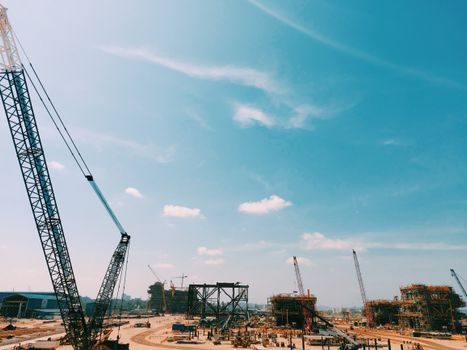
Above 500 t, crawler cranes converge with mining-class machines: multi-module lattice, ring-rail slew bearings, and either duty-cycle rope crowd or heavy-lift hook blocks. Caterpillar's 8-series dragline family runs 1,770 t (1,951.1 US ton) minimum and 7,500 t (8,267.3 US ton) maximum with 75–132.5 m working height and operating envelopes for construction and mining [S3].
This class uses boom architecture (rigid tubular or angle-chord lattice) rather than lattice-pin or telescopic construction because the cyclic duty rating (full-load shifts per hour, not per shift) and the abrasive dust environment punish bolted pin joints. For comparison, a gantry crane on rails shares the duty-cycle load rating but lacks slew; a dragline combines slew with rope crowd, which a standard crawler crane does not.
Selection Criteria: Capacity, Reach, Ground, Mobility
Selection between the three families runs on four criteria: (1) rated capacity vs. radius curve, (2) ground bearing pressure, (3) site mobility, and (4) rigging/setup time. The table below aligns lattice, telescopic, and dragline against typical values found in current OEM data [S1][S2][S3].
Decision matrix from the spec data: lattice-boom 150 t class (Sumitomo SCX1500A-3) for mid-radius heavy lift with low ground pressure [S1]; telescopic 1.6 t trailer-tracked (Befard XJ) for light handling where mobility and tow-ability matter more than capacity [S2]; dragline 1,770–7,500 t (Cat 8 series) for mining cycles where the application is continuous overburden removal, not one-off picks [S3].
Application Mapping and Real Use Cases

Lattice crawlers are specified for wind turbine installation, refinery steel, and bridge segment work; telescopic crawlers for service, glazing, modular building, and short-radius mechanical erection; dragline-class crawlers for open-pit mining overburden stripping and large-scale earthmoving. The Befard XJ catalogs the lighter end as compatible with vacuum grippers, sandwich-panel clamps, and glazing manipulators, supported by two braked trailer axles and an internal-combustion engine [S2].
Within a site fleet, a single telescopic crawler at 50–80 t can replace a mobile crane for repeated picks on soft ground, while a lattice 150 t handles the heavy tail. The distinction matters for safety: 29 CFR § 1910.180 sets separate hand-signal, swing-path, and outrigger/stabilizer rules for crawler vs. truck-mounted units, and inspectors use those definitions to classify the same machine differently if it is on tracks vs. outriggers [S4].
Limitations, Failure Modes, and Standards Anchors
Common failure modes across the family are boom-pin wear (lattice), boom-section bending under overload (telescopic), track-chain pin fatigue (all classes), and slew-ring bolt loosening on heavy units. US regulation addresses crawler operation through 29 CFR § 1910.180 [S4], which covers crawler locomotive and truck cranes, side-load testing, and operator-hand-signal protocols; in the EU, equivalent machinery safety is governed by the Machinery Directive (2006/42/EC) and EN 13000 for crane safety, with EN 13001 for general crane design principles.
Track a rental fleet's renewal cycle and the next release of mid-capacity telescopic crawlers between 80–150 t, where hydraulic-system commonality with excavators is squeezing the BOM cost down. On the heavy end, monitor the next 8-series dragline retrofit campaigns, since the supplier notes mechanical upgrade solutions for "major dragline structure repair/replacement for improved reliability and productivity enhancement" [S3] — a signal that the 7,500 t class is moving into rebuild territory rather than new-build.
See also our earlier report, Hearing Protector Advantages, Disadvantages, and Selection Criteria.