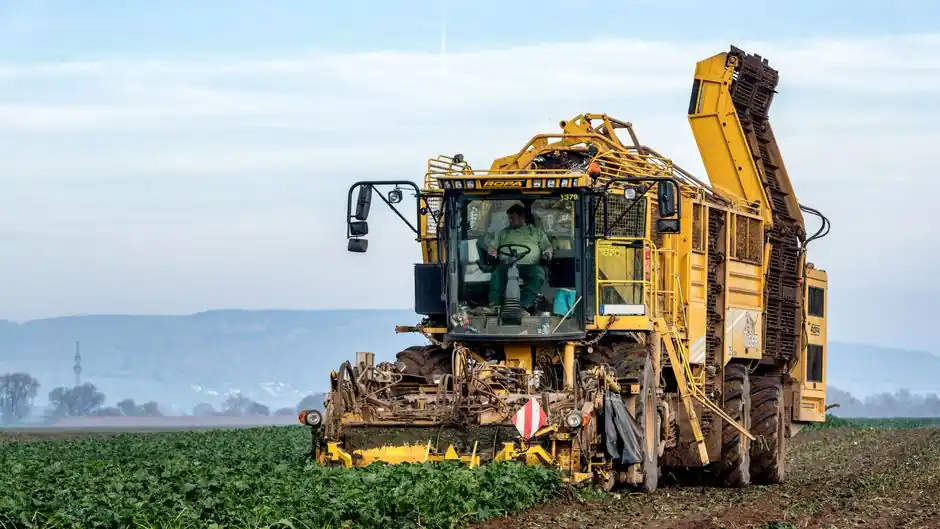
Agricultural crawler crane selection differs from construction-site selection in three measurable ways: ground-bearing pressure must stay under 50 kPa on tilled or saturated soil, working radius routinely exceeds 30 m for barn and silo erection, and the machine must self-load onto a low-bed trailer without auxiliary jacking [S3][S6].
The equipment category spans compact 8 t utility units for livestock-shed work, mid-range 80-150 t lattice-boom machines for grain-elevator and biogas-plant construction, and heavy 250-600 t crawlers for digester steelwork and bridge-class rural infrastructure [S3].
Why a crawler, not a wheeled or all-terrain crane, on the farm
Crawler cranes carry their full counterweight on continuous tracks rather than outriggers, so ground-bearing pressure drops into the 30-60 kPa band versus 100-300 kPa for a single outrigger pad on a 100 t all-terrain unit, and the machine can travel short distances on soft ground without matting [S3]. A crawler crane also lifts heavier loads at longer radii than a hydraulic truck crane of comparable gross weight because the track frame resists tipping moment without dependence on outrigger spread [S3].
The trade-off is speed between setups: a tracked unit typically walks at 1.0-2.5 km/h unloaded, while an all-terrain crane drives at highway speed under its own power [S3]. For a contractor covering one farm site per day, this is a non-issue. For a rental fleet rotating between three jobs, transport logistics, not ground pressure, drives the choice.
The five spec gates that decide fit on agricultural sites
Selection collapses to five numbers, and the order matters: (1) maximum lift at the heaviest pick, (2) ground-bearing pressure calculated against the softest route on the access track, (3) track-shoe width versus row-crop headland clearance, (4) transport weight on the lowest-loaded agricultural trailer, and (5) undercarriage parts availability inside one planting season [S1][S3].
The undercarriage is the agricultural failure point, not the boom. Track shoes, bottom rollers, top rollers, idlers, and sprockets wear faster on abrasive soil and crop-residue-laced dust than on clean quarry rock, and OEM-brand service intervals assume cleaner environments. Independent ISO 9001 undercarriage manufacturers now stock 30-year-experience product lines for Link-Belt, Liebherr, Kobelco, Hitachi Sumitomo, IHI, Hitachi, Manitowoc, Demag, Terex, American, Nippon Sharyo, Fuwa, and Sany machines, with 7-14 day shipment on common parts [S1]. For a farm contractor, that supply window is shorter than a single missed planting window.
Capacity tiers and their agricultural use cases
Compact 8-30 t crawlers handle livestock-shed steel erection, small grain-bin hoist work, and fence-post pile driving, with typical pick weights of 2-5 t at 8-12 m radius [S3]. The 50-80 t mid-tier is the workhorse for dairy parlour steel, mid-rise hay-barn trusses, and small biogas digester tank lifts, with 15-30 t picks at 18-25 m radius [S3].
At 100-250 t, lattice-boom crawlers enter the agricultural civil-infrastructure range: full-height grain elevator construction, river-crossing rural bridges, and digester-membrane support frames, with pick weights of 40-80 t at 30-40 m radius [S3][S5]. Above 300 t, the work shifts to modular processing-plant installation and large-bore wind-turbine foundation pours in rural industrial parks, typically lifted on a mobile crane or gantry crane auxiliary rather than a single crawler in the field.
Undercarriage wear: the soil-versus-spec gap
Top rollers specified in 40Mn2 carbon steel and sprockets in 35SiMn alloy steel are standard grades for OEM undercarriages, and those same materials dominate the ISO 9001 aftermarket for common models such as the NIPPON SHARYO DH508, Terex HC275, Demag CC2500, Sumitomo SC500, and Nippon Sharyo DHP80 [S1]. Track-shoe pin-and-bushing wear accelerates by roughly 30-50% in sandy-loam versus crushed-stone environments, based on the published maintenance-interval deltas between quarry and agricultural undercarriage service kits.
Idler and front-idler replacement becomes the schedule driver, not track shoes, because idlers absorb vibration and maintain track tension over uneven ground; on tilled headlands and irrigation-channel banks, idler life is typically 1,500-2,500 hours versus 3,000-4,000 hours on a prepared construction platform [S1]. Sprocket tooth wear, in turn, accelerates once idler life is exceeded, so the practical maintenance gate is: replace idlers and bottom rollers together, inspect sprockets at the same service window, and budget track shoes for the next cycle [S1].
Ground-pressure calculation for the softest route

Ground-bearing pressure equals total machine mass plus pick load divided by the contact area of both tracks; a 100 t crawler with a 1.2 m shoe width and 4.5 m track length on ground contact of about 5.4 m² per side generates roughly 80 kPa under static load with full counterweight, dropping into the 50-60 kPa band with the pick set down. Agricultural access tracks often test below 40 kPa CBR (California Bearing Ratio), so a crawler crane in the 50-60 kPa operating band will rut the surface; matting with bog mats or temporary road plates is mandatory, not optional. [S3]
The flexible-ground slewing-stability problem has been quantified in published multibody-dynamics models, where a crawler crane on low-CBR soil loses 8-15% of its rated capacity at full slewing moment because the track frame pitches under dynamic load [S6]. For an agricultural lift, the practical rule is: derate the published load chart by 10% when working on a documented sub-50 kPa CBR surface, and require mats under any outrigger-equipped assist crane on the same site.
Standards, training, and operator gates
Crawler crane operation in agricultural settings still falls under the same national crane-safety regulations as construction-site work: operator certification, daily inspection logs, and documented load-chart use are non-negotiable, and the industry bodies that publish those requirements, including AEM, CECE, and ERA in the European context, are active in current crawler-crane training and technician-certification programmes [S2][S4].
Independent industry reporting through 2026 emphasises technician training as the pinch point, not machine supply, with brand programmes running alongside third-party certification [S4]. For a farm operation buying or renting a crawler crane for the first time, the training budget is typically 5-10% of the machine's annual hire cost and should be booked before, not after, delivery.
Comparison: crawler versus mobile versus all-terrain on the farm
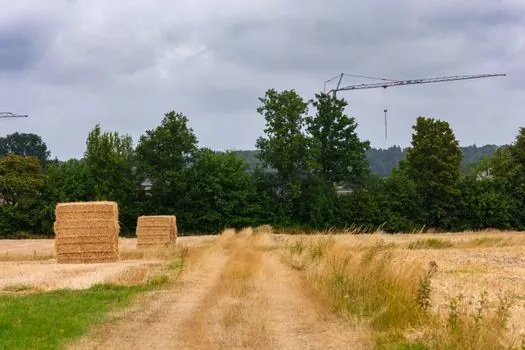
On a 50-150 t pick at 20-30 m radius on soft ground, the crawler crane wins on ground pressure and tipping-moment capacity but loses on inter-site mobility; the mobile crane wins on drive-between-sites speed but requires outrigger mats and a prepared pad; the all-terrain sits between, with the ability to drive on-road at 80 km/h and set up on outriggers in tight farmyard spaces. Decision criteria for the agricultural buyer reduce to: pick weight, ground CBR, transport logistics, and rental-day count, and on the first two, the crawler almost always wins [S3].
For a farm contractor running a single 80-150 t pick per day across multiple sites within 30 km, an all-terrain on outrigger mats is usually the lower total-cost option. For a biogas-plant build or grain-elevator retrofit with two-to-three heavy picks per day on a fixed site for six months, a crawler with independent undercarriage support is the lower total-cost option, because the avoided matting labour and the avoided ground-prep hours pay the mobilisation cost back within four-to-six weeks [S1][S3].
Limitations, failure modes, and what the spec sheet will not tell you
Three failure modes dominate agricultural crawler-crane operation and rarely appear on the OEM data sheet: track-shoe pin failure from soil-pH corrosion, hydraulic-cylinder seal failure from dust ingestion, and slewing-ring wear from sustained low-speed rotation under high moment load [S1][S6]. Each is addressable through specification: specify sealed-pin track shoes for acidic or high-organic soils, specify dust-resistant rod seals on lift and luffing cylinders, and limit continuous slewing under maximum load to the duty cycle published in the operator's manual.
Agricultural buyers should also verify that the rental contract covers undercarriage wear as a separate line item, because track-shoe and roller wear is typically billable above a defined percentage threshold, and the threshold is where the bulk of the in-contract cost ends up. For a crawler crane in continuous agricultural service, the realistic undercarriage-rebuild interval is 4,000-6,000 hours, against 6,000-10,000 hours in a quarry, and that delta is the number to negotiate against.
Track the next signals: the 2026 OEM service-bulletin cycle for high-CBR agricultural undercarriage kits, any new ISO 9001 aftermarket parts releases for the dominant mid-tier 80-150 t models, and the publication of updated slewing-stability guidance for low-CBR working surfaces. Related buying paths worth following: Rebar Cutter Selection for Electrical Installation Sites for on-site steel-prep tooling and Steel Pipe Selection Gates for Industrial Facilities for digester and irrigation plumbing that often pairs with the crane lift plan.