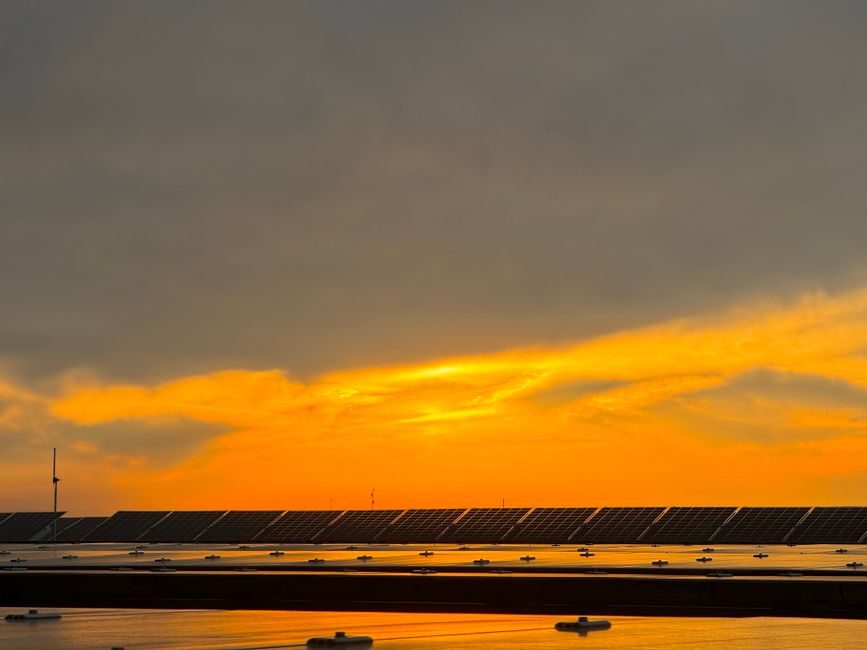
Spot pricing for 144-cell crystalline PV modules on Made-in-China.com sits at US$ 0.075–0.12/Wp at 10,000 Wp minimum order, with every listing carrying a 25-year performance warranty and ISO/CE/TUV certification [S2]. Per-piece equivalents land at US$ 63.25–66.25 per panel at 1,000 W minimum, giving industrial buyers a usable 2026 reference band for direct sourcing from Chinese suppliers [S2].
The global solar panels market report dated 2026-04-06 segments the industry along four decision axes: technology (Solar PV versus Concentrated Solar Power), module type (Thin Film versus Crystalline), grid connectivity (On-Grid versus Off-Grid), and application (Residential, Commercial, Industrial), with the forecast horizon running through 2035 [S1]. For procurement engineers, those four axes are the exact selection grid — pick a column on each row and the vendor shortlist collapses quickly.
Module Type Comparison: Crystalline vs Thin-Film categories segmented in the 2025–2035 global solar panels market, with 2026 sourcing channels listing products from Chinese suppliers.
144-cell monocrystalline and polycrystalline modules dominate the Made-in-China.com catalog at 18 V nominal with 5 W to 300 W output laddering, all shipping with 25-year warranties and ISO/CE/TUV certification [S2]. The 144-cell count is the de-facto standard for utility and commercial strings in 2026 because it maps cleanly to 1500 V DC string architecture. Thin-film sits in the same portal as a separate procurement path, typically specified where roof-load tolerance, high-temperature coefficient, or partial-shade tolerance matters more than watts-per-square-metre [S1].
Industrial buyers weighing the two should score four criteria directly: cost per Wp, efficiency per m², temperature coefficient, and bifaciality.
Hybrid and Off-Grid Systems: Inverter Sizing and Battery Pairing
Deye and similar hybrid inverters on Made-in-China.com are listed in 5 kVA / 8 kVA / 10 kVA / 12 kVA tiers, wall-mounted with 48 V lithium-ion battery storage, at US$ 4,000–10,000 per set MOQ 1 [S5]. The 48 V bus is the 2026 default for residential and small-commercial hybrid strings because it lets installers parallel 51.2 V LFP packs without DC-DC conversion. For a deeper look at the cell-to-module line that feeds those panels, the solar panel manufacturing walkthrough covers stringer, laminator and framing stages in detail.
Grid-tied PV with battery storage — what the Solar Panels Talk forum terms "hybrid solar" — is flagged as the fastest-growing residential segment heading into mid-2026, with the dedicated sub-forum carrying 5,871 topics and 79,730 posts as of 2026-06-01 [S4]. That traffic volume is itself a signal: installer and homeowner discussion has shifted from "should I add batteries" to "which chemistry and what inverter kVA rating," which is a mature-procurement conversation, not an early-adopter one.
On-Grid Utility vs Off-Grid Industrial: Connectivity Decision
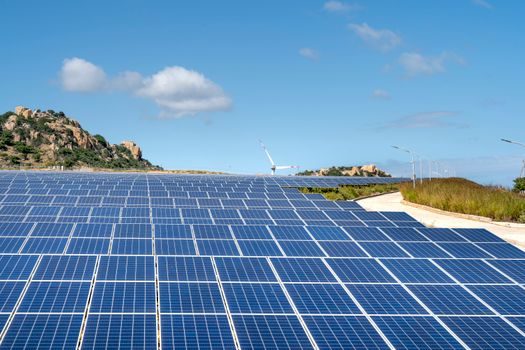
On-grid remains the default for anything 100 kW and above because net-metering and feed-in tariffs still pencil out in most U.S. state jurisdictions and in China's commercial-and-industrial (C&I) tariff bands [S1]. Off-grid specifies where grid extension cost exceeds US$ 1.50/W of PV installed, which is the typical rule-of-thumb for remote mining, telecom, and agricultural pumping in 2026. Made-in-China.com's Industrial Solar Panel System category pages index 5 kVA through 30 kW hybrid packages explicitly aimed at the off-grid C&I buyer [S5].
For specifiers choosing between the two, the comparison grid is short: load profile (continuous vs peak), distance to nearest MV transformer, and tariff structure. Where the grid is within 1 km and the tariff includes a demand charge, on-grid plus batteries wins. Beyond 5 km of single-phase LV line, off-grid hybrid wins on avoided infrastructure. The carbon steel price reference is relevant here because mounting structure and tracker torque-tube steel is roughly 15–20% of the EPC bill of materials on a utility site, and 2026 steel spot bands move that number quarter to quarter.
Installer Channel: U.S. Residential Ranking Signal
This Old House's 2026 installer guide evaluated 68 U.S. solar installers against customer feedback from 2,000 solar buyers, ranking Elevation (Powered by Elevation) first, with Sunrun, Blue Raven, Palmetto Solar, and Venture Solar rounding out the top tier [S3]. The 25-year savings horizon is the headline value proposition — "over 25 years" appears explicitly in the guide's framing of system payback [S3]. For a U.S. spec engineer, that ranking is the cleanest 2026 cross-vendor performance-and-reliability benchmark available without a custom RFP.
Warranty term is the single most under-weighted variable in residential procurement: a 25-year performance warranty on the module [S2] is structurally different from a 10-year workmanship warranty on the installer's labour, and the two stack. The 2026 catalog data confirms module-side 25-year coverage is now table-stakes from Chinese Tier-1 suppliers [S2], which pushes the buyer's due diligence onto the installer workmanship warranty and the inverter warranty terms.
Application Split: Residential, Commercial, Industrial
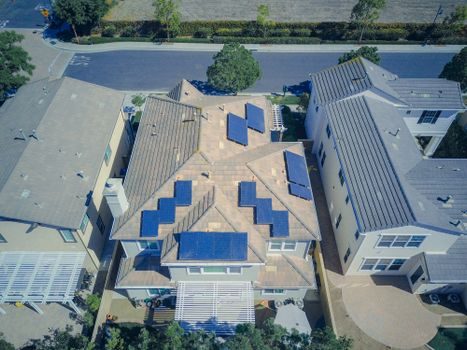
Residential 2026 demand runs 5–12 kW rooftop systems, typically paired with 5–10 kWh LFP battery and a 5–8 kVA hybrid inverter in the 48 V class [S5]. Commercial 2026 demand runs 50 kW to 1 MW rooftop or carport arrays, still dominantly on-grid crystalline, with string inverters in the 50–110 kW class. Industrial 2026 demand runs 1 MW to 100 MW ground-mount, tracker-equipped, 1500 V DC architecture, and increasingly co-located with battery energy storage for demand-charge management [S1].
For industrial buyers specifically, the Made-in-China.com category index surfaces "10/20/30 kW High Quality Solar" packages as the smallest C&I tier above residential, with explicit manufacturer audits (Diamond Member, Audited Supplier flags) on the listing page [S5]. For procurement teams, those audit flags are the first-pass vendor screen before the deeper UL/IEC/ISO paperwork check.
Standards, Sourcing Discipline and Failure Modes
Module-level certification in 2026 Chinese B2B listings bundles ISO 9001, CE, and TUV on virtually every 144-cell SKU [S2]. For U.S. residential rebate eligibility, UL 61730 (module safety) and UL 1703 (legacy) plus IEC 61215/61730 performance are the spec floor; for European utility-scale, IEC 61215 and IEC 61730 plus country-specific grid codes apply. ATEX/IECEx are not normally required for the module itself but enter the spec when battery enclosures are mounted in hazardous-area industrial sites.
Common 2026 failure modes to spec against: PID (potential-induced degradation) on high-voltage strings, LID (light-induced degradation) in the first year of PERC modules, and hot-spot risk from partial shading. Encapsulant choice (EVA vs POE) drives PID susceptibility; POE is the 2026 default for bifacial and high-humidity installs. Procurement language should require PID-resistant encapsulation explicitly, not assume it.
Trackable 2026 Signals for the Next Buying Cycle
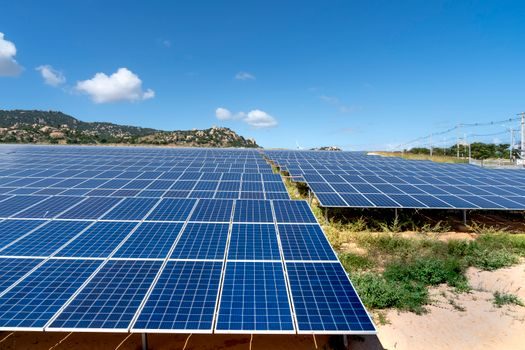
distribution channels; (3) installer-channel consolidation in the U.S. residential market, where This Old House's top-5 list [S3] gives a baseline against which Q4 2026 M&A activity can be measured. The broader EV battery and upstream mineral picture, covered in the EV battery supply chain 2026 brief, also feeds back into PV because LFP cell oversupply directly lowers residential solar-plus-storage pack costs.
For component-level specifications, see alc panel, hmi panel, and aluminum veneer panel.