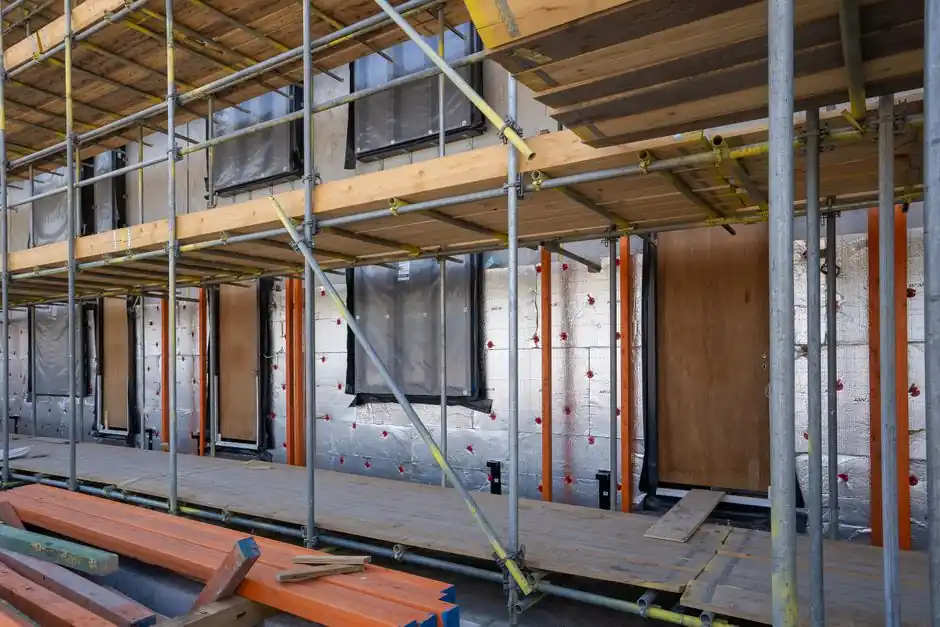
Cuplock scaffolding is a modular steel scaffold system built around a welded top-cup / bottom-cup node that locks four horizontal blades per standard with a single hammer blow, no loose nuts, bolts, or wedge clamps required [S3][S1].
Verticals (standards) are typically 48.3 mm OD scaffold tube in 3.2–3.5 mm wall thickness with cups welded at 500 mm centres; a 3 m standard in 3.2 mm S235 steel carries a working load of 76 kN (ultimate 153 kN ÷ 2.0 safety factor) [S3][S4].
System Definition and Core Components
Cuplock's signature connection uses a top cup (drop-forged for premium systems, malleable cast iron for budget lines) rotating over a fixed bottom cup to clamp the ledger, transom, or brace blades from up to four directions in one node [S3].
The standard kit-of-parts is consistent across manufacturers: verticals, ledgers (horizontals), transoms, base jacks, frame planks / steel decks, side brackets, diagonal braces, stair towers, and ladder access [S4][S1]. Top-cup drop-forging and 3.2 mm wall tube are the differentiators between a structural-grade Cuplock and a light-duty knock-off, since a forged cup resists deformation under repeated impact locking far better than cast iron [S3].
European Manufacturers: Origin and Compliance Baseline
The Cuplock system originated in Europe: SGB (Scaffolding Global Brand, founded in Switzerland) is the original Cuplok patent holder and continues to manufacture to EN 12810 and EN 12811, with full type testing for load capacity, corrosion resistance, and durability [S4].
The 2025 European supplier ranking from TP-Scaffold places four additional heavyweights alongside SGB: PERI Group (Germany), MJ-Gerüst (Germany), RMD Kwikform (UK), and ULMA Construction (Spain), all shipping Cuplock-format systems that satisfy EN 12810/EN 12811 façade and Class B–D load tables [S4]. The "EN 12810-tested, CE-marked" claim now appears on most tier-one European and Chinese OEM datasheets, which is the baseline most EU contractors require for site acceptance [S3][S4].
For broader context on how these modular scaffolds relate to the wider scaffolding equipment category, Cuplock sits in the "system scaffold" family alongside Ringlock (also called Allround or Layher-style) and Kwikstage, distinguished by its unique two-cup node geometry rather than rosette or wedge-clamp nodes.
Chinese OEM Suppliers: Capacity, Pricing, and Export Footprint
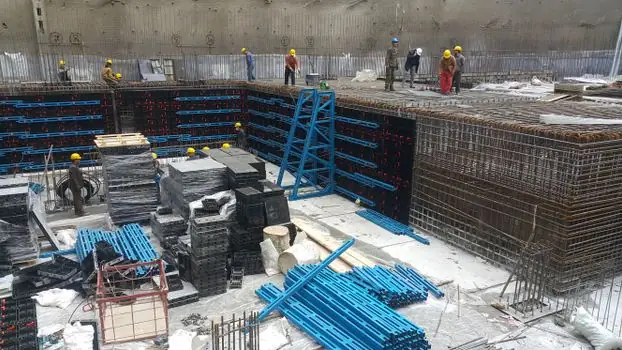
China is the dominant Cuplock manufacturing hub by volume: APAC Scaffold (Tianjin / coastal China base) sells direct-factory hot-dip galvanised Cuplock with single-column working capacity of 15–35 kN and surface options of galvanising or powder-coating [S1].
Wellmade (also known as wm-scaffold) is an OEM Cuplock factory exporting to 63 countries, with EN 12810-tested and CE-marked product lines and hot-dip galvanised as the default export finish, painted (cheaper) lines targeted at dry-climate Gulf buyers [S3]. Material grades, welding procedure qualification, and hot-dip galvanising bath thickness (typically 60–85 µm for export-grade) are the three line items a buyer's QA team should request in writing before issuing a PO.
For a fuller breakdown of how Cuplock stacks up against the dominant alternative modular system on connections, load capacity, and component count, the construction machinery and equipment category reference lays out the ringlock vs cuplock trade-off in practical terms: Cuplock is heavier per bay but faster to erect (one node, four directions, one hammer blow), while Ringlock is lighter per component but more flexible on irregular geometry [S6].
North American Suppliers: Distribution and Re-Supply
In the USA, Cuplock is supplied through a mix of domestic distributors and import-OEM channels: AAIT Scaffold markets itself as a Cuplock manufacturer and supplier to the US market, while Scaffold Supply (LaPorte, Indiana-adjacent) stocks hot-dip galvanised Cuplock verticals, ledgers, braces, board brackets, horizontal trusses, casters, and base collars in mild and high-strength low-alloy structural steel [S2][S5].
US buyers typically specify hot-dip galvanised finish (vs painted) for any scaffold that will see weather exposure beyond a single project cycle, since the zinc coating drives service life from 2–3 years (painted) to 10+ years (galvanised) in temperate climates [S1][S3][S5].
Selection Criteria: Cuplock vs Ringlock vs Kwikstage
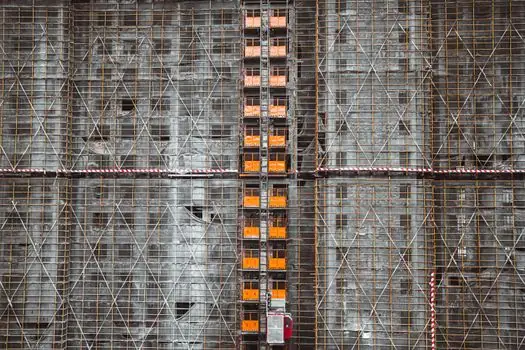
For most specifiers, the Cuplock vs Ringlock decision turns on five criteria: erection speed, load per standard, component count, ledger spacing flexibility, and unit cost. [S3]
Cuplock: 500 mm fixed cup spacing on the standard (rigid), one-node four-direction locking, working load up to 76 kN per 3 m standard, fewer loose parts (no separate clamps or rosettes), and the lowest per-bay material cost among the three systems [S3][S4][S6]. Ringlock: rosette-node with up to 8 connections per disc, ledger placement every 500 mm but on a rosette, lighter individual components, and higher per-tonne price. Kwikstage: wedge-clamp node, common in North America, narrower bay geometry, similar load class to Cuplock but slower to erect on large façades.
Choose Cuplock for large planar façades, shoring, and birdcage access where erection speed and minimum loose-part count matter; choose Ringlock for industrial process work, curved structures, and shipyards where 8-way connection flexibility offsets the higher unit cost; choose Kwikstage for North American commercial work where the local labour pool is already Kwikstage-trained [S6].
Standards, Verification, and QA on Incoming Shipments
EN 12810 (performance requirements) and EN 12811 (structural design, load classes 1–6) are the two European standards any compliant Cuplock shipment must reference on its DoC and CE plate; ISO 9001 on the mill is the typical quality-system baseline, with EN 1090-1 (structural CE) factory production control required for the steel fabrication itself [S4][S7].
For buyer-side verification, request the EN 12810 type-test report (not just a certificate of compliance), the steel mill certificate with grade and CEV, the hot-dip galvanising certificate (coating mass g/m² and bath chemistry), and a weld procedure specification record per EN ISO 3834 [S7]. Three reject-rate signals to watch on incoming product: (1) cup weld undercut visible at 10× magnification, (2) zinc drips or bare spots exceeding 5% of any single component surface, (3) ledger blade twist greater than 2 mm over 1.0 m length.
Limitations, Failure Modes, and Sourcing Risks
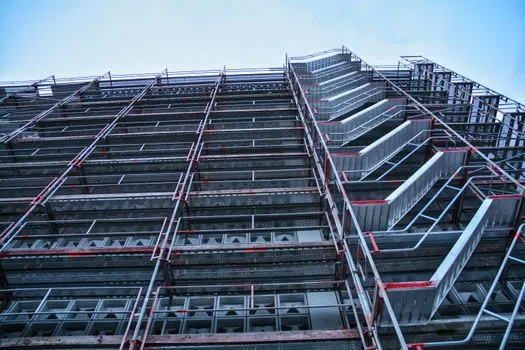
Cuplock's 500 mm cup spacing is rigid: you cannot place a ledger at an arbitrary height, so any non-standard deck-to-deck dimension requires either a purpose-welded special or a hybrid with adjustable U-heads, which is the most common cause of field improvisation that breaks EN 12811 compliance. [S3]
Common failure modes in service: (1) cast-iron top-cup cracking under repeated hammer impact (mitigated by specifying forged cups above 4 m lift heights); (2) bottom-cup weld fatigue at the heat-affected zone, typically after 8–10 years of heavy-cycle use; (3) galvanising breakdown at the cup-to-tube transition, which is where the zinc coating is thinnest [S3][S7]. For buyers running mixed fleets, ledger and transom dimensional standardisation across Cuplock suppliers is generally good (48.3 mm OD tube is universal), but blade-blade engagement tolerances vary enough between Chinese OEMs that mixing verticals from one mill with ledgers from another can produce loose nodes; sourcing a full system from one OEM is the safer default for structural-critical work.
For project teams already running cuplock alongside suspended access equipment, the rigging and load-class selection logic for suspended working platform is a useful parallel reference, since both systems rely on a defined working load plus a 2:1 safety factor on ultimate capacity, the same convention used for the 76 kN working / 153 kN ultimate cuplock standard [S3].
The underlying component specifications are covered under lamps and light fittings.