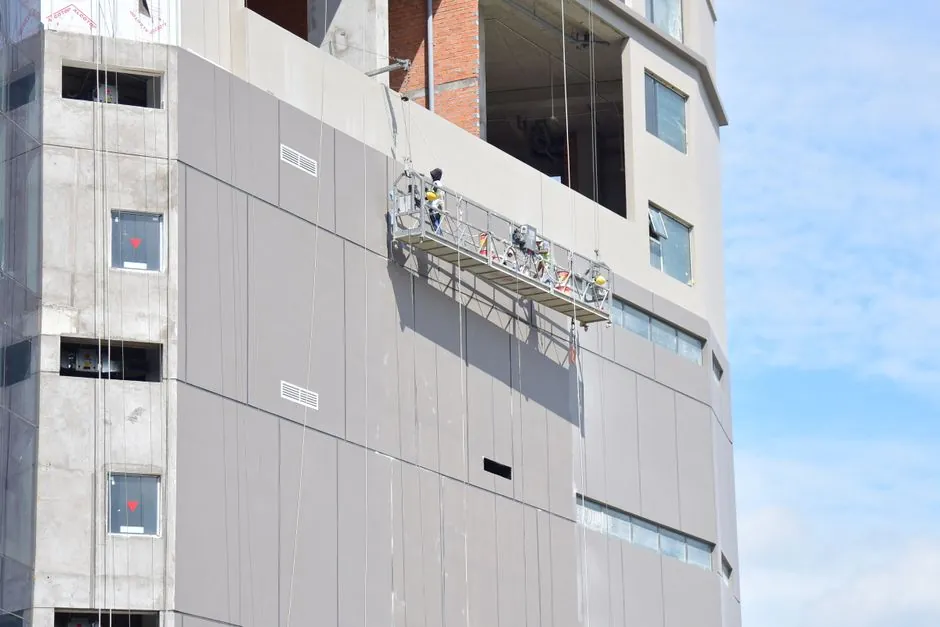
Suspended working platforms divide into five functional families, single-point, two-point (swing stage), multi-point, modular, and powered, distinguished by rigging-point count, deck geometry, and hoist drive [S4][S2].
Manufacturer catalogues in 2025 list load limits from 150 kg (GEDA 367AR, single-rigger chair style) up to 1500-3000 kg on the Morello SCAF 2000 S twin-tier unit, covering everything from one-person inspection cradles to multi-segment shipyard repair stages [S1].
Rigging-Point Count Defines the Family
Single-point suspended platforms hang from one anchor and suit light-duty work such as window cleaning, inspection, and minor patch repairs, with the platform chair (bosun's chair) being the most reduced form [S2][S4]. Two-point platforms, the swing stage, are the workhorse of facade access: two independent wire ropes from two outrigger davits share the load and give a stable 2 m to 6 m working deck [S4][S3]. Multi-point platforms add three or more suspension lines and are the choice for long spans, L-, U-, Z-, or circular deck geometries, and double-tier configurations used on industrial facades and chimneys [S3][S4].
Deck shape is a sub-classifier within multi-point work. The L-, U-, Z-, and circular layouts let crews wrap inside corners, re-entrant reveals, and round structures like silos and storage tanks without leaving an unwashed or unworked strip [S3]. Double-tier (two-storey) swing stages stack a second working level above the primary deck; Fixator's temporary two-storey stage, for example, is built from 2 m and 3 m tray modules clipped together to extend reach on high-rise facades [S1].
Load Classes Span 150 kg to 1500 kg Per Platform
Manufacturer published load limits define the practical envelope. At the light end, the GEDA 367AR lifts one person with a 150 kg limit, suited to inspection and light maintenance [S1]. Mid-range swing stages such as the GEDA AB 650 and Fixator MODULECO run 250-900 kg, with MODULECO accepting electric, manual, and pneumatic hoist heads (e.lift, m.lift, p.lift) on the same deck [S1]. Heavy-duty twin-tier units like the Morello SCAF 2000 S cover 1500-3000 kg, used for sandblasting, epoxy coating, insulation, and shipyard hull repair where crew, tooling, and material all ride together [S1].
Modular suspended platforms like the Fixator MODULECO accept 2 m and 3 m tray extensions to scale length without changing hoist type, which is the practical answer where deck length must grow with the project rather than be fixed at purchase [S1]. Modular systems also accept manual winches for low-headroom or indoor shafts where electric drives are impractical, and pneumatic hoists for explosion-risk or wet environments where sparks must be suppressed [S1].
Drive Type: Manual, Electric, Pneumatic, and Battery
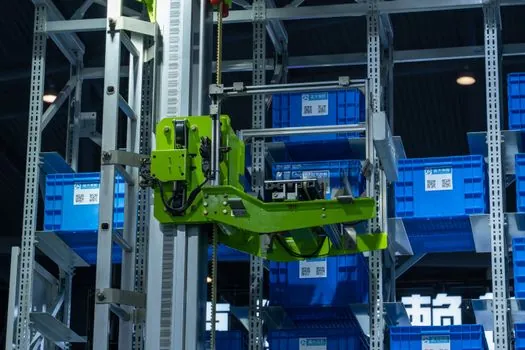
Powered suspended platforms use motorised hoists for precise elevation control and frequent repositioning; they are the default on industrial maintenance and large facade contracts [S4]. The winch (hoist) head is selected independently of the deck: electric for mains-powered sites with the highest lift speed, manual (hand-operated) for low-utilisation or standby rescue, and pneumatic (air-driven) where ATEX or spark-free conditions apply, such as refinery turnarounds or coatings work near solvents [S1].
Single-person platform chairs are a separate functional sub-type, essentially a small seat rigged on one rope with a separate safety line, used for inspection, anchor testing, and short-duration light work where a full deck is uneconomic [S2].
Suspended vs Mobile Platforms: When Each Wins
Suspended working platforms are tied to the structure above by ropes, chains, or wire cables from outrigger beams, parapet hooks, or roof anchors, so they suit work where ground bearing is poor, ground access is blocked, or the work face is a vertical facade, shaft, or tower [S6]. Mobile elevating work platforms (MEWPs), including scissor, articulated, telescopic, and articulated-telescopic booms, are ground-supported self-propelled machines, preferred on flat slab decks, indoor fit-out, and sites where rigging a roof anchor is impractical or forbidden [S5].
For elevator-shaft and inside-of-shaft work, a Fixator False Car at 500 kg load is a dedicated suspended platform that runs on the guide-rail rigging to install counterweights, plumb lines, and cabin wiring; a scissor lift cannot do this work because it sits on the slab and cannot straddle the shaft opening [S1]. Equally, on a high-rise facade where the building height exceeds any practical MEWP reach, a two-point or multi-point suspended stage is the only tool that can do the job [S6].
Selection Criteria Compared Across the Five Families
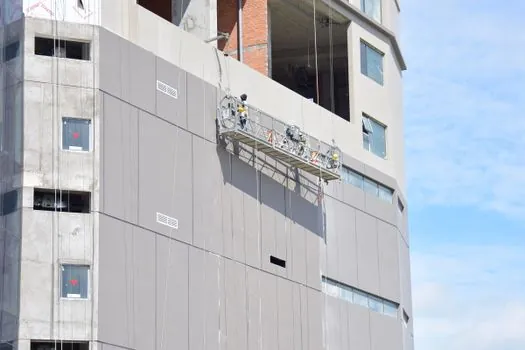
On rigging count, single-point (1 line) suits one operator with hand tools, two-point (2 lines) is the standard facade deck, multi-point (3+ lines) handles long or shaped decks, modular is variable per project, and powered variants overlay any rigging count with motorised hoists [S4]. On load class, single-point typically runs 120-150 kg, two-point 250-650 kg, multi-point 500-1500 kg, modular scales 250-900 kg, and powered units inherit their host family's rating [S1]. On typical deck geometry, single-point is a chair or small tray, two-point is straight 2-6 m, multi-point covers L, U, Z, and circular plans plus double-tier, and modular accepts field-added 2 m or 3 m tray modules [S3][S1]. On drive type, single-point and modular accept manual/electric/pneumatic, two-point is almost always electric, multi-point is electric on facade work, and powered explicitly means electric or pneumatic [S1][S4].
Use-case fit follows the same matrix: window cleaning and inspection map to single-point; facade painting, plastering, and cladding to two-point; silos, chimneys, re-entrant facades, and shipyard hulls to multi-point; phased or variable-length projects to modular; and any of the above with frequent height changes to powered [S4][S3].
Limitations, Failure Modes, and Safety Constraints
Suspended working platforms are limited by anchorage capacity, roof edge geometry, and overhead clearance, and they are not appropriate on structures that cannot certify the rigging point for the full rated load plus a sensible safety factor. Sway and pendulum action grow with deck length and with single-point rigging, which is why multi-point and rigid outrigger systems dominate long or tall facades [S4]. Operator qualification is regulated in many jurisdictions: in Poland, ERGON's training catalogue lists a dedicated "hanging mobile platforms operator" entitlement alongside MEWP and scissor-lift courses, reflecting that suspended work is treated as a separate authorisation from ground-supported elevating work [S5].
Single-person platform chairs carry the highest relative risk because the operator is the load and there is no deck to recover onto in a failure; most regulators require an independent secondary safety line (a separate fall-arrest rope with its own descender) in addition to the primary suspension line [S2]. Pneumatic hoists trade speed for spark suppression and are slower, but they are the right answer in coating, refinery, and solvent atmospheres where an electric hoist cannot be safely energised [S1].
Manufacturer Catalogue Snapshot (2025-2026 Listings)
DirectIndustry's suspended-platform category lists 26 manufacturers and 72-73 products at the time of writing, with Fixator, Morello, Safi, and GEDA among the most-listed brands [S1]. Fixator's range covers the temporary two-storey stage at 720 kg, the False Car at 500 kg, and the MODULECO modular deck at 250-900 kg with swappable hoist heads [S1]. Morello's tPE SBA 4R 300/DX is a compact aerial deck at 300 kg with 2.5 m x 0.75 m x 0.55 m dimensions, and the SCAF 2000 S covers 1500-3000 kg twin-tier work [S1]. GEDA's AB 450 (single-person) and AB 650 (650 kg) are rope-suspended working platforms aimed at facades, silos, towers, and cooling towers, with the AB 450's angle-track section and brackets letting the deck adapt to irregular building shapes [S1].
For a related spec walkthrough on rigging-class equipment and a deeper look at suspended platform deck geometry, the catalogue entries pair cleanly with the modular and multi-point family. Adjacent categories worth scanning for cross-spec decisions are suspended ceiling access work, construction machinery and equipment for hoist and winch classes, and lamps and light fittings for facade lighting retrofits that often piggyback on the same swing-stage contract. Sister articles on torque and hydraulics, including Hydraulic Power Unit Types: Compact, Mobile, Industrial, and Customized Classes Compared, help frame the hoist-drive choice, while cutting-tool spec maps such as Oxy-Fuel Cutting Torch Selection for Bridge Construction: Plate Thickness, Seat Type and Impact Drill Types, Impact Mechanisms, and Selection Criteria sit on the tooling side of the same envelope.
Watch DirectIndustry's suspended-platform category count and the GEDA/Fixator product pages for new modular tray lengths and revised load limits, as those two signals lead the catalogue refresh by a quarter.