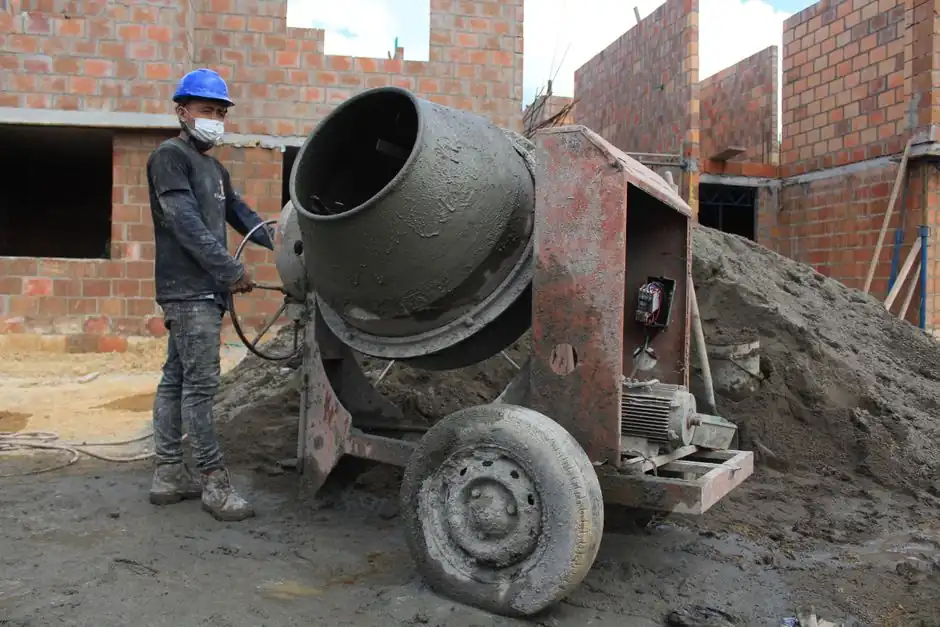
For a wet-mix shotcrete machine operating 1,000 hours per year, the unit's purchase price typically accounts for only 20–30% of its total cost of ownership across an eight-year service life, with fuel, wear-parts, pumps, and unplanned repairs absorbing the remaining 70–80% [S1]. TCO is calculated as acquisition cost plus ownership costs (insurance, financing, depreciation, storage) plus variable operating costs (energy, consumables, labor, mobilization) minus residual value at disposal [S1][S3].
Heavy construction equipment generally loses 20–40% of its value in year one, and insurance typically runs 1–5% of machine value annually, both of which apply to a stationary or trailer-mounted shotcrete pump package the same way they apply to a backhoe [S1]. The implication for specifiers is straightforward: choose the machine that minimizes cost per cubic meter of placed concrete, not the one with the lowest line-item quote.
Cost Driver Breakdown: What Actually Moves a Shotcrete Rig's TCO
TCO for a shotcrete spread splits into six controllable cost centers, each with a different elasticity to operating hours and mix design [S5]. Depreciation and finance charges are fixed; energy, wear-parts (concrete pistons, wear plates, nozzle rings, packing kits), and unplanned repair are variable and scale with throughput [S1][S5]. For a high-cycle tunnel lining job, wear-part consumption dominates; for a low-duty repair crew, depreciation and mobilization dominate [S5].
Storage and yard costs on a stationary electric-driven shotcrete pump typically run $500–$1,000 per month, a non-trivial line item when the unit sits idle between pours [S1]. Operator wages, accelerator-dosing consumables, and routine hose replacement all sit on the variable side and respond directly to operator training and mix-design discipline [S1].
Wet-Mix vs Dry-Mix: A Criteria Comparison for TCO-Driven Specifiers
Wet-mix shotcrete rigs (concrete pump + accelerator dosing + nozzle) carry higher acquisition cost, lower rebound waste, and lower dust-related operator health overhead; dry-mix rigs (rotor-type or butterfly valve) carry lower acquisition cost, higher rebound (commonly 10–30% in overhead work), and higher silicosis-related PPE/compliance overhead [S1]. On a cost-per-cubic-meter-placed basis, wet-mix typically wins for volumes above roughly 2,000 m³ per project because rebound waste and labor productivity gains offset the higher capital outlay [S5].
For remote, low-volume, or shaft work where dust suppression is handled by ventilation rather than inherent mix moisture, dry-mix remains a defensible TCO play because the rig itself is mechanically simpler, with fewer hydraulic and pumping components to fail [S1]. Electric-driven wet-mix units have a strong TCO edge on indoor and urban sites where diesel particulate cost (ventilation, aftertreatment, regulatory exposure) is on the books, while diesel-driven units remain the default for off-grid tunnel headings [S5].
Wear-Parts and Maintenance: The 60% Line Item That Quietly Eats Margin

In a worked example for general construction equipment, fuel and maintenance combined account for roughly 60.71% of eight-year TCO on a $100,000 backhoe running 8,000 hours, with purchase price at 35.71% and a 10.71% residual offset [S1]. The same proportion holds directionally for shotcrete machines, with wear-parts (concrete pistons, wear rings, upper/lower seals, delivery hoses, nozzle bodies) replacing general "repairs" as the dominant variable line [S1][S5].
A wet-mix concrete piston running 4–6 hours per shift typically needs replacement at 200–400 m³ of sprayed volume, depending on aggregate hardness and mix design, and the cost of a piston-plus-cylinder assembly is a non-trivial fraction of the machine's annual maintenance budget [S5]. Planned replacement intervals, on-condition oil sampling, and keeping wear-parts kits in site stores are the three levers that move a shotcrete rig's TCO from "average" to "best in class" [S1].
Energy, Compliance, and the Hidden Variable Line
Energy cost for an electric wet-mix unit is roughly proportional to kW rating and duty cycle; for diesel units, fuel cost scales with engine load profile, and idling during boom repositioning is the single largest wasted-energy line in tunneling work [S1][S5]. Operator training that eliminates unnecessary idling and matches pump output to actual placement rate is a documented TCO lever, not a soft suggestion [S1].
Compliance and inspection overhead (pressure-vessel certs on the concrete cylinder, lifting-gear inspection on the boom where fitted, electrical test on the diesel-electric model, silica-dust exposure monitoring under most modern occupational hygiene regimes) is a fixed annual cost that is easy to under-budget on small contracts [S3][S4]. Storage, mobilization between sites, and boom-cert renewals each carry a per-event cost that adds up fast for contractors running multiple small pours rather than one large tunnel drive [S1].
Buy vs Rent: When the TCO Math Flips

Rental converts a fixed ownership cost into a variable cost tied to utilization, which is mathematically attractive when projected annual hours fall below the break-even with owned-equipment financing [S4][S7]. For contractors running a single 6-month tunnel project, rental or contract hire typically beats purchase because residual-value risk, storage between jobs, and off-season insurance are offloaded to the rental company [S4].
For a 5+ year pipeline of structural shotcrete work at high utilization (above roughly 800–1,000 hours per year), purchase with a planned mid-life overhaul (typically at 4,000–6,000 hours) usually wins on TCO once financing costs are netted against avoided rental margins [S1][S4]. The ERA TCO Calculator, an industry-standard buy-vs-rent tool launched in 2016, allows specifiers to model both paths with adjustable risk and residual-value inputs, and is widely cited as the reference independent framework for this decision in Europe [S4].
Concrete Steps to Cut a Shotcrete Rig's Lifecycle Cost
For a longer view on lifecycle cost methodology applied to adjacent equipment classes, see the Sander TCO lifecycle model and the Circular Saw TCO breakdown, both of which carry over the same fixed-vs-variable framework. For the higher end of the placement-equipment decision tree, the Crawler Crane vs Tower Crane spec map covers the same buy-vs-rent math at larger scale.
The underlying component specifications are covered under total station, and coding machine.