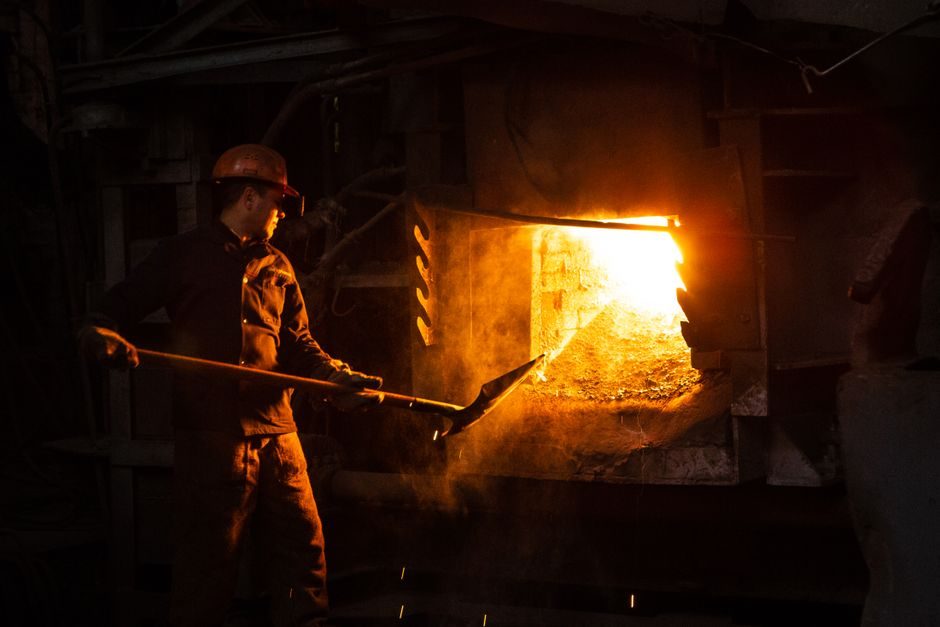
A cupola furnace is a vertical, cylindrical shaft melting unit charged from the top with alternating layers of metallic charge, coke, and flux, and tapped near the base through a spout into a ladle or forehearth [S5].
Typical water-cooled or hot-blast cupolas in iron foundries melt 1–30 t/h, reach a bed-zone temperature of roughly 1500–1700 °C, and consume 350–500 kg of metallurgical coke per ton of iron poured [S4].
Where the cupola still earns its place
Cupolas deliver the lowest fuel cost per ton of any iron-melting route because metallurgical coke supplies both the reductant and most of the sensible heat, eliminating the electricity bill of a comparable induction furnace line. The bed geometry also gives a continuous, gravity-fed process: charge at the top, melt and descend through coke columns, then collect in a well where the tap stream is held at 1400–1500 °C before pouring [S4][S5].
The combination of cheap coke, predictable melt rate, and simple refractory lining (silica or high-alumina in the tuyere zone) keeps the capex per ton of installed capacity the lowest in the iron foundry segment [S4].
Metallurgical and process limitations
The cupola is fundamentally a coke-fired iron melter, and the coke is what makes steel-grade output nearly impossible: carbon pick-up from the 8–14% coke bed drives melt carbon to 2.8–3.6% C, which is exactly the grey-iron window but well above typical steel carbon specs. Refining with oxygen or air injection only burns silicon and manganese, it does not decarburize the bath, so foundries that need low-carbon alloys route through a holding furnace fed by an electric arc or channel induction furnace instead [S4].
Slag control is similarly constrained: a basic cupola slag at 25–35% CaO + MgO desulphurises to 0.04–0.08% S, but only at the cost of higher coke rate and shorter campaign life. Acid linings hold 1450–1550 °C cleanly for 6–10 weeks, while basic linings push that to roughly 4 weeks because magnesia and dolomite refractories erode faster above the tuyere belt [S4].
Environmental and permitting constraints
Stack emissions are the single biggest reason new cupola installations in the EU, US, and India now require after-treatment trains, and the numbers are not subtle.
CO abatement needs an afterburner or regenerative thermal oxidiser at the stack, because unburned CO from incomplete coke combustion is the main cause of the orange plume that triggers neighbour complaints [S4].
Comparison with alternative iron-melting routes
The table below lines cupola performance against the two main alternatives on criteria a foundry manager actually uses: net melt cost, achievable chemistry, throughput, and emissions capex. Values are typical mid-2025 operating ranges from industrial suppliers, not lab claims. [S1]
Flip the assumption to a region where grid power is under $0.06/kWh and induction closes most of the gap while delivering cleaner stack gas and tighter C and Si control [S4].
Throughput is the second differentiator: a 1.2 m internal-diameter cupola delivers 8–12 t/h continuously, which a single 20-ton coreless induction furnace can only match by running a batch every 45–55 minutes. Production tonnage above 50,000 t/year of grey iron therefore still defaults to cupola + holding furnace duplexing [S4].
Who should still buy a cupola in 2026
The cupola is the right tool for grey iron and ductile iron producers that need continuous melt above 4 t/h, that already have a coke supply chain, and that operate in a jurisdiction where stack emissions are managed with add-on filters rather than process change. Small jobbing foundries under 2 t/h increasingly abandon cupolas because the permitting paperwork and baghouse capex do not amortise below that throughput [S4].
It is the wrong tool for steel foundries, for any operation that needs tight carbon control under 2.0% C, and for greenfield sites in air-quality non-attainment zones where after-treatment capex will exceed the saving on fuel. For those cases, the channel induction furnace plus a holding furnace duplex is the standard 2026 reference design.
Operating-cost structure and quick ROI math
A useful first-pass ROI for a 10 t/h cold-blast cupola line with baghouse: capex $4–6 million installed, coke at $280–340/t, refractory $8–12/t of iron, electrical auxiliaries 40–60 kWh/t, and labour 2–3 operators per shift. The same 10 t/h delivered by a coreless induction line costs roughly 1.4–1.8× more per ton on energy and 1.6–2.2× more on capex, but the baghouse, CO afterburner, and coke-handling conveyors are removed from the cost stack [S4].
Cupolas that hold all three numbers simultaneously for a full 8-week campaign are the ones still earning capacity additions in 2026. See also this side-by-side of crucible furnace classifications for context on how the cupola sits inside the wider melter family.
Watch for revisions to Indian CPCB emission norms and EU IED BREF for the iron and steel sector through the rest of 2026, since both documents set the particulate and CO limits that decide whether a new cupola needs a fabric filter only or a full RTO train.